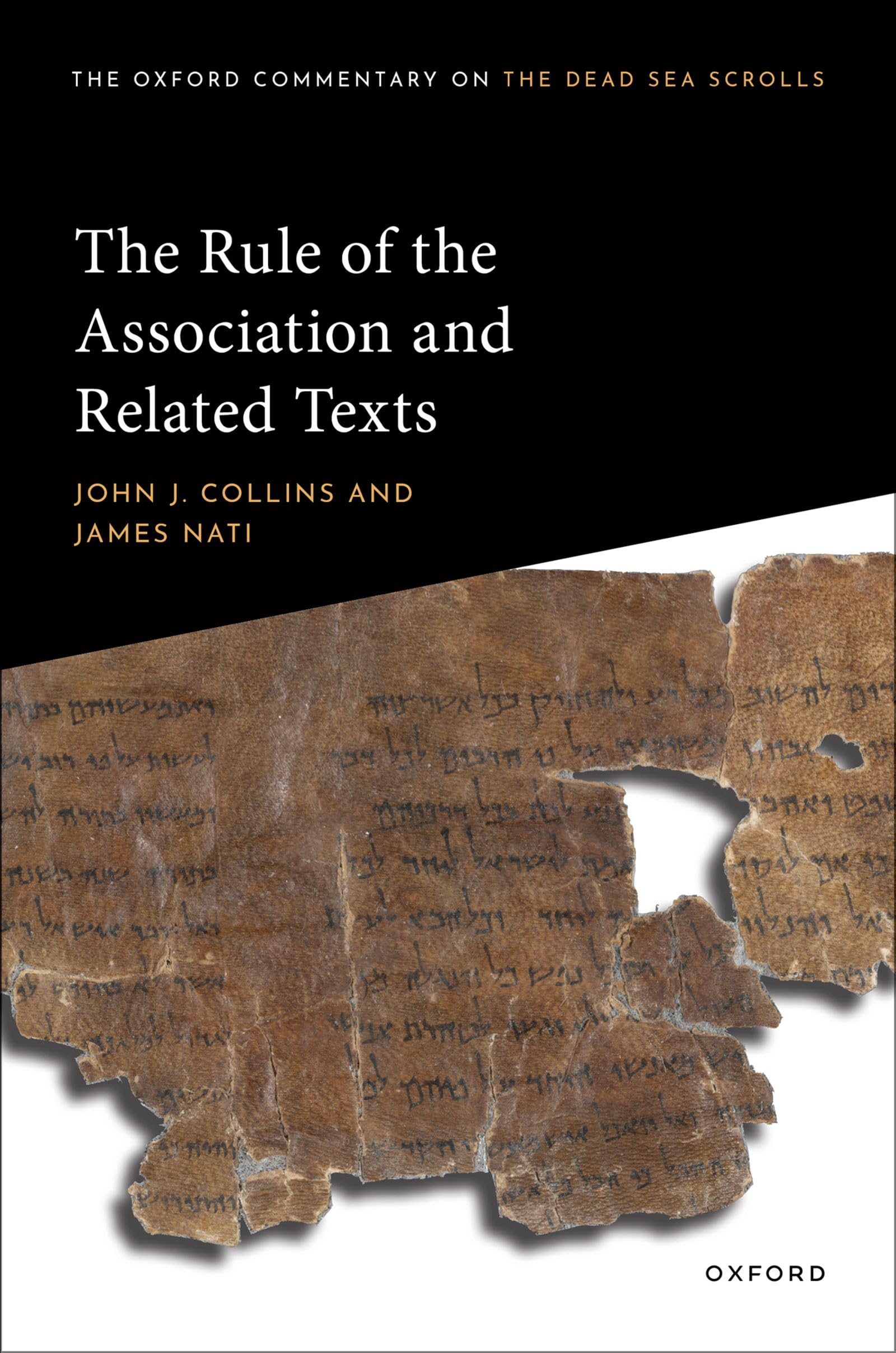
The Rule of the Association and Related Texts (Oxford Commentary on the Dead Sea Scrolls)
$69.31
by John J. Collins



The Rule of the Association (1QS; Serek ha-Yahad) is the primary description of the sectarian community described in the Dead Sea Scrolls. It was one of the first Scrolls published, in 1951. Several related fragmentary scrolls subsequently came to light. This book provides text, translation, and commentary on all these manuscripts, with a substantial introduction that locates the Rule in the context of the sectarian movement. Distinctive features of this commentary include: presentation of the Hebrew text; treatment of the related manuscripts as texts in their own right, not just as stages in the development of 1QS; recognition that this was a rule for a movement with many settlements and not just for the community that lived at Qumran; recognition of graded levels of holiness within 1QS; recognition of conceptual differences between 1QS and some of the related fragments with regard to the nature and goals of the association; discussion of the broader cultural context of voluntary associations in the Hellenistic world, and the influence of Persian dualism on the Instruction on the Two Spirits in 1QS 3-4. The commentary also engages the full range of scholarship on the texts known as 1QSa (The Rule of the Community) and 1QSb (The Scroll of Blessings) which were copied on the same scroll as 1QS but appear to have originated separately. "This is a major achievement: the field has waited for proper commentary series for a while. Especially great is to see 1QSa and 1QSb taken into account as part of the same manuscript." -- Jutta Jokiranta, Professor of Hebrew Bible and Cognate Studies, University of Helsinki "Indispensable and welcome contribution." -- Daniel M. Gurtner, Religious Studies Review "This volume stands out for its rigorous yet accessible approach, combining philological precision, historical depth, and interpretive breadth...Collins and Nati have produced a meticulously constructed, carefully crafted commentary that combines philological rigor with historical and theological insights. It is an indispensable resource for both specialists and non-specialists interested in the Dead Sea Scrolls and the formative traditions of Second Temple Judaism." -- Kamilla Skarström Hinojosa, Dead Sea Discoveries "Collins and Nati have produced a meticulously constructed, carefully crafted commentary that combines philological rigor with historical and theological insights. It is an indispensable resource for both specialists and non-specialists interested in the Dead Sea Scrolls and the formative traditions of Second Temple Judaism." -- Kamilla Skarström Hinojosa, Dead Sea Discoveries John J. Collins, Holmes Professor of Old Testament Emeritus, Yale University ,James Nati, Assistant Professor of Hebrew Bible/Old Testament, Santa Clara University Jesuit School of Theology John J. Collins is Holmes Professor of Old Testament Emeritus at Yale University. He has held Academic appointments at the University of Notre Dame, University of Chicago, and Yale, and has honorary Degrees from University College Dublin and the University of Zurich. he has been President of the Catholic Biblical Association and the Society of Biblical Literature. He has been editor of the Journal of Biblical Literature, Dead Sea Discoveries, Journal for the Study of Judaism Supplements , and Anchor Yale Bible . He is member of the American Academy of Arts and Sciences and has published widely on the Hebrew Bible, Second Temple Judaism, the Dead Sea Scrolls, and Apocalypticis. James Nati, PhD (Yale, 2019) is Assistant Professor of Hebrew Bible/Old Testament at the Santa Clara University Jesuit School of Theology. He is the author of Textual Criticism and the Ontology of Literature in Early Judaism: An Analysis of the Serekh ha-Yahad (Brill, 2022). His research focuses on the Hebrew Bible and Early Judaism, and on the Dead Sea Scrolls in particular.