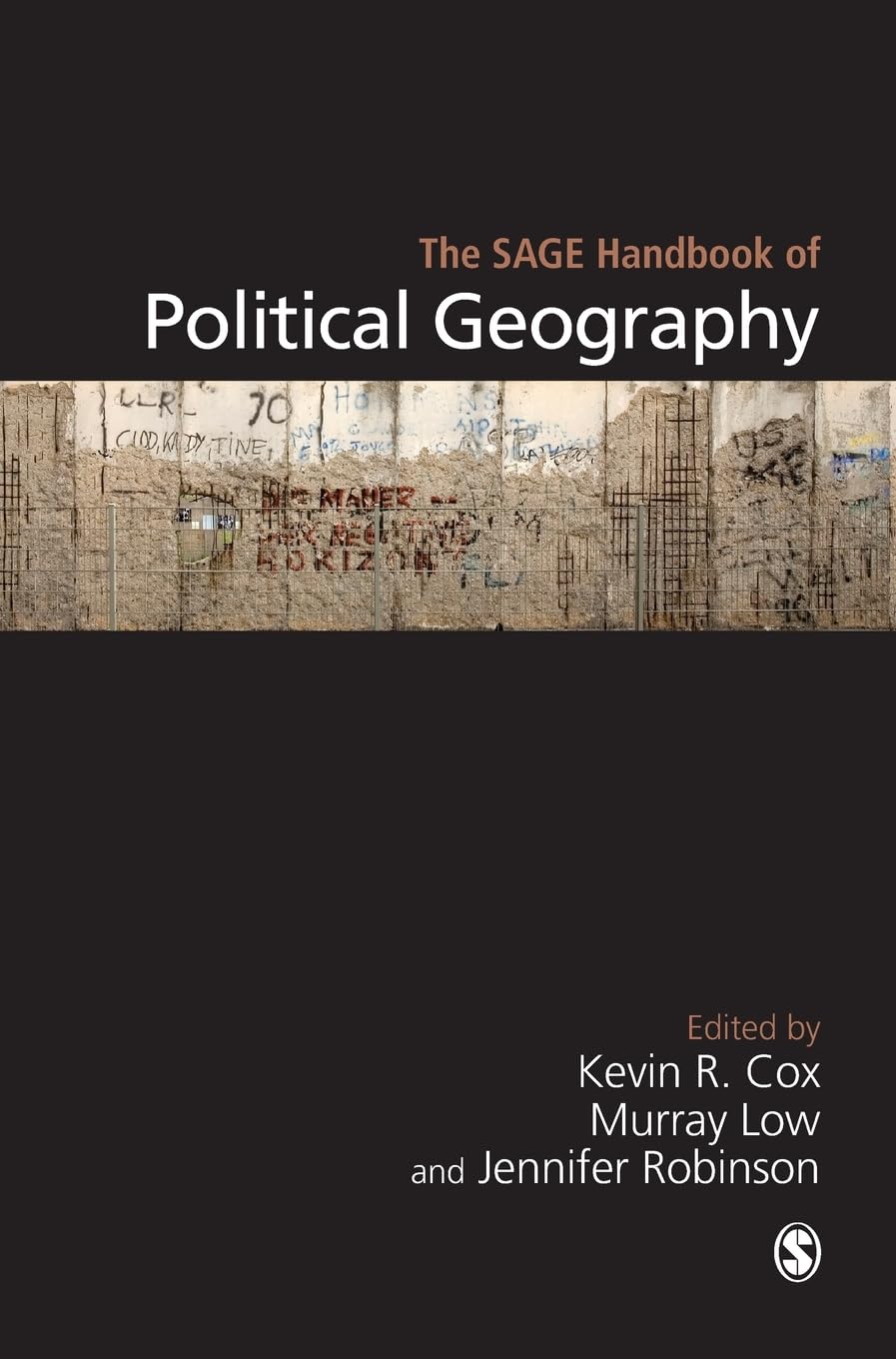



The SAGE Handbook of Political Geography provides a highly contextualized and systematic overview of the latest thinking and research. Edited by key scholars, with international contributions from acknowledged authorities on the relevant research, The SAGE Handbook of Political Geography is divided into six sections: - Scope and Development of Political Geography - key debates; the geography of knowledge; conceptualisations of power; and conceptualisations of scale; - Geographies of the State - state theory; territory and central local relations; legal and judicial geographies; borders; and states and nature; - Participation and Representation - citizenship; space; electoral geography; place; media public space; and social movements; - Political Geographies of Difference - class; nationalism; gender, sexuality; and culture; - Geography Policy and Governance - regulation; welfare; urban space; planning, environment; - Global Political Geographies - geographies of imperialism; post-colonialism; globalization; environmental politics; international relations; war; and migration. The Handbook of Political Geography is the standard work and will be widely used and highly-cited by all scholars with an interest in politics and space. The SAGE Handbook of Political Geography is designed to be the standard work, widely used and highly-cited, by all scholars with an interest in politics and space. ′A thorough and absorbing tour of the sub-discipline... An essential acquisition for any scholar or teacher interested in geographical perspectives on political process, this Handbook is sure to become the major reference work in anglophone political geography′ - Sallie Marston, University of Arizona ′This unique book is a true encyclopedia of political geography... The volume is a result of cooperation between a big international team of well known geographers, including scholars beyond the Anglo-American world′ - Vladimir Kolossov, Institute of Geography of the Russian Academy of Sciences, Moscow, and Vice President of the International Geographical Union Kevin R. Cox is an emeritus distinguished professor of geography at the Ohio State University. Born in England, he studied geography at Cambridge University and then at the University of Illinois. His major interests are in the politics of local development, geographic thought and method, and the difference that countries make. He is the author of numerous books, most recently Making Human Geography and The Politics of Urban and Regional Development and the American Exception . He has a personal website, including frequent blogs, at Unfashionable Geographies. He has been a Guggenheim Fellow. Murray Low′s research focuses on relationships between geography and democracy including institutional and spatial aspects of elections, changing practices of accountability and legitimacy in cities, and the geography of political party organisations and social movements. His work has dealt with the relationships between global networks and democracy, constructions of globalization and states in geography, and geographical aspects of political representation. He has recently completed research funded by the Leverhulme Foundation into city democratisation in South Africa. He is co-editor of Spaces of Democracy: Geographical Perspectives on Citizenship, Participation and Representation (Sage, 2004), and of The Sage Handbook of Political Geography (Sage, 2008) Current research builds on my book, Ordinary Cities: Between Modernity and Development (Routledge, 2006) which develops a postcolonial critique of urban studies, presenting resources for cutting across the thinking which has divided understandings of Western and Third World Cities. I argue against perspectives which categorize cities as Global, Third World, Mega, African etc. and suggest instead an attentiveness to the diverse trajectories of ′ordinary cities′. This work has strong implications for the practices of urban studies internationally, and invites a regrounding of comparative urbanism in rigorous practices able to encompass both wealthier and poorer cities so as to generate approaches to understanding cities which are properly international. Future plans include an empirical project to exemplify comparative methods incorporating wealthier and poorer cities, taking as the object of study the ubiquitous technology of developing city strategies and visions. This will also enable an investigation of the international circulation of urban policy to understand how policy arrives in and is adopted or adapted in different localities. The research will press an engagement with analyses of neoliberalism in urban studies to incorporate perspectives from cities in poorer contexts. It contributes to conceptualisations of the spatialities of circulation, reflecting my wider interests in general theoretical accounts of space. Previous research has centred on the relationship between power and space, specifica