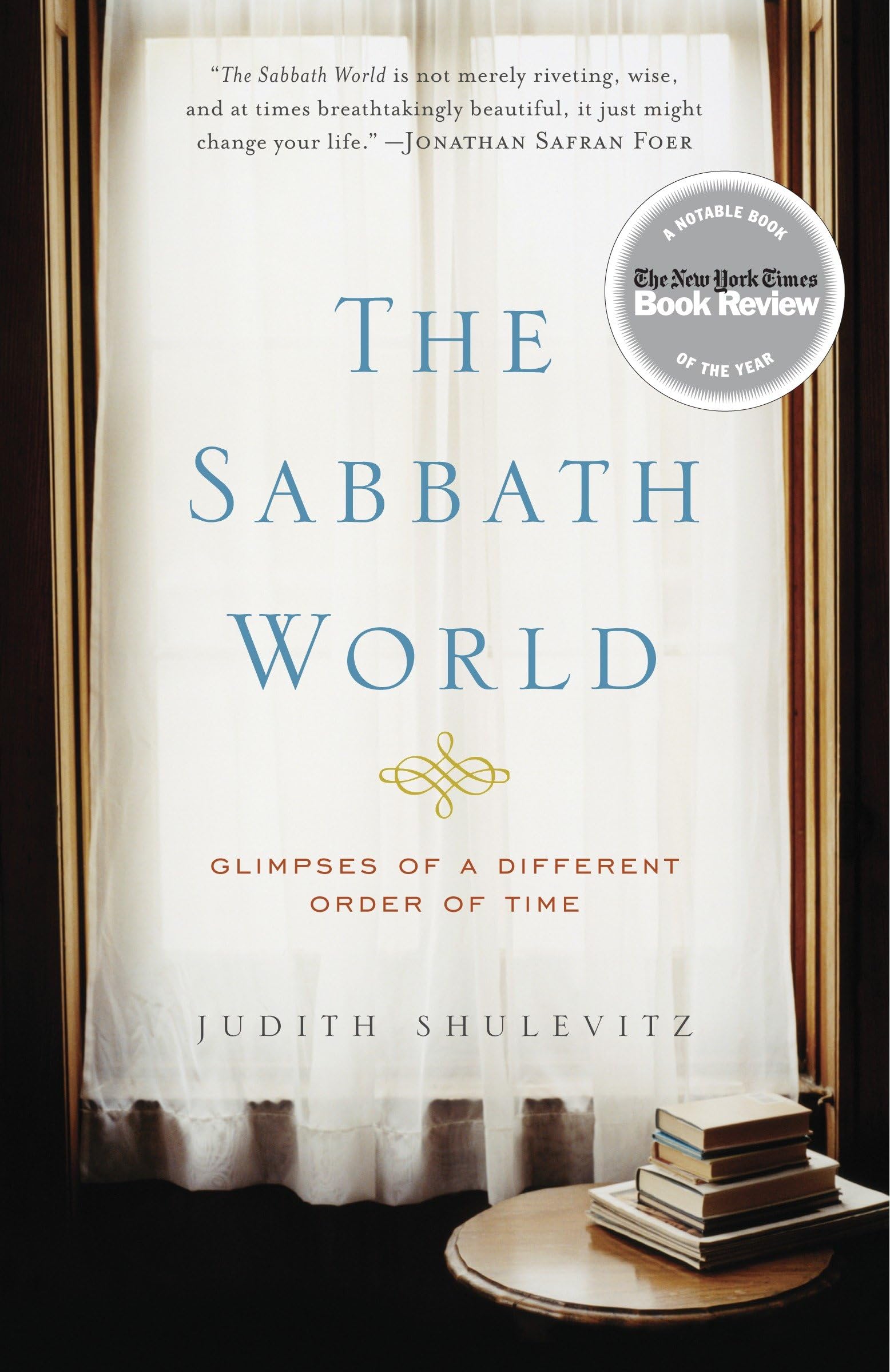



What is the Sabbath, anyway? The holy day of rest? The first effort to protect the rights of workers? A smart way to manage stress in a world in which computers never get turned off and work never comes to an end? Or simply an oppressive, outmoded rite? In The Sabbath World, Judith Shulevitz explores the Jewish and Christian day of rest, from its origins in the ancient world to its complicated observance in the modern one. Braiding ideas together with memories, Shulevitz delves into the legends, history, and philosophy that have grown up around a custom that has lessons for all of us, not just the religious. The shared day of nonwork has built communities, sustained cultures, and connected us to the memory of our ancestors and to our better selves, but it has also aroused as much resentment as love. The Sabbath World tells this surprising story together with an account of Shulevitz’s own struggle to keep this difficult, rewarding day. “ The Sabbath World is not merely riveting, wise, and at times breathtakingly beautiful, it just might change your life.”—Jonathan Safran Foer “Compassionate, revealing, and deeply personal . . . destined to become a classic.”—Bruce Feiler, author of Walking the Bible “What a brilliant idea. . . . Part history, part meditation . . . The Sabbath offers a way to live outside of time, even for a day a week—an act not just of renewal but of resistance in an obsessively over-scheduled and over-networked world.”— Los Angeles Times “An intense book and intensely engaging, one that as a reader I didn’t want to end.”— Chicago Tribune “Every chapter of [ The Sabbath World ] is a wise and winsome meditation on yet another aspect of this inexhaustible topic. ... Shulevitz asks all the right questions.”— Christianity Today “A book of richness and depth.”— The New York Times Book Review “A swift, penetrating book intent on shattering the habits of mindless workaholism.”— The New Yorker Judith Shulevitz is a literary critic and a former columnist for The New York Times and Slate . Her work has also appeared in The New Republic and The New Yorker. She lives in New York City with her husband, Nicholas Lemann, and children. Part One Time Sickness 1. In the poetry of the prayer book, the Sabbath is a bride greeted by an impatient bridal party with an almost anguished relief. In the more prosaic dominion of my house, the Sabbath sees herself in and sits down to wait. As the woman of the house, and, more to the point, the only person in my family whose heart pounds anxiously at the approach of a religious obligation, it’s up to me to acknowledge her presence by lighting the candles eighteen minutes before sunset, when they should be lit. During the winter, however, I don’t light the candles on time. I ignore the clock at the bottom of my computer screen and when I don’t see the numbers turn to, say, 4:10, I don’t look out the window, where the shadows of our trees are beginning to black out the backyard. I know without looking, though, that the room where the candles would be burning is having its last golden moment of the day, the sun having sunk low enough to gild the walls. The sun sets shortly thereafter and plunges the world inside my time zone into what Jewish tradition regards as a kind of temporal no-man’s-land. It’s neither the end of the sixth day nor the beginning of the seventh (the Jewish day beginning and ending at nightfall). It’s twilight. The rabbis, who mixed their prescriptions and proscriptions with legend, defined twilight as “from sunset as long as the face of the east has a reddish glow.” They also called the twilight before the Sabbath a witching hour. The story is told that on the very first Sabbath twilight God created ten magical objects that he would later use to make miracles: the rainbow that came after the flood to assure mankind that God wouldn’t destroy the world again; the staff with which Moses wrought the ten plagues; the mouth of the earth that opened up to swallow an Israelite who tried to launch a coup against Moses; and so on. By the time I’m ready to enter the kitchen and start my Sabbath, the moment for miracles will have passed. So will my chance to cheat time. The rabbis were inflexible about punctuality. The Romans having leveled the Temple more than a century before the rabbis became the Jews’ highest religious authorities, the sages inherited an inoperative religion of space, and set about turning it into a religion of time. It’s no accident that in the very first passage of the Talmud, they try to determine the exact instant in the evening after which a Jew may say the Shema, the most important prayer in Judaism. To the rabbis, time is irreversible. Generally speaking, either you do things at the appointed time or you don’t do them at all. Such is the magic of the twilight before the Sabbath, though, that for that moment the march of time pauses in mid-step. The Jew may no longer light candles, but he or she