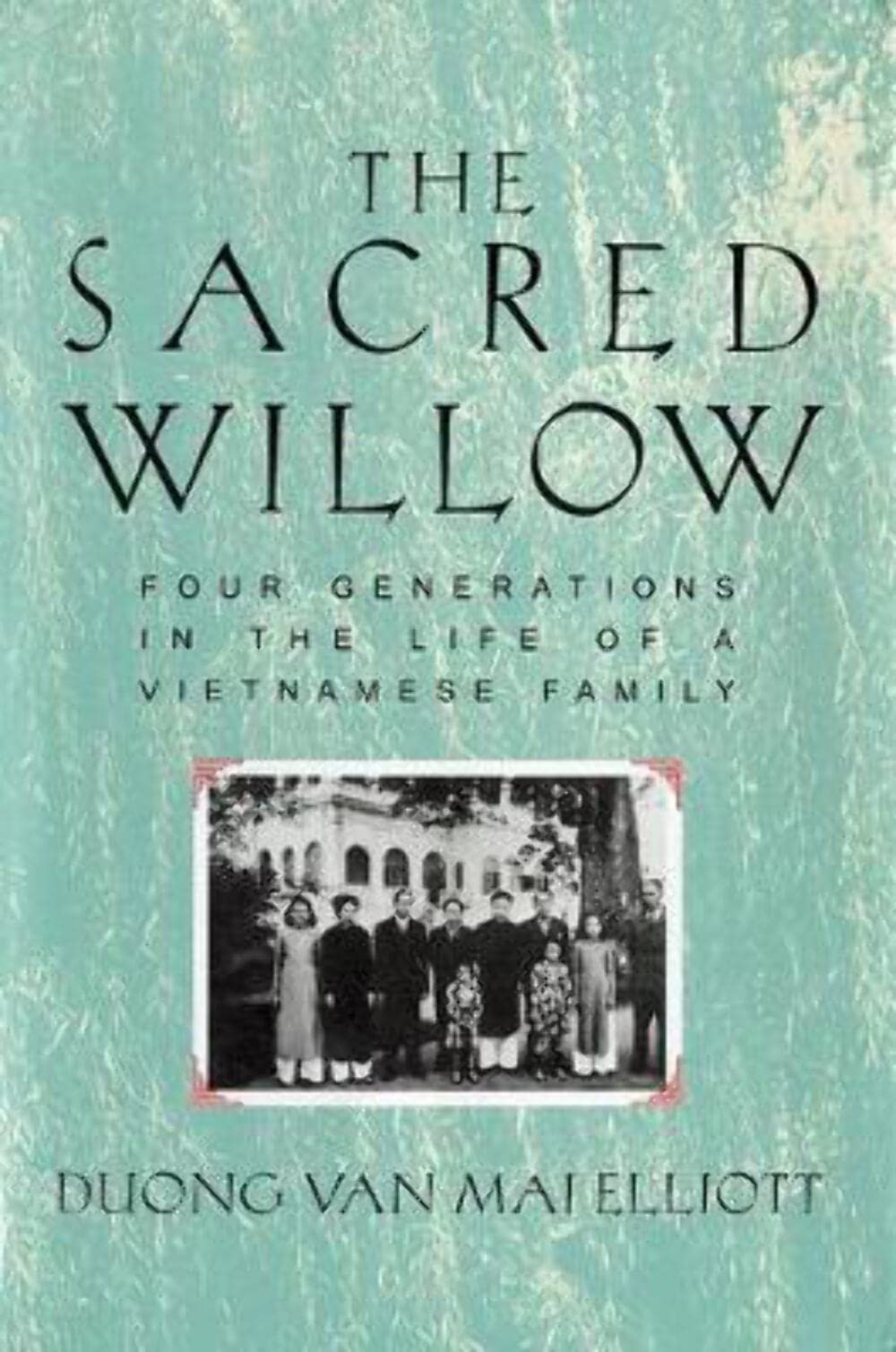
The Sacred Willow: Four Generations in the Life of a Vietnamese Family
$32.46
by Mai Elliott



A finalist for the Pulitzer Prize, Duong Van Mai Elliott's The Sacred Willow illuminates recent Vietnamese history by weaving together the stories of the lives of four generations of her family. Beginning with her great-grandfather, who rose from rural poverty to become an influential landowner, and continuing to the present, Mai Elliott traces her family's journey through an era of tumultuous change. She tells us of childhood hours in her grandmother's silk shop, and of hiding while French troops torched her village, watching while blossoms torn by fire from the trees flutter "like hundreds of butterflies" overhead. She makes clear the agonizing choices that split Vietnamese families: her eldest sister left her staunchly anti-communist home to join the Viet Minh, and spent months sleeping in jungle camps with her infant son, fearing air raids by day and tigers by night. And she follows several family members through the last, desperate hours of the fall of Saigon-including one nephew who tried to escape by grabbing the skid of a departing American helicopter. Based on family papers, dozens of interviews, and a wealth of other research, this is not only a memorable family saga but a record of how the Vietnamese themselves have experienced their times. Most books about Vietnam focus on the French who colonized it or the Americans who sought to "save" it. This combination of memoir and family history shows the Vietnamese "as they saw themselves as the central players in their own history." The author's perspective is particularly enlightening because her relatives, though unquestionably better-educated and better-off than the typical Vietnamese, made a variety of political and social choices over the course of the turbulent century she chronicles. Her great-grandfather was a mandarin and member of the imperial court; her father was a government official under French rule; her older sister married a Communist. Elliott herself enrolled in Georgetown's School of Foreign Service in 1960, married an American, and supported the U.S. crusade in Vietnam until her experiences interviewing Vietcong prisoners of war for a Rand Corporation study convinced her that the corrupt Saigon regime failed to offer a convincing alternative to Communism. Because she had family on both sides, Elliott's portrait of the war is subtler and less didactic than previous accounts by proponents of either ideology. Her prose is a bit formal and dense for the casual reader, but by telling her relatives' personal stories and explicating their culture's traditional values, her reflective narrative makes humanly complicated a history too often oversimplified. --Wendy Smith Family bonds are the core of Vietnamese society, so there can be no better vehicle for understanding the modern history of Vietnam than the microcosm of the family. The Duong clan of Van Dinh village in northern Vietnam contributed several generations of high-ranking officials to the service of the imperial, colonial, and postcolonial state from the late 19th century to the fall of South Vietnam in 1975. The story of this family is the story of modern Vietnam, viewed from the perspective of the elite, well educated, and powerful. With deep insight and empathy, Elliott skillfully weaves the life stories of her great-grandparents, grandparents, parents, uncles, aunts, sisters, brothers, and cousins into the intricate tapestry of modern Vietnamese history. This is a beautiful and utterly absorbing work, a book of extraordinary emotional power that is also a major contribution to historical understanding. It deserves the widest audience and belongs in all libraries.?Steven I. Levine, Univ. of Montana, Missoula Copyright 1999 Reed Business Information, Inc. A sprawling attempt to chronicle a large Vietnamese family buffeted by French colonization, WWII, and the French and American wars. Elliott was born into an upper-middle-class family in northern Vietnam. Her long book tells her family's story in detail, beginning with her great-grandfather, a mandarin who died in 1920. Elliott's goal is to weave the many stories over four generations into a tale that reflects, ``in miniature, the history of Vietnam in the modern era.'' After five years of researching and interviewing, Elliott has come up with a book that partially reaches her lofty goal. That's because the book tells the story of only one portion of Vietnamese society and sheds precious little light on the country's large peasant class, the urban working class, or the intelligentsia. Elliott tells her own family's story well and in great detail. She begins with her formidable great-grandfather Duong Lam and then chronicles the next three generations of the Duong clan. Most of the males held high-level government jobs or did well in business. That includes Elliott's father, who was mayor of Haiphong during the last years of French rule. Most of the author's family fled to Saigon when the Vietnamese Communists took over North V