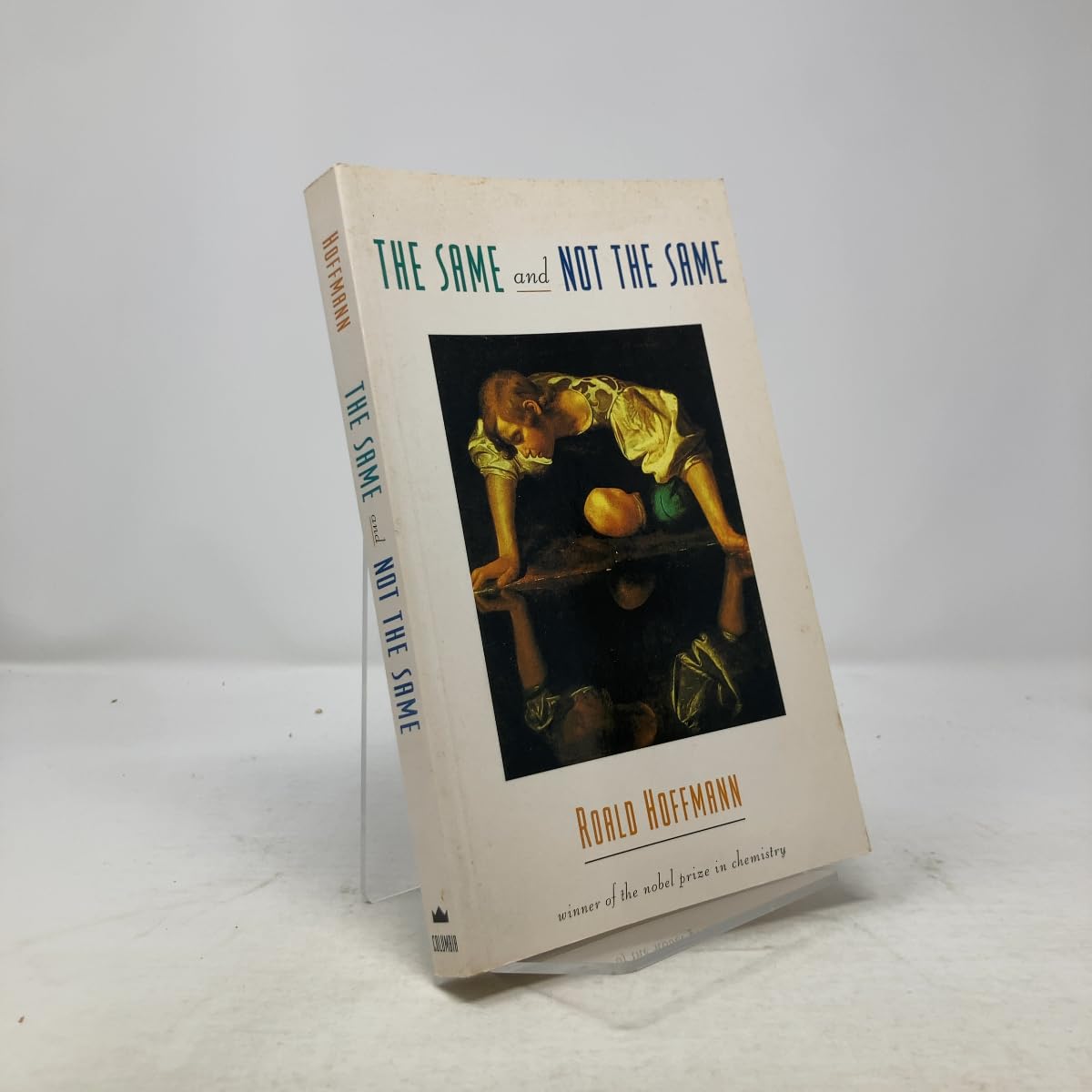



Positioned at the crossroads of the physical and biological sciences, chemistry deals with neither the infinitely small, nor the infinitely large, nor directly with life. So it is sometimes thought of as dull, the way things in the middle often are. But this middle ground is precisely where human beings exist. As Hoffmann shows in his inspired prose, the world observed at its molecular level is complex and agitated, as are the emotions of the supposedly dispassionate scientists who explore it. In The Same and Not the Same the vital tensions of chemistry are revealed; with down-to-earth explanations, Hoffmann uncovers the polarities that power, rend, and reform the world of molecules. When we wash an apple before eating it, we are thinking not merely of the dirt that may still be on it but of the pesticides used in agricultural production. When we take medication, we expect relief for our pain but also fear side effects. The Same and Not the Same shows this ambivalence to be only one of a number of dualities pervading the world of molecules. The theme of identity, reflected in the title of the book, is central to the story. Other dualities, from stasis and dynamics, to creation and discovery to the rich complexity of revealing and concealing, are lucidly delineated for nonscientist and scientist alike. The Same and Not the Same also offers a rare and compelling personal statement of the social responsibility of scientists. Unabashedly confronting some of the major ethical controversies in chemistry today, the book strives for balance in facing the pressing ecological and environmental concerns of our time. "This [is a] refreshing, often controversial panorama of science as it is really conducted by talented, fallible human beings... by one of America's most respected chemists and joint winner of the 1991 Nobel Prize for Chemistry." -- "Biologist" "This [is a] refreshing, often controversial panorama of science as it is really conducted by talented, fallible human beings... by one of America's most respected chemists and joint winner of the 1991 Nobel Prize for Chemistry." -- Biologist "This Ýis a¨ refreshing, often controversial panorama of science as it is really conducted by talented, fallible human beings... by one of America's most respected chemists and joint winner of the 1991 Nobel Prize for Chemistry." -- "Biologist" "This [is a] refreshing, often controversial panorama of science as it is really conducted by talented, fallible human beings... by one of America's most respected chemists and joint winner of the 1991 Nobel Prize for Chemistry." -- "Biologist" In 'The Same and Not the Same' Hoffmann does for chemistry what Stephen Hawking did for cosmology: he illuminates a science that for many has been shrouded in mystery. Roald Hoffmann was born in Zloczow, Poland, in 1937. Having survived the Nazi occupation, he arrived in the U.S. in 1949, after several years of postwar wandering in Europe. He graduated from Stuyvesant High School, Columbia University, and proceeded to take his Ph.D. in 1962, at Harvard University, working with W. N. Lipscomb and Martin Gouterman. Dr. Hoffmann stayed on at Harvard University from 1962-1965, as a Junior Fellow in the Society of Fellows. Since 1965, he has been at Cornell University, where he is now the Frank H. T. Rhodes Professor of Humane Letters Emeritus. Professor Hoffmann is a member of the National Academy of Sciences, The American Academy of Arts and Sciences, and the American Philosophical Society. He has been elected a Foreign Member of the Royal Society, the Indian National Science Academy, the Royal Swedish Academy of Sciences, the Finnish Society of Sciences and Letters, the Russian Academy of Sciences, the Nordrhein-Westfällische Academy of Sciences, and the Leopoldina. He has received numerous honors, including over twenty-five honorary degrees. He is the only person ever to have received the American Chemical Society's awards in three different specific subfields of chemistry ― the A. C. Cope Award in Organic Chemistry, the Award in Inorganic Chemistry, and the Pimentel Award in Chemical Education. As well as two other ACS awards. In 1981, he shared the Nobel Prize in Chemistry with Kenichi Fukui. "Applied theoretical chemistry" is the way Roald Hoffmann likes to characterize the particular blend of computations stimulated by experiment and the construction of generalized models, of frameworks for understanding, that is his contribution to chemistry. In more than 500 scientific articles and two books he has taught the chemical community new and useful ways to look at the geometry and reactivity of molecules, from organic through inorganic to infinitely extended structures. Dr. Hoffmann participated in the production of a television course about chemistry. "The World of Chemistry" is a series of 26 half-hour programs developed at the University of Maryland and produced by Richard Thomas. Dr. Hoffmann is the Presenter for the series, which h