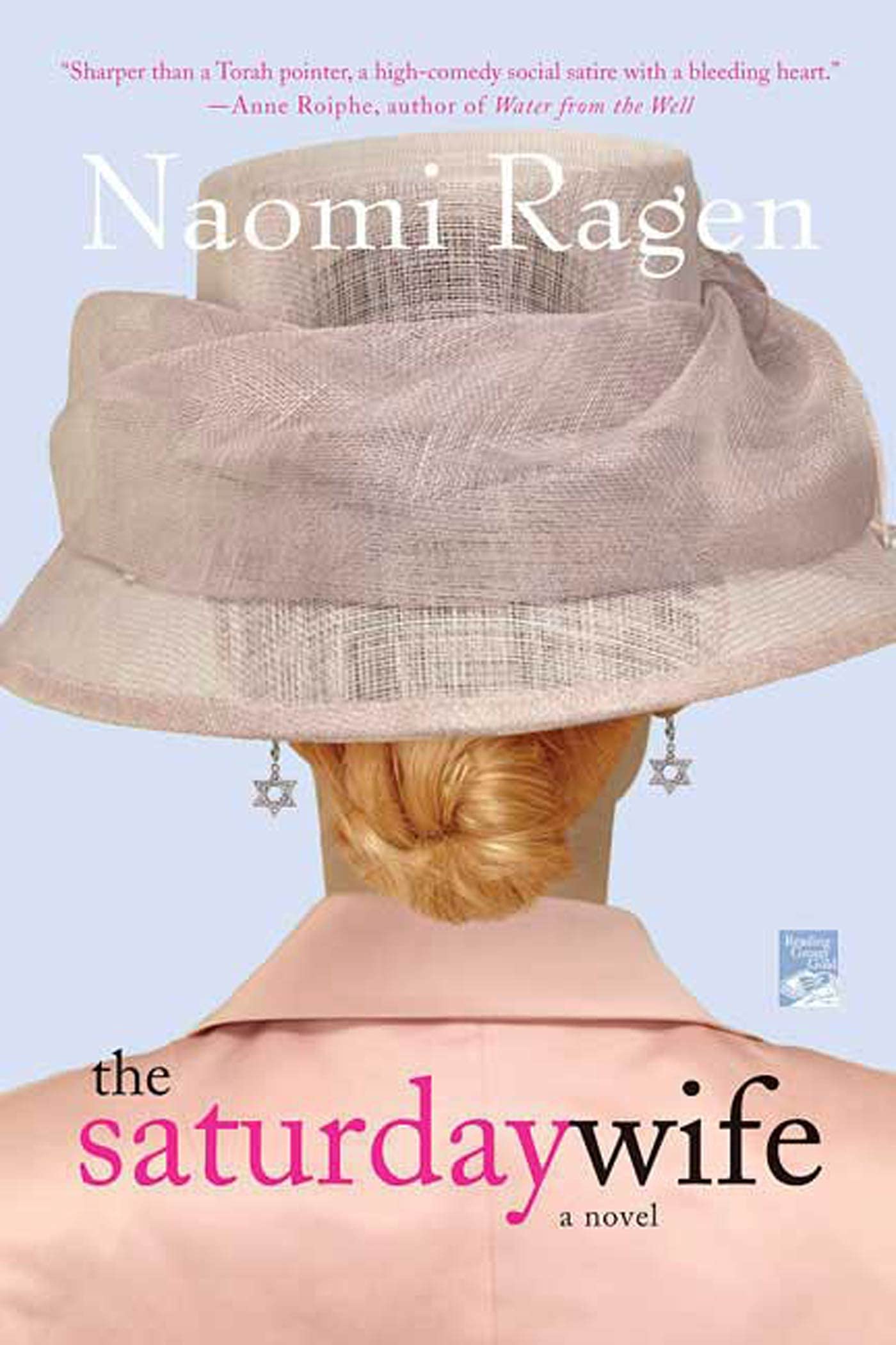



Bestselling author Naomi Ragen mixes poignant storytelling and irreverent wit with her talent for creating finely drawn characters in this tale of a young Rabbi's wife who slowly begins to unravel under the incessant and unreasonable demands of her congregation, her faith, and her life. Beautiful, blonde, materialistic Delilah Levy steps into a life she could have never imagined when in a moment of panic she decides to marry a sincere Rabbinical student. But the reality of becoming a paragon of virtue for a demanding and hypocritical congregation at an Orthodox synagogue in the suburbs leads sexy Delilah into a vortex of shocking choices which spiral out of control into a catastrophe which is as sadly believable as it is wildly amusing. Told with immense warmth, fascinating insight, and wicked humor, The Saturday Wife depicts the pitched and often losing battle of all of us as we struggle to hold on to our faith and our values amid the often delicious temptations of the modern world. “The pleasure of this novel is in its mercilessness, with Ragen raising the stakes until the very end.” ― Publishers Weekly “With The Saturday Wife , Naomi Ragen proves herself an adept satirist as well as a brilliant storyteller.... The heiress to such eternally discontented heroines as Emma Bovary and Undine Spragg, Delilah Goldgrab Levi's story is funny, poignant, and unforgettable.” ― India Edghill, author of Wisdom's Daughter Naomi Ragen is an award-winning novelist, journalist and playwright. Her first book, Jephte’s Daughter , was listed among the one-hundred most important Jewish books of all time. Her bestselling novels include Sotah, The Covenant , The Sisters Weiss , and Devil in Jerusalem . An outspoken advocate for women’s rights, and an active combatant against anti-Israel and anti-Semitic propaganda through her website, she has lived in Jerusalem since 1971. An Observant Wife is her thirteenth novel. The Saturday Wife By Ragen, Naomi St. Martin's Griffin Copyright © 2008 Ragen, Naomi All right reserved. ISBN: 9780312352394 It is not an easy thing for an Orthodox Jewish girl to be saddled with the name of a gentile temptress responsible for destroying a famous Jewish hero. When Delilah’s father filled in her name in the Hebrew Academy day school application form, the rabbi/administrator assumed it was a mistake, a feeble attempt on the part of some clueless, nonreligious Jew to find a Hebrew equivalent for Delia, or Dorothy. “You are aware, Mr. Goldgrab, that in the Bible, Delilah seduced Samson and is considered a wicked whore by our sages?” he pointed out as gently as he could. “Well now, you don’t say?” Delilah’s father drawled, his six-foot two-inch frame towering over the little man, who nervously clutched his skullcap. “Just so happens it was my mother’s name.” Our first meeting with Delilah was in second grade out on the punch ball fields of the Hebrew Academy of Cedar Heights on Long Island. Punch ball was a Jewish girl’s baseball without the bat. You just made the hardest fist you could and wham! – started to run. When you hit that ball, you took out all your anger, all your angst, all your frustration. You ran and ran and ran and ran, hoping you’d hit it hard enough so that no one could catch it or you, and send you back to first base –or worse- throw you out of the game altogether. The privilege of hitting the punchball was not to be taken for granted. Each recess, teams were picked anew by captains, who were, by mutual agreement, the prettiest and richest girls in the class. Everyone who wanted to play lined up and just waited for the magic summons. And as in life, some girls—like rich, snobby Hadassah Mittelman—were always the captains, and some girls, like me, were never asked to play. Never. We knew who we were and finally slipped away. But there were others- like Delilah- that sometimes made it in. Girls like her always had it the hardest. To almost make it was a far crueler fate that to be permanently relieved of hope. The world was a simple place back then, neatly divided between those of us who got the little blue admission cards in the mail at the start of each new term because our parents had paid the full tuition; and those who got them at the last minute, only after much parental groveling and pleading had pried them from the tightfisted grip of the merciless rabbi/administrator in charge. It was a world divided between those who had cashmere sweaters and indulgent fathers who dropped them off at school in their big cars because they lived in even more upscale neighborhoods further out on the Island and those who shivered in scratchy wool on public buses coming from the opposite direction. Delilah took the bus, but she also had a cashmere sweater, the most glorious color pink, that seemed to float around her shoulders like angel hair. Rumor had it that her mother had actually knitted it for her, from scratch; a rumor which cruel