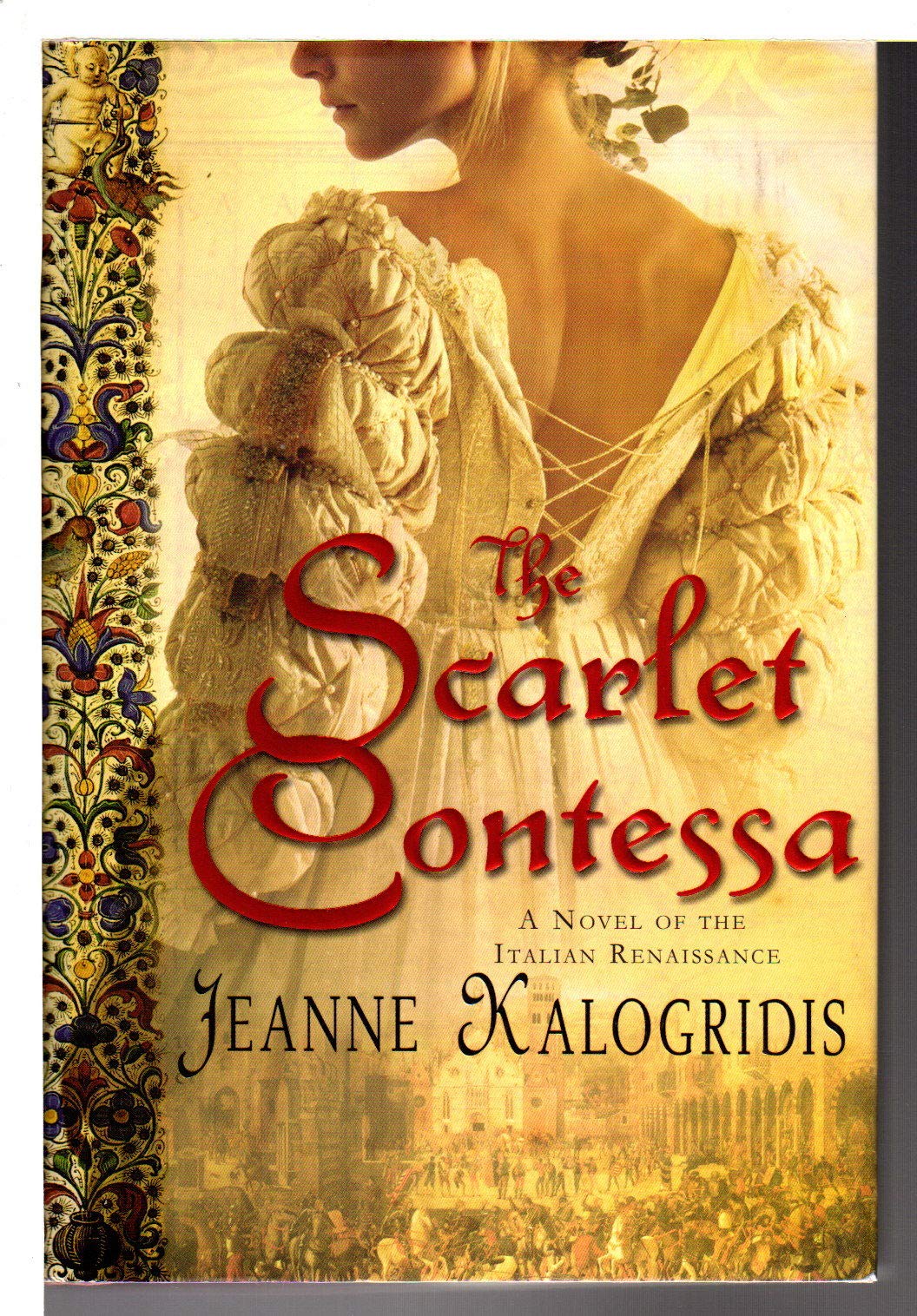



What Philippa Gregory has done for Tudor England, Jeanne Kalogridis does for Renaissance Italy. Her latest irresistible historical novel is about a countess whose passion and willfulness knew no bounds—Caterina Sforza Daughter of the Duke of Milan and wife of the conniving Count Girolamo Riario, Caterina Sforza was the bravest warrior Renaissance Italy ever knew. She ruled her own lands, fought her own battles, and openly took lovers whenever she pleased. Her remarkable tale is told by her lady-in-waiting, Dea, a woman knowledgeable in reading the “triumph cards,” the predecessor of modern-day Tarot. As Dea tries to unravel the truth about her husband’s murder, Caterina single-handedly holds off invaders who would steal her title and lands. However, Dea’s reading of the cards reveals that Caterina cannot withstand a third and final invader—none other than Cesare Borgia, son of the corrupt Pope Alexander VI, who has an old score to settle with Caterina. Trapped inside the Fortress at Ravaldino as Borgia’s cannons pound the walls, Dea reviews Caterina’s scandalous past and struggles to understand their joint destiny, while Caterina valiantly tries to fight off Borgia’s unconquerable army. “Sexually voracious, battle-hardened, a ruler in her own lands, Caterina rejects a woman’s place in a macho culture. Does she get away with it? That’s what this guilty pleasure of a novel is about.”— USA Today “In her fascinating novels Kalogridis focuses on the intrigues, passions and history of the Renaissance, drawing readers into the events that shaped the era through the lives of remarkable women. In a time when women quietly obeyed, Caterina Sforza forged her own destiny, choosing her lovers and fighting battles. In Kalogridis’ hands, she comes alive as an extraordinary woman ahead of her time.”— RT Book Review (4 stars) “Historical novelist Kalogridis has again woven a delightful and intricate tapestry of life, love, lust, politics and ambition that made up the Italian peninsula in the 15th century. . . . Depictions of sumptuous richness and the basest squalor, the petty enmities and jealousies, the corruption at the heart of the Vatican are shown in splendid detail and make this an incredibly rewarding read. Highly recommended.”— Library Journal “[A] vividly rendered historical . . . plenty of intrigue and conspiracy in the lusty plot.”— Publishers Weekly “action and drama aplenty. . . a very good historical”— Historical Novel Society “Bestselling author Jeanne Kalogridis returns to Renaissance Italy in this vivid tale of one of the era's lesser known figures— the indomitable Caterina Sforza. . . . Kalogridis has crafted a magnificent evocation of a tumultuous and complex era . . . Highly recommended!”— Goodreads Jeanne Kalogridis lives with her partner on the West Coast, where they share a house with two dogs. She is the author of The Borgia Bride, The Devil’s Queen , and other dark fantasy and historical novels. Born in Florida, Kalogridis has a B.A. in Russian and a master’s in linguistics, and taught English as a second language at The American University for eight years before retiring to write full-time. One At dusk the screams came—outraged, feminine, shrill. We would never have marked them had it not been for the smoke and the singers’ sudden silence. I heard them eight days before Christmas as I stood in the loggia, gasping in stinging cold air from the open window, brusquely unshuttered by a quick-thinking servant. A moment earlier, I had been sitting in front of the snapping hearth in the duchess’s quarters while one of her chambermaids roasted pignoli on a wood-handled iron peel—treats for the ducal heir, seven-year-old Gian Galeazzo Sforza, who stared blankly into the flames while his nurse brushed out the straw-colored curls covering his frail shoulders. Beside him sat his six-year-old brother, Ermes—thick-limbed and thick-waisted, slow to move or think—with a straight cap of dull red hair. To their left sat their mother, Duchess Bona, a sheer white veil wrapped about her coiled, muddy braids, her lips pursed as she squinted down at the needle and silk in her plump hands. She was twenty-seven and matronly; God had dealt her a stout frame, squat limbs, and a short, thick neck that dwarfed her broad face. Though her features were not unpleasant—her nose was short and round, her skin powder-soft and fine, her teeth small and fairly even—she had a low forehead with thick, overwhelming eyebrows. Her profile was flat, her eyes wide set, her small chin lost in folds of fat, most of it acquired after the birth of her first child; yet at the court of Duke Galeazzo, to my thinking, there was no lovelier soul. To Bona’s left sat the duke’s two natural daughters, results of his dalliance with a courtier’s wife. The elder, Caterina, was, at thirteen, an example of physical perfection, with a lithe body that promised full breasts, clear skin, and a straight, well-proportioned nose, though her lips were rath