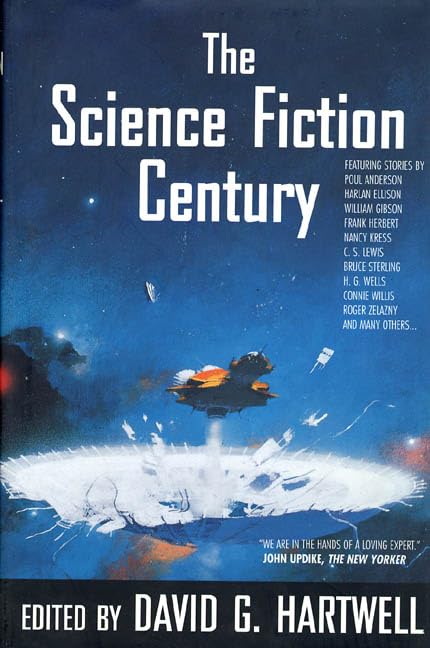



"Science fiction is the characteristic literary genre of the century. It is the genre that stands in opposition to literary modernism." So says David G. Hartwell in his introduction to The Science Fiction Century, an anthology spanning a hundred years of science fiction, from its birth in the 1890s to the future it predicted. David G. Hartwell is a World Fantasy Award-winning editor and anthologist who has twice before redefined a genre--first the horror field with The Dark Descent, then the subgenre of hard science fiction with The Ascent of Wonder, coedited with Kathryn Cramer. Now, Hartwell has compiled the mother of all definitive anthologies, guaranteed to change not only the way the science fiction field views itself but also the way the rest of literature views the field. The Science Fiction Century includes stories from the founding fathers of the field, such as H.G. Wells, C.S. Lewis, Jack London, and Rudyard Kipling; beloved mainstays of the genre, such as Philip José Farmer, Roger Zelazny, Jack Vance, and Poul Anderson; noted female writers, including Connie Willis, Nancy Kress, and James Tiptree, Jr.; and writers who have hit their stride in the last two decades, such as Bruce Sterling, William Gibson, Michael Swanwick, and James Morrow. Hartwell has also included writers widely recognized outside the genre, such as E.M. Forster, Michael Shaara, and John Crowley; and translations of foreign writers' formative works, including Dino Buzzati and Wolfgang Jeschke. This is must-have anthology for all literary interests. The Science Fiction Century is editor David G. Hartwell's ambitious attempt to create an anthology spanning 100 years of science fiction, beginning with stories from the 1890s. It is a veritable tome of science fiction that contains 45 tales in all, some from well-known genre authors such as Robert Silverberg and Jack Vance, and others from less science fictionally inclined writers such as Jack London and E. M. Forster. While Hartwell's selections will probably be seen as somewhat controversial (except for five stories, the anthology spans the period from 1950 onward, which is less than half a century at best), they all undeniably make for good--and more often great--reading. This anthology contains 45 short stories, mostly post-World War II and mostly American, representing the earliest writers in the genre (H.G. Wells, C.S. Lewis), Golden Age authors (Poul Anderson, A.E. Van Vogt), hard science and cyberpunk writers (William Gibson, Bruce Sterling), women authors (James Tiptree Jr., Connie Willis), and writers known outside science fiction (Michael Shaara, E.M. Forster). In his introduction, Hartwell places sf in the context of literary history and prefaces each story with a short biographical and bibliographical essay. While he purposely omits certain authors who have been heavily anthologized (Ray Bradbury, Ursula K. Le Guin), Hartwell has chosen excellent examples representing 100 years of science fiction. Highly recommended for sf and literature collections. Copyright 1997 Reed Business Information, Inc. Science fiction's sibling genre, detective fiction, has thrived much more spectacularly in the past 100 years, but sf is the characteristic genre of the twentieth century for the simple reason that so many sf dreams have been realized during it. Sf seems predictive, and the relentless futurism of the twentieth century is indissolubly married to it. Experienced sf anthologist Hartwell combs the century and the world to amass a celebratory collection that rather resembles one of Norton's whopping anthologies for college lit courses. If some entries in it are overfamiliar (e.g., Forster's "The Machine Stops"), others by very influential figures--especially writers of languages other than English, such as the Belgian J.-H. Rosny aine(according to critic Damon Knight, the true father of sf in French) and the Russian Alexander Kuprin--are barely known, and not because they are not excellent. A superb survey for the uninitiated and a definitive sampler for confirmed fans. Ray Olson "We are in the hands of a loving expert." --John Updike, The New Yorker David G. Hartwell, called "an editor extraordinaire" by Publishers Weekly , is one of science fiction's most experienced and influential editors. As an editor with Berkley Books, Pocket Books, William Morrow, and Tor Books, he has worked with many of the field's best authors and edited many award-winning works. He is the author of Age of Wonders , a nonfiction study of the science fiction field. Among his many anthologies are the bestselling World Treasury of Science Fiction and the World Fantasy Award winner The Dark Descent . He is the holder of a Ph.D. in comparative literature from Columbia University, a winner of the Eaton Award, and has been nominated for the Hugo Award twenty-four times.