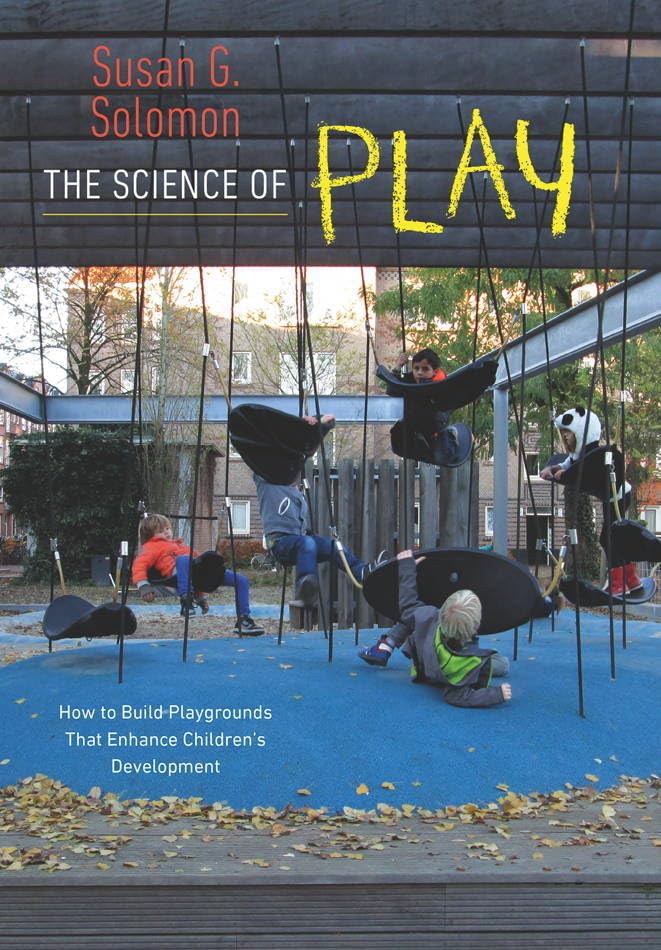
The Science of Play: How to Build Playgrounds That Enhance Children's Development
$40.00
by Susan G. Solomon



Poor design and wasted funding characterize today’s American playgrounds. A range of factors―including a litigious culture, overzealous safety guidelines, and an ethos of risk aversion―have created uniform and unimaginative playgrounds. These spaces fail to nurture the development of children or promote playgrounds as an active component in enlivening community space. Solomon’s book demonstrates how to alter the status quo by allying data with design. Recent information from the behavioral sciences indicates that kids need to take risks; experience failure but also have a chance to succeed and master difficult tasks; learn to plan and solve problems; exercise self-control; and develop friendships. Solomon illustrates how architects and landscape architects (most of whom work in Europe and Japan) have already addressed these needs with strong, successful playground designs. These innovative spaces, many of which are more multifunctional and cost effective than traditional playgrounds, are both sustainable and welcoming. Having become vibrant hubs within their neighborhoods, these play sites are models for anyone designing or commissioning an urban area for children and their families. The Science of Play, a clarion call to use playground design to deepen the American commitment to public space, will interest architects, landscape architects, urban policy makers, city managers, local politicians, and parents. "Susan Solomon provides the missing link of playground design: serious research about how the built form of the playground affects children, parents, and even whole communities. In so doing, she exposes both the failure of the American playground and its enormous potential. Great places for play are great places for life: read this book to learn how, and why, to make them."--Paige Johnson, editor of Play-Scapes.com "Choice" So what's the alternative to standard-issue playgrounds? Solomon envisions multipurpose, multigenerational urban parks that incorporate spaces where kids can take charge of their own play. Instead of a fixed bridge in a plastic fort, they would have to use their imagination to decide which objects could be converted to play equipment. Such a challenging play space also would include nooks where kids could temporarily escape the nervous gaze of their caregivers. There would be no fences, plenty of trees and bushes, and good seating."-- "Philadelphia Inquirer" The conclusion of the author's research is that playgrounds should be multigenerational and mesh with the surrounding environment. Peppered with color and black-and-white illustrations, this well-written, well-researched book is a much-needed inspiration for and to children. . . . Recommended."-- "Choice" Through the Science of Play: How to Build Playgrounds that Enhance Children's Development, Susan G. Solomon strongly advocates for the revamping of playgrounds in the United States. . . . She makes the case for replicating the playgrounds of Europe and Japan that provide spaces for taking risks, solving problems, experiencing natural consequences, and engaging in multiple-generational social interactions."--Paige Johnson, editor of Play-Scapes.com "American Journal of Play" "So what's the alternative to standard-issue playgrounds? Solomon envisions multipurpose, multigenerational urban parks that incorporate spaces where kids can take charge of their own play. Instead of a fixed bridge in a plastic fort, they would have to use their imagination to decide which objects could be converted to play equipment. Such a challenging play space also would include nooks where kids could temporarily escape the nervous gaze of their caregivers. There would be no fences, plenty of trees and bushes, and good seating." -- Philadelphia Inquirer "The conclusion of the author's research is that playgrounds should be multigenerational and mesh with the surrounding environment. Peppered with color and black-and-white illustrations, this well-written, well-researched book is a much-needed inspiration for and to children. . . . Recommended." -- Choice "Through the Science of Play: How to Build Playgrounds that Enhance Children's Development, Susan G. Solomon strongly advocates for the revamping of playgrounds in the United States. . . . She makes the case for replicating the playgrounds of Europe and Japan that provide spaces for taking risks, solving problems, experiencing natural consequences, and engaging in multiple-generational social interactions." -- American Journal of Play "The conclusion of the author s research is that playgrounds should be multigenerational and mesh with the surrounding environment. Peppered with color and black-and-white illustrations, this well-written, well-researched book is a much-needed inspiration for and to children. . . . Recommended. Choice " Susan Solomon provides the missing link of playground design: serious research about how the built form of the playground affects children, parents, and even whol