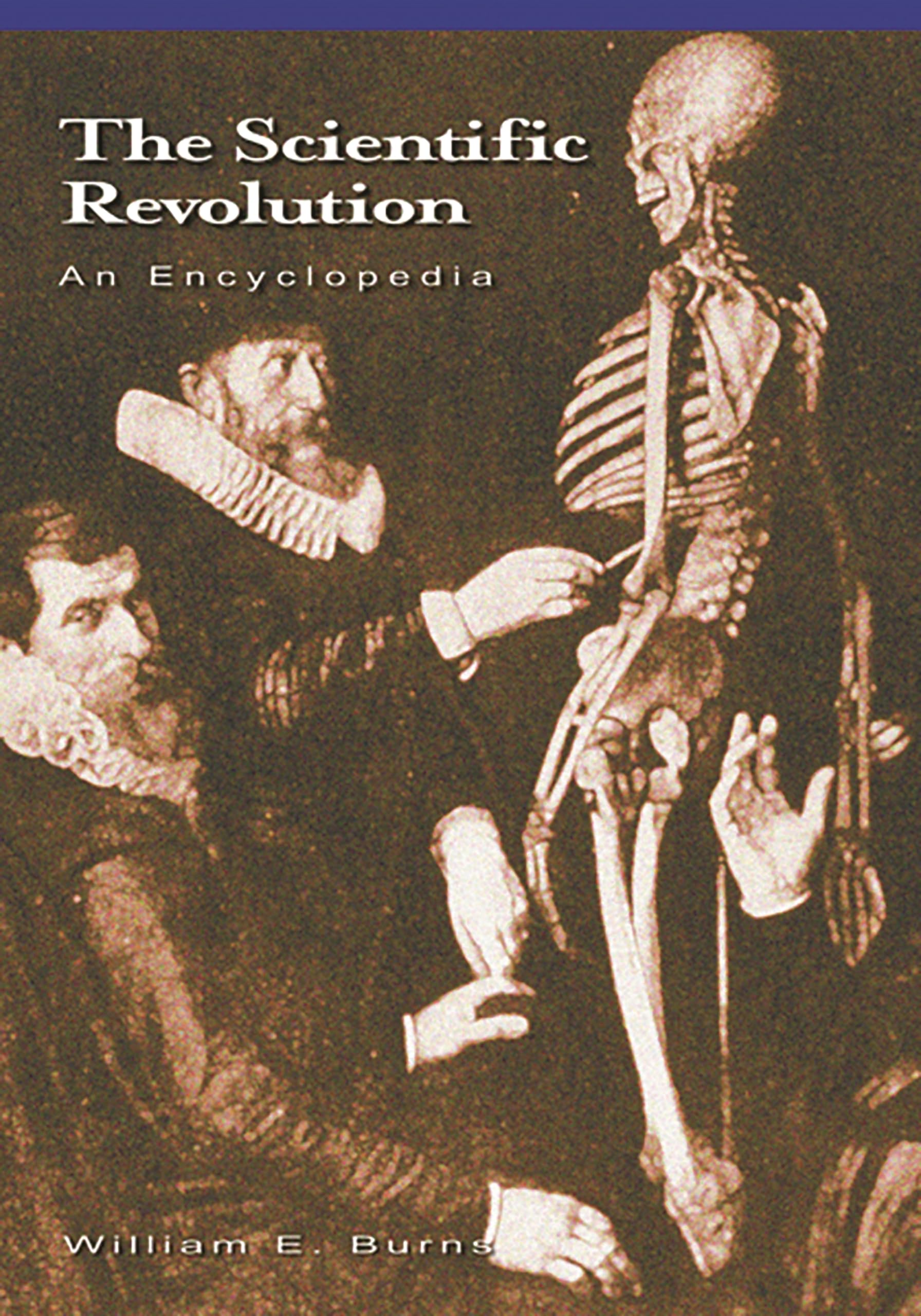
The Scientific Revolution: An Encyclopedia (History of Science)
$103.00
by William E. Burns



An encyclopedic collection of key scientists and the tools and concepts they developed that transformed our understanding of the physical world. Many are familiar with the ideas of Copernicus, Descartes, and Galileo. But here the reader is also introduced to lesser known ideas and contributors to the Scientific Revolution, such as the mathematical Bernoulli Family and Andreas Vesalius, whose anatomical charts revolutionized the study of the human body. More marginal characters include the magician Robert Fludd. The encyclopedia also discusses subjects like Arabic science and the bizarre history of blood transfusions, and institutions like the Universities of Padua and Leiden, which were dominant forces in academic medicine and science. This encyclopedia covers not only the keynote moments of the intellectual transformation that we call the Scientific Revolution but also its influences and cultural effect. It ranges from the early 16th century to the 18th century in 228 entries, which feature traditional topics such as Corpernicus, William Harvey, and Isaac Newton as well as less-expected subjects like magic, Robert Fludd, and the Jesuits. An annotated chronology and a detailed bibliography are included. Burns, a historian who has taught at the University of Pennsylvania, the University of Maryland, and Oklahoma State University, has attempted to fit a significant amount of current research and thinking into this heavily illustrated and attractively formatted work. Each entry is one or two pages long and includes references for further reading, making this a good resource for public as well as college and research libraries. However, owing to the brevity of the entries and the limited number of references provided at the end of each, users can get only the most basic information. A better choice for younger readers is The Renaissance and the Scientific Revolution (LJ 5/1/01). No better quick reference exists for adult readers, who might instead turn to Steven Shapin's The Scientific Revolution (LJ 8/96) for a general overview. Eric D. Albright, Duke Univ. Medical Ctr. Lib., Durham, NC Copyright 2001 Reed Business Information, Inc. This encyclopedia covers the advances in science during the fifteenth and sixteenth centuries. Many of us are familiar with the ideas of Copernicus, Descartes, and Galileo, but here we are also introduced to the lesser-known ideas and scientists of the movement known as the Scientific Revolution. More than 200 entries of one or two pages discuss topics including Atomism , Blood transfusions , Humanism , Navigation , Physics , Telescopes , and Witchcraft and demonology . Also discussed are individuals such as Maria Cunitz, who simplified Kepler's theories for working astronomers; and Andreas Vesalius, whose anatomical charts revolutionized the study of the human body. Numerous see also references are provided, as are bibliographic citations to works for further research. An assortment of beautiful black-and-white prints and photographs complements the entries. An extensive bibliography adds great value, but the list of Web resources is a token one, listing just seven sites. A comparable title is Encyclopedia of the Scientific Revolution: From Copernicus to Newton (Garland, 2000), which has almost twice the number of entries. Topics that are covered in both encyclopedias are often treated at greater length and in more detail in the Garland volume, and supported by more extensive and scholarly bibliographies. The Scientific Revolution is generally more accessible, and has the added bonus of entries on several women not found in the Garland offering. It is recommended for high-school, undergraduate, and large public libraries. RBB Copyright © American Library Association. All rights reserved “A good resource for public as well as college and research libraries.” ― Library Journal “It is recommended for high school, undergraduate, and large public libraries.” ― Booklist “This book is one of the few to present brief essays with illustrations concerning the state of science and technology and the major figures and their times in one volume for reference. . . . It is well illustrated and attractively formatted. For high school and undergraduate libraries.” ― Choice “An attractive reference work that discusses the personalities, ideas, and instruments that comprised this era. . . . Has an edge in readability and cost and will be a solid addition to many collections.” ― American Reference Books Annual William E. Burns is a historian who lives in the Washington, D.C., area. Used Book in Good Condition