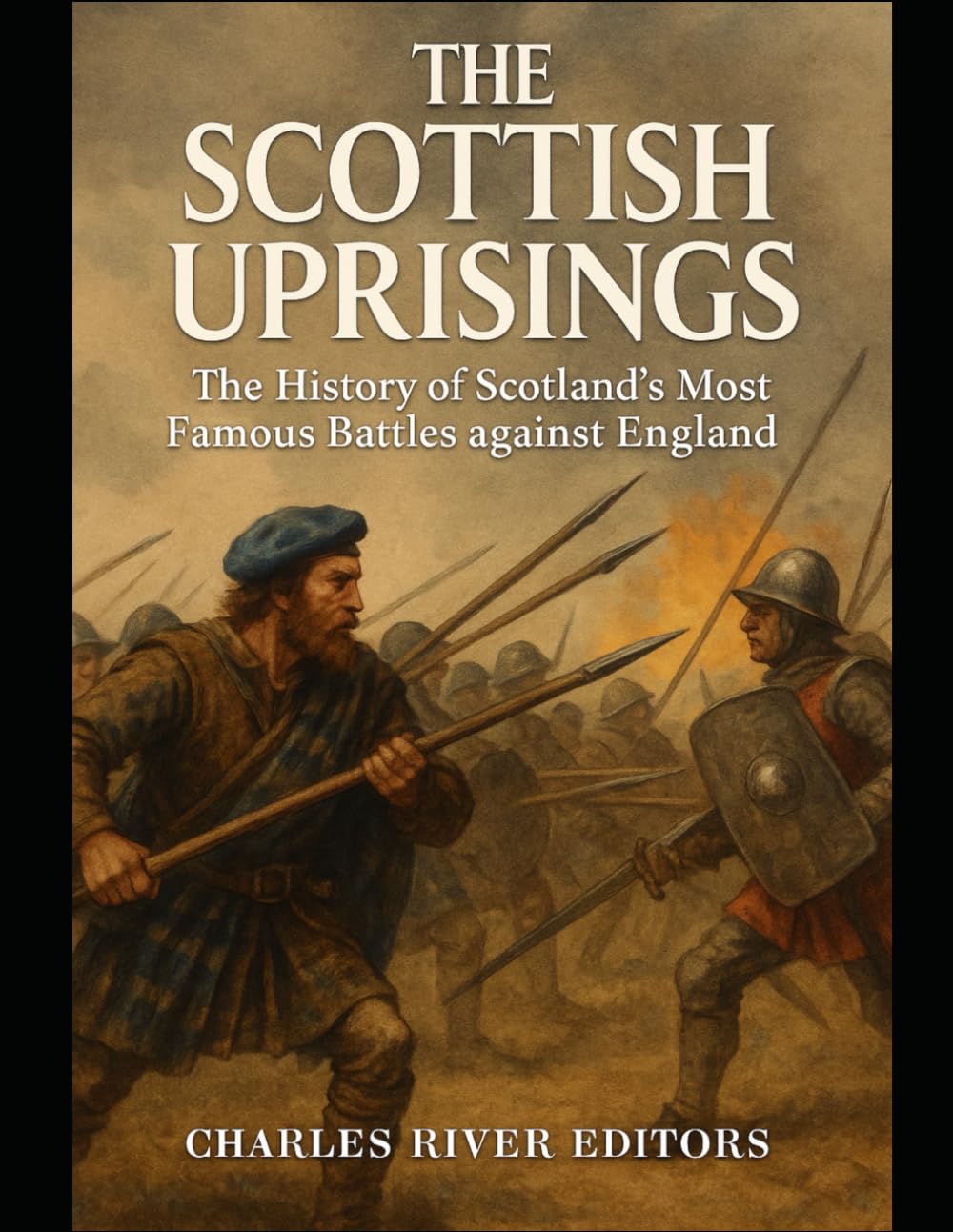
The Scottish Uprisings: The History of Scotland’s Most Famous Battles against England
$12.99
by Charles River Editors



From their very beginnings, England and Scotland fought each other. Emerging as unified nations from the early medieval period, their shared border and inter-related aristocracy created endless causes of conflict, from local raiders known as border reivers to full blown wars between their monarchies. Every century from the 11th to the 16th was colored by such violence, and there were periods when not a decade went by without some act of violence marring the peace. Out of all of this, the most bitterly remembered conflict is Edward I's invasion during the late 13th century. After Edward’s death, the English were eventually beaten back at the famous Battle of Bannockburn in 1314, and thus the early 14th century was a period featuring some of Scotland's greatest national heroes, including William Wallace and Robert the Bruce. It still resonates in the Scottish national memory, all the more so following its memorable but wildly inaccurate depiction in the 1995 film Braveheart , which had Scottish audiences cheering in cinemas. England has more often been faced with the claims of competing kings and queens than with a period of no monarch at all. The major exception to that rule came in the 11 years between 1649 and 1660, when England was a republic. Following the disastrous reign of Charles I and the civil wars that led to his execution, Parliament and the army ruled England. That situation was one that would not have been possible without the Bishops’ Wars that preceded it. In the 1630s, Charles’s high-handed approach to politics caused further trouble north of the border, and not just because of the lands he had taken back from the nobility. The Scots were Presbyterian Protestants, and Charles wanted to enforce the same religious practices on them as he supported in England. His attempt to enforce use of the English Book of Common Prayer led to a rebellion by the Scots in 1639, a rebellion which ultimately became known as the Bishops’ Wars. Although Charles I lost his head and Oliver Cromwell established a short-lived Commonwealth, the Stuarts would eventually be restored to the throne under Charles II, but by the end of the 17th century, an uprising of a completely different nature would soon unfold on English soil. In 1678, a sinister scheme to assassinate King Charles II was unearthed, sending the public into a frenzy of mass panic. Fingers were pointed at the Catholics, who had been accused of concocting the elaborate conspiracy, and this very event would intensify the white-hot flames of the Anti-Catholic hysteria that was already running unchecked within the nation. Seven years later, the openly Catholic King James II rose to the throne, and needless to say, the largely Protestant public was anything but pleased. As the people slowly turned against him, the king's daughter, Mary, and her husband, William of Orange, watched across the English Channel from a distance. The people were begging for change in a broken system, and something drastic had to and would be done. The Jacobites conjure up many images to 21st century Britons, including romantic heroism, the Outlander series, and Bonnie Prince Charlie as the doomed hero of the cause, but Jacobitism was a cause that had far reaching consequences across 18th century Europe. The Jacobites were not only supporters of the exiled Stuart monarchy, but also against the political and religious settlements agreed to across the British Isles. As Jacobite historians such as Daniel Szechi and Frank McLynn have noted, the specter of the Jacobite threat was present for the British government and monarchy in their dealings with European powers throughout the 18th century. This was especially true in France, the country that supported the exiled Stuarts and gave them a home until 1714.