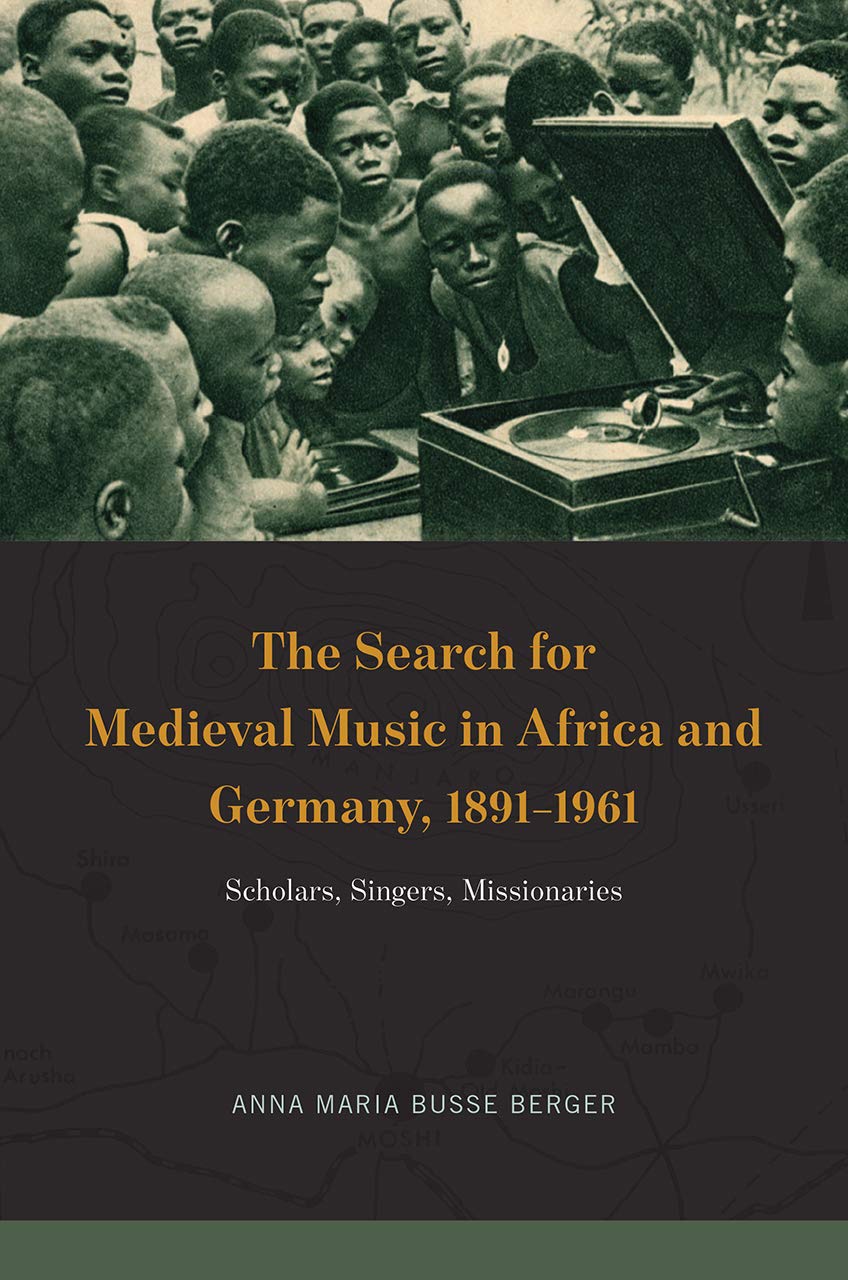
The Search for Medieval Music in Africa and Germany, 1891-1961: Scholars, Singers, Missionaries (New Material Histories of Music)
$60.31
by Anna Maria Busse Berger



This innovative book reassesses the history of musicology, unearthing the field’s twentieth-century German and global roots. In the process, Anna Maria Busse Berger exposes previously unseen historical relationships such as those between the modern rediscovery of medieval music, the rise of communal singing, and the ways in which African music intersected with missionary work in the German colonial period. Ultimately, Busse Berger offers a monumental new account of the early twentieth-century music culture in Germany and East Africa. The book unfolds in three parts. Busse Berger starts with the origins of comparative musicology circa 1900, when early proponents used ideas from comparative linguistics to test whether parallels could be drawn between nonwestern and medieval European music. She then turns to youth movements of the era—the Wandervogel , Jugendmusikbewegung , and Singbewegung —whose focus on joint music making influenced many musicologists. Finally, she considers case studies of Protestant and Catholic mission societies in what is now Tanzania, where missionaries—many of them musicologists and former youth-group members—extended the discipline via ethnographic research and a focus on local music and communities. In highlighting these long-overlooked transnational connections and the role of global music in early musicology, Busse Berger shapes a fresh conception of music scholarship during a pivotal part of the twentieth century. "Berger crafts a rich, nuanced analysis of a foundational moment in the making of modern musical thought... The author’s scrupulous account of events, based on the painstaking review of an enormous body of archival material, makes for a dizzyingly complex history. Her book charts multiple paths, and heightening its drama are the circumstances of colonial occupation in which events unfold." ― Music and Letters "[A] pioneering account of early 20th-century musical culture in Germany and East Africa. . . . [Busse Berger's] book opens up a host of new opportunities to combine historical musicology with ethnomusicology, to study structures of musical knowledge, and to take us in new directions which will ultimately make musicology more diverse, equal and inclusive." ― Early Music "There is much to learn from Busse Berger’s authoritative musical expertise and extensive archival research. Global historians, Europeanists, and Africanists will learn about a largely forgotten chapter of twentieth-century history in this imaginatively conceived work." ― Central European History "One can see how the book describes people, thoughts and positions in the Germany of the first half of the twentieth century (including its colony in East Africa) in a stirring way and thus leads into the middle of the ramified discussions about the foundations of musicology. Anyone interested in the subject will read the book with profit." ― Die Musikforschung "Busse Berger sheds light on the long overlooked transnational contexts and the role of of global music in early musicology and shapes a new conception of musicological research in a crucial part of the 20th century.” ― Zeitschrift für Missionswissenschaft and Religionswissenchaft "A wide-ranging work that uncovers layers of reciprocal influence between comparative musicology, early music historiography, the culture of the Jugendmusik- und Singbewegung , and German missionaries in Africa." ― H-Net Reviews "The book presents an exciting and completely new view of early and mid twentieth-century music history, placing the focus again and again on the search for medieval music, combining it with African music, with questions of how this search was realized by missionaries, as well as by amateur singers and musicians. In the end, [Busse Berger] uncovers completely new connections." ― Connections "Busse Berger's book should, above all, be read by every musicologist. It is, after all, a work about the fascinating and difficult beginnings of comparative musicology, but also of musicology in general as a scientific discipline that was slowly finding its place among other fields of study that had long been well established in universities." ― Res Facta Nova “Meticulously researched and engagingly written, The Search for Medieval Music in Germany and Africa, 1891–1961 eschews glib appeals to globalism for focused accounts of three topics: European medieval music and its supposed parallels with non-Western (specifically African) music; antimodernist ideologies and a longing for participatory music; and the need to save the souls of contemporary others living far away. Reflecting the respective concerns of comparative musicologists, youth movements, and missionaries to East Africa, these three inquiries turn out to be mutually reinforcing, sometimes in surprising ways. Busse Berger’s labors in various archives, her nuanced and judicious readings, and her consistent focus on human agency even while acknowledging the shaping forces