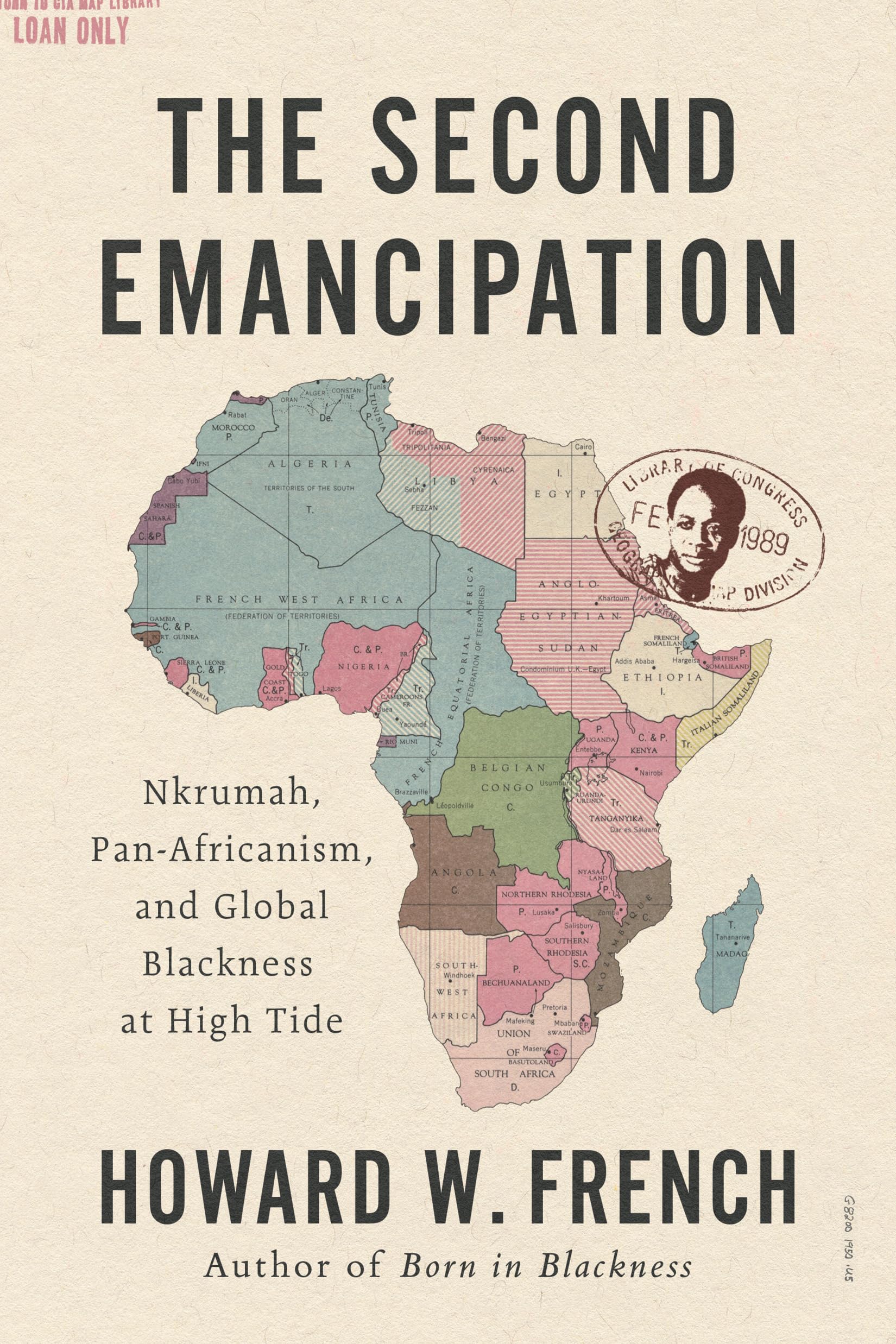
The Second Emancipation: Nkrumah, Pan-Africanism, and Global Blackness at High Tide
$22.99
by Howard W. French



Publishers Weekly • Best Books of 2025 [Nonfiction] Foreign Policy • Most Anticipated Books of 2025 “Howard French’s The Second Emancipation stands the second half of the last century on its geopolitical head.” ―David Levering Lewis, winner of the Pulitzer Prize From the acclaimed author of Born in Blackness comes an extraordinary account of Africa’s liberation from colonial oppression, a work that fundamentally reshapes our understanding of modern history. The Second Emancipation , the second work in a trilogy from best-selling author Howard W. French about Africa’s pivotal role in shaping world history, underscores Adam Hochschild’s contention that French is a “modern-day Copernicus.” The title―referring to a brief period beginning in 1957 when dozens of African colonies gained their freedom―positions this liberation at the center of a “movement of global Blackness,” with one charismatic leader, Kwame Nkrumah (1909–1972), at its head. That so few people today know about Nkrumah is an omission that French demonstrates is “typical of our deliberate neglect of Africa’s enormous role in the birth of the modern world.” Determined to re-create Nkrumah’s life as “an epic twentieth-century story,” The Second Emancipation begins with his impoverished, unheralded birth in the far-western region of Ghana’s Gold Coast. But blessed with a deep curiosity, a young Nkrumah pursued an overseas education in the United States. Nowhere is French’s consummate style more vivid than in Nkrumah’s early years in Depression-era America, especially in his mesmerizing portrait of a culturally effervescent Harlem that Nkrumah encountered in 1935 before heading to college. During his student years in Pennsylvania and later as an activist in London, Nkrumah became steeped in a renowned international Black intellectual milieu―including Du Bois, Garvey, Fanon, Padmore, and C.L.R. James, who called him “one of the greatest political leaders of our century”―and formed an ideology that readied him for an extraordinarily swift and peaceful rise to power upon his return to Ghana in 1947. Four years later, in a political landslide he engineered while imprisoned, Nkrumah stunned Britain by winning the first general election under universal franchise in Africa, becoming Ghana’s first independent prime minister in 1957. As leader of a sovereign nation, Nkrumah wielded his influence to promote the liberation of the entire continent, pushing unity as the only pathway to recover from the damages of enslavement and subjugation. By the time national military and police forces, aided by the CIA, overthrew him in 1966, Nkrumah’s radical belief in pan-African liberation had both galvanized dozens of nascent African states and fired a global agenda of Black power. In its dramatic recasting of the American civil rights story and in its tragic depiction of a continent that once exuded all the promise of a newly won freedom, The Second Emancipation becomes a generational work that positions Africa at the forefront of modern-day history. 16 pages of illustrations; 3 maps "[An] epic narrative…This is a sprawling book, and the better for it. Mr. French has delivered a panoramic, sympathetic, yet analytical portrait of a global black movement, deepened by his own family connections with West Africa…As the fastest-growing part of the world in population, Africa will matter more and more. And Mr. French is an expert guide to its nuances." ― Robert Kaplan, Wall Street Journal "French, a professor of journalism at Columbia and a former foreign correspondent for The New York Times , covers a lot of ground in a book that merges biography with panorama. His previous book, Born in Blackness , showed how the making of the modern world wasn’t just a story about Europe; it was also about Africa. The Second Emancipation is a sequel, bringing that approach into the postwar era... The Second Emancipation ably treads the line on Nkrumah’s complicated legacy. French keeps reminding the reader of the larger context, pointing out how European colonies were laboratories not for good governance but for authoritarianism." ― Jennifer Szalai, New York Times "Howard W. French thinks Nkrumah deserves better.... He calls Nkrumah 'comparable in his impact on the world of his era to Mandela, and even Gandhi.' He is especially attentive to the way Nkrumah was influenced by Black Americans, and how he influenced them in turn, by showing what Black political power might look like... [ The Second Emancipation ] re-creates the era of soaring hopes in Africa." ― Kelefa Sanneh, New Yorker " The Second Emancipation, as political and intellectual history, is profound and excellent." ― Walton Muyumba, Boston Globe "Nkrumah’s odyssey is the subject of Howard W. French’s riveting new book …Nkrumah paralleled Mahatma Gandhi and Martin Luther King Jr. in his reach and influence. That little is known about him outside of Africa and African diasporic com