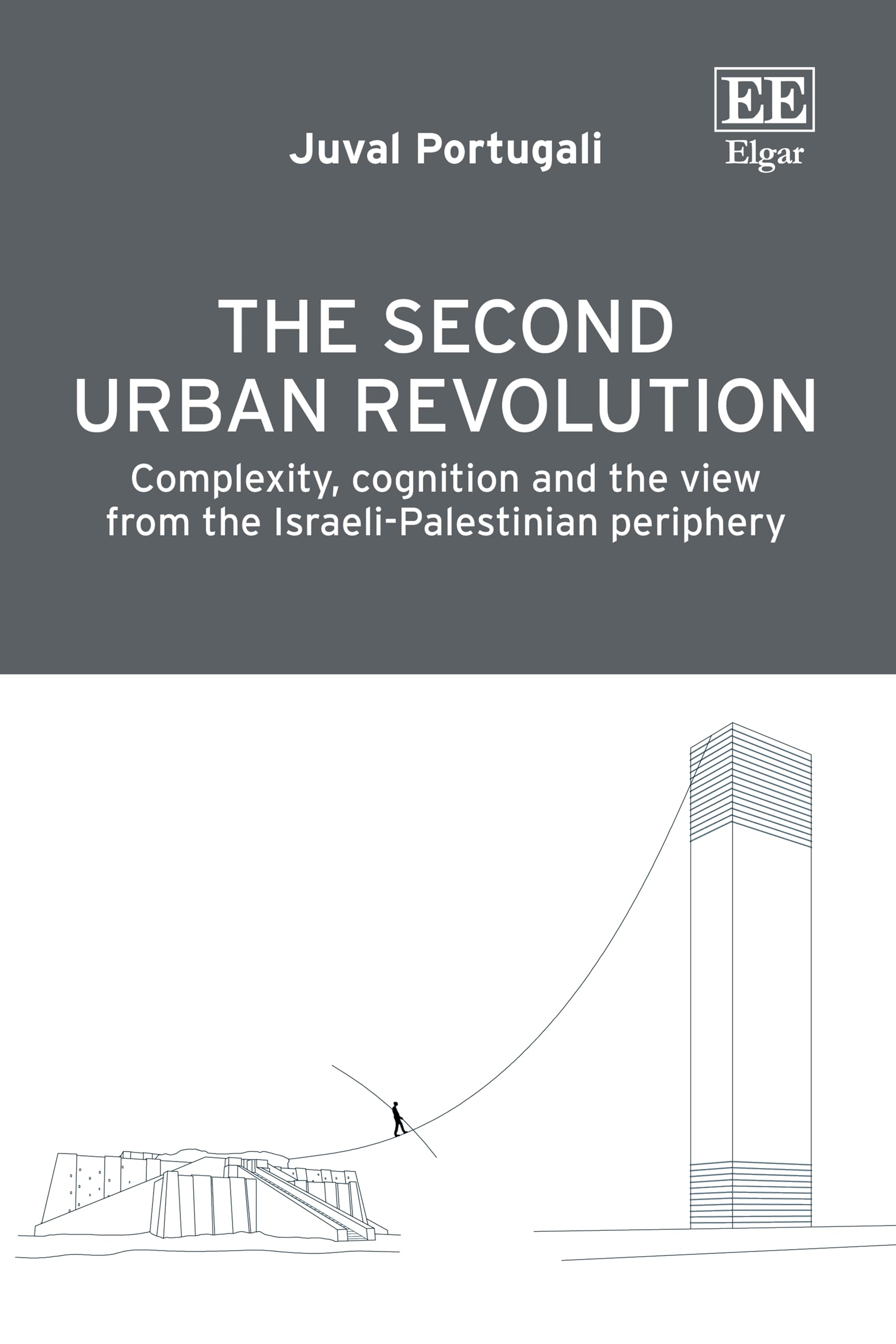
The Second Urban Revolution: Complexity, Cognition and the View From the Israeli-Palestinian Periphery
$180.00
by Juval Portugali



In this timely book, Juval Portugali ties together ancient archaeology with the present to explore the city as a phenomenon that has been rapidly increasing in power and importance since its earliest emergence. He links the walled cities of ancient civilization with modern-day borderless cities, while providing connections between modern nationalism and postmodern urbanism. With a specific focus on two urban revolutions, the first emergence of the city 5,500 years ago and the urban revolution we are currently undergoing, Portugali analyzes the shift to a global population residing predominantly in urban environments. He examines these two urban revolutions from the perspective of the Israeli-Palestinian periphery, in terms of complex-cognitive, self-organized systems. Ultimately, the book addresses how urbanism is becoming the driving force behind human life and consciousness for the first time in history and expresses a new theory of ancient and modern urbanism oriented around socio-spatial evolution. Investigating the interrelation between complexity theory and cognitive theory – and their connection to the city – this book is an enlightening read for scholars and students of urban studies, human geography, political geography and geopolitics, and urban economics. It is also a crucial resource for those researching cities and complexity. ‘There is a new and ill-understood tension between the emerging globalized network of multi-national cities and the national (and more homogeneous) peripheries surrounding them, and Professor Portugali manages to weave a fascinating story―grounded in a wide variety of contemporary theories and emerging new evidence―to explain this tension, claiming it to be nothing less than a second urban revolution.’ -- Shlomo Angel, New York University, USA ‘A culmination of a lifetime’s work, this book offers a bold new synthesis of fundamental questions in urbanization, complexity, geography, and society. Portugali presents an original, unifying perspective on social theory while addressing urgent global issues―from rising nationalism to the evolving Israeli-Palestinian conflict.’ -- Luís M. A. Bettencourt, University of Chicago, USA ‘In this rich and enlightening book, Portugali explores the urban phenomenon from the theoretical standpoints of complexity and cognition. The originality of this work lies in the systematic attempt to interestingly combine the viewpoint of social sciences and that of hard sciences to investigate cities and their peculiarities. The challenging book’s central thesis is that the essence of what Portugali calls the “second urban revolution” is a shift from nationalism (i.e. the dominant social order in the twentieth century), to urbanism (since the end of the twentieth century, emerging as a new form of generative order of society).’ -- Stefano Moroni, Politecnico di Milano, Italy Juval Portugali, Professor of Human Geography, Department of Geography and the Human Environment and Head of the City Center-Tel Aviv University Research Center for Cities and Urbanism, Tel Aviv University, Israel