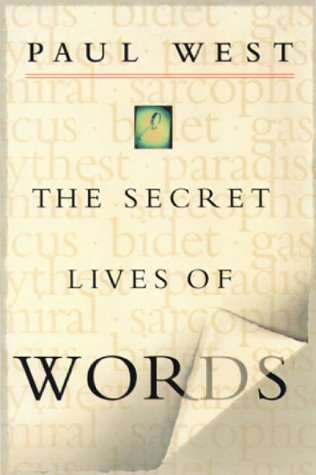



This fascinating new study reveals the amazing and bizarre histories of language's building blocks and chronicles the etymologies of dozens of common words whose original meaning has been obscured through the passage of time. Paul West delights in the vicissitudes of language, and his enthusiasm is exquisitely catching. West particularly loves a good etymology (and who, deep down, doesn't?), and he's dedicated this newest of his 30-odd books to 500 of his favorite words and phrases, and the stories that go with them. West tells a good tale, and he uses his gift to explain the derivation of words such as "Hottentot" and "humble pie," "patter," "conkers," and "nurdle." He starts with "abacus" and "ablative absolute" and works his magic alphabetically through his personal lexicon, ending with "zoot suit" and "zymurqist" (i.e., one who works with yeast, from the Greek zume for leaven and urqist for worker, as in metallurgist). Along the way, he provides definitions, usage, and derivations for "snite" (to blow one's nose without a tissue or handkerchief) and "scranny" (nuts, crazy, as in "driven scranny," from the Yorkshire dialect), as well as for more common words like "leotard" (named after James Léotard, the 19th-century French aerialist) and "decimate" (which means to kill one-tenth of, despite common misusage, and comes from the Roman practice of killing one of every 10 soldiers in times of mutiny). West's entry on "nun" explores the many food items containing that name--such as the Portuguese barriga de freira (nun's tummy) and the Neapolitan coscia de monaca (nun's thigh)--and his short essay on pumpernickel explains how (and why) the name derives from words meaning devil fart. As fun a word book as has hit the market since Eric Partridge's Dictionary of Slang and Unconventional English , The Secret Lives of Words is selective instead of comprehensive, and therein lies some of its charm. It's informal. It's a taste. It's purely for the joy of the language. In his introduction, West reflects that "sadly, all words seem much the same to many people, like checkers, and they feel about them much as I do about Vivaldi's Four Seasons : all sound like Winter." Yet it's hard to imagine anyone skimming through the boondoggles and dead-cat bounces of The Secret Lives of Words and emerging without a joyous smile and a hunger for more. --Stephanie Gold Since his student days, West, the celebrated author of 18 novels (e.g., Life with Swan, LJ 2/1/99) and a dozen works of nonfiction and poetry, has kept notebooks of words that intrigue him, especially those with puzzling or obscure histories. In this wonderful little book, he shares some 400 of these words. West's special interest is in a word's origins and its evolution over time and across cultures. Each entry traces the word from its origin through its sometimes-tangled development into current usage. More than etymologies and dictionary facts, these entries are short essays about words as human "characters" with fascinating life stories. From digging up the origin of the word assassin among Muslim hashish eaters to finding the roots of quark in James Joyce's Finnegans Wake, each entry gives the reader the joy of discovery and the satisfaction of untying a knot. This is a thoroughly enjoyable book that word enthusiasts, writers, and indeed any interested reader can savor. Highly recommended. -Paul A. D'Alessandro, Portland P.L., ME Copyright 2000 Reed Business Information, Inc. West's enthrallment with words manifests itself in wordplay and puns throughout his inventive novels and evocative nonfiction. He now attests to his obsession in a piquantly entertaining celebration of the evolution of language. Our understanding of most words, West observes, is based on the latest sound bite in a long and convoluted history, and he proves his point in 400 genealogies of words both common in our times and lost to history. Words, West believes, are vital testimony to "human ingenuity and the bizarre twists we permit our minds to make," and this sensibility is everywhere present in his gleeful word biographies. Feisty is Middle English for "farting dog"; mump once meant "grimace" or "scowl"; and fiction is a magical word that metaphorically links the kneading of bread with the making and safeguarding of a paradise. There is nothing predictable here, neither West's word choices nor his spicy and cheerfully opinionated etymologies, and even the most casual of readers will be smitten with his knowledge and wizardry. Donna Seaman Copyright © American Library Association. All rights reserved "...useful and wonderful flights of fancy from a great writer." -- Roger Harris, Newark Star Ledger, 7/9/00 ...a zestful account of West's love for "history-laden words." -- The New York Times Book Review , Alec Michod Paul West has written eighteen novels, most recently Life with Swan , and ten works of nonfiction, including A Stroke of Genius and the bestse