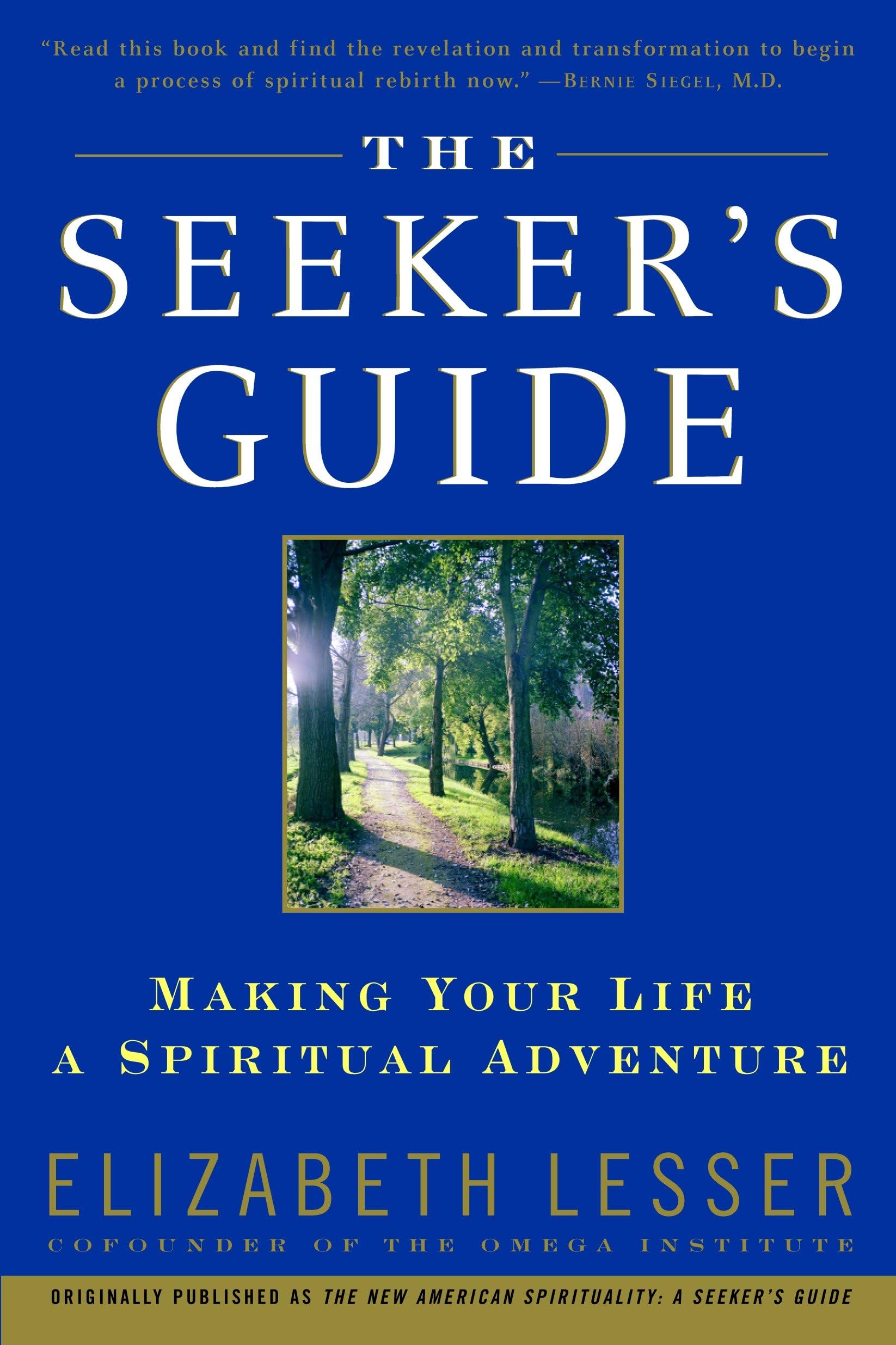
The Seeker's Guide (previously published as The New American Spirituality)
$13.39
by Elizabeth Lesser



In 1977, Elizabeth Lesser cofounded the Omega Institute, now America's largest adult-education center focusing on wellness and spirituality. Working with many of the eminent thinkers of our times, including Zen masters, rabbis, Christian monks, psychologists, scientists, and an array of noted American figures--from L.A. Lakers coach Phil Jackson to author Maya Angelou--Lesser found that by combining a variety of religious, psychological, and healing traditions, each of us has the unique ability to satisfy our spiritual hunger. In The Seeker's Guid , she synthesizes the lessons learned from an immersion into the world's wisdom traditions and intertwines them with illuminating stories from her daily life. Recounting her own trials and errors and offering meditative exercises, she shows the reader how to create a personal practice, gauge one's progress, and choose effective spiritual teachers and habits. Warm, accessible, and wise, this book provides directions through the four landscapes of the spiritual journey: THE MIND: learning meditation to ease stress and anxiety THE HEART: dealing with grief, loss, and pain; opening the heart and becoming fully alive THE BODY: returning the body to the spiritual fold to heal and overcome the fear of aging and death THE SOUL: experiencing daily life as an adventure of meaning and mystery "Elizabeth Lesser has witnessed the search for God in America from a front-row seat. As both an observer and a participant, she is funny, profoundly moving, and simply brilliant. This is a book for anyone who wants to read their own spiritual story more clearly and find the inner compass that can lead them home." -Rachel Naomi Remen, M.D., author of Kitchen Table Wisdom Elizabeth Lesser is the cofounder and senior adviser of the Omega Institute in Rhinebeck, New York. Prior to her work at Omega, she was a midwife and childbirth educator. She attended Barnard College and San Francisco State University. She can be reached at elesser@eomega.org. Although a book is born of many impulses, and influenced by diverse experiences, authors often speak of a symbolic moment of conception--an "aha" moment when you say to yourself, "I have to tell this story." That moment came for me several summers ago, in the faculty dining room at Omega Institute, the education and retreat center I cofounded in 1977. Over the years I have shared countless meals with conference and workshop leaders in that room, moderating discussions between medical doctors and shamanic healers, Christian monks and Jewish rabbis, Zen teachers and business executives. On this particular day I was eating lunch with Babatunde Olatunji, the West African drum master and world-music innovator. Seated next to Baba was the American poet Allen Ginsberg, engaged in conversation with Gelek Rinpoche, a Tibetan Buddhist lama, and Joseph Shabalala, a South African musician and freedom fighter. They were talking about their twin passions--politics and spirituality--and how challenging it was to combine the two. At the other end of the table was the onetime heavyweight champion of the world Floyd Patterson picking over his plate of tofu salad and discussing his workshop, "The Tao of Boxing," with a Chinese tai chi master, a tiny woman dressed in black pajamas. Next to them sat Huston Smith, the renowned authority on the history of religions, chatting with Ysaye Barnwell of the gospel group Sweet Honey in the Rock, and John Mohawk, a Seneca author and spiritual leader. Catching bits and pieces of conversations, I turned to Baba Olatunji and asked, "So, what do you make of this--all these traditions meeting and merging?" Baba leaned back in his chair and surveyed the scene. Then, waving his fork at the extraordinary cast of characters seated around us, he announced, "This is a new kind of spirituality. It's American, and one day it will be the world." An American spirituality--I liked that concept. It described my own spiritual life, something I had never been able to label. I had been actively searching for God since childhood. My path wove through the peaks and valleys of many different traditions: organized religion, disorganized mysticism, psychotherapy, philosophy, mythology, science. My search had all the signs of being an American one: it was open-minded, individualistic, and adventurous. It celebrated diversity: ten years of discipleship with an Eastern meditation master; a deep immersion into Christian, Jewish, and Islamic mysticism; extended work with a psychotherapist; study of Jungian psychology and Western schools of philosophy; and exposure, from my work at Omega Institute, to a range of healing systems, from ancient Chinese medicine to modern consciousness research. For more than twenty-five years I had been on an adventure, searching for a genuine and fearless kind of spirituality. My goal had not been to become a Christian or a Jew or a Muslim; a Buddhist or a Sikh or a Hindu. I didn't want to become anything other than my