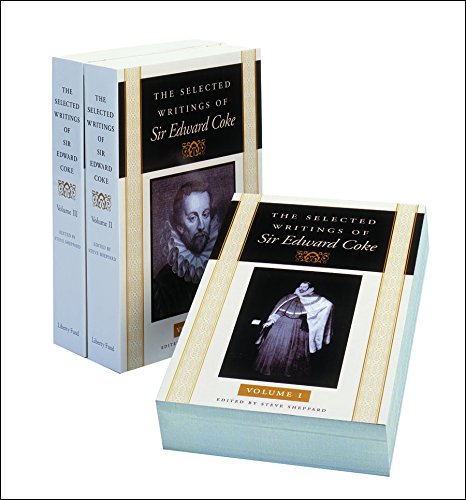



Sir Edward Coke (1552–1634) successfully defended English liberties against the royal prerogative of the Stuart kings and virtually single-handedly established the rule of law for the English-speaking peoples. Coke’s view of English law has had a powerful influence on lawyers, judges, and politicians through the present day. It was Coke’s astonishing task to set down the whole of the law―from Magna Carta to land law to criminal law, and the system of court procedure, from the High Court of Parliament down to the lowest courts of the realm―for students, lawyers, and laymen to understand it. The Institutes derived their authority not only from Coke’s personal influence but also, in part, from the great authority accorded the Reports , which themselves solidified the modern understanding of case law. The Liberty Fund edition of The Selected Writings of Sir Edward Coke is the first anthology of his works ever published. Steve Sheppard is Associate Dean for Research and Faculty Development and the William H. Enfield Distinguished Professor of Law at the School of Law, University of Arkansas. The Selected Writings of Sir Edward Coke in three volumes, edited by Steve Sheppard, is a welcome addition, and provides a rich and full selection of the writings of Coke, who established the rule of law and defined Common Law by defending the "traditional liberties" of the English people from the abuses of power (including the king's) and by writing down the English laws and court procedure. Sheppard has done a splendid job of making Coke's writings available and accessible, providing headnotes, a general "Introduction", and an extensive "Chronology of Events" that includes Coke's legacy. There are ample selections from Coke's Reports (including the case de Libellis Famosis establishing libel law), and from all four parts of Coke's Institutes , including the entire discussion of the Magna Charta. The third volume includes fascinating discussions of heresy, treason, and "Of Felony by Conjuration, Witchcraft, Sorcery, or Inchantment." As a companion to this edition, Liberty Fund has also published Law, Liberty, and Parliament: Selected Essays on the Writings of Sir Edward Coke, edited by Allen D. Boyer, which reprints essays on Coke published during the twentieth century, including the chapter in Helgerson's Forms of Nationhood (1992). Studies in English Literature 1500-1900 Winter 2005 When it came to British law, Coke (1552-1634) was akin to a force of nature. In addition to his duties in Parliament as Speaker of the House, it fell to Coke to write down all of British law for academic study. He also was the power behind numerous laws that ended abuses of citizens by the crown; many of his ideas were incorporated into the U.S. Constitution. This three-volume set offers a large selection of his writings for a very reasonable price. Library Journal April 15, 2004 The common law of England, unless repugnant to the Constitution or altered by the General Assembly, has been adopted in §1-10 of the Code of Virginia. The common law is derived from decisions, customs and usage over time "whereof the memory of man runneth not to the contrary." Enmeshed in the mists of history, the Virginia Supreme Court has cited both Edward Coke and William Blackstone as primary sources. Edward Coke (1552-1634) is the first great expositor of the common law. Coke possessed undeniable stature in his career as solicitor general, attorney general, speaker of the House of Commons and lord chief justice. His professional career straddled the reigns of Queen Elizabeth and King James, when England made the transition from a feudal to commercial society. The widespread development in printing allowed Coke's influence to eclipse the writings of his predecessors, John Fortescue and Thomas Littleton. With the publication of Selected Writings , Liberty Fund has provided ready access to Coke. Volume 1 begins with fifty-eight cases between 1600-1615, starting with that most notable to first-year law students, "Shelley's Case." Coke's collection and publication of cases during his lifetime contributed to regularity in the law and laid a solid foundation for judge's decisions based on established precedent. Volume II of Selected Writings contains extracts from his four-part "Institutes on the Lawes of England" and were based largely in name on Justinian's "Institutes," a studious recurrence to the Roman basis of English civil law. The first part was subtitled "Coke upon Littleton" and was his attempt to update Littleton's treatise on real property. The next three parts of Coke's "Institutes" contained in Volume II dealt respectively with statutes, crimes and courts. It is Coke's "Institutes" that provide his most enduring legacy. Legal education of Colonial Virginians rested on Coke, and the popular understanding of the meaning of common law was a function of his "Institutes." Coke's assertion of Magna Carta and the ancient