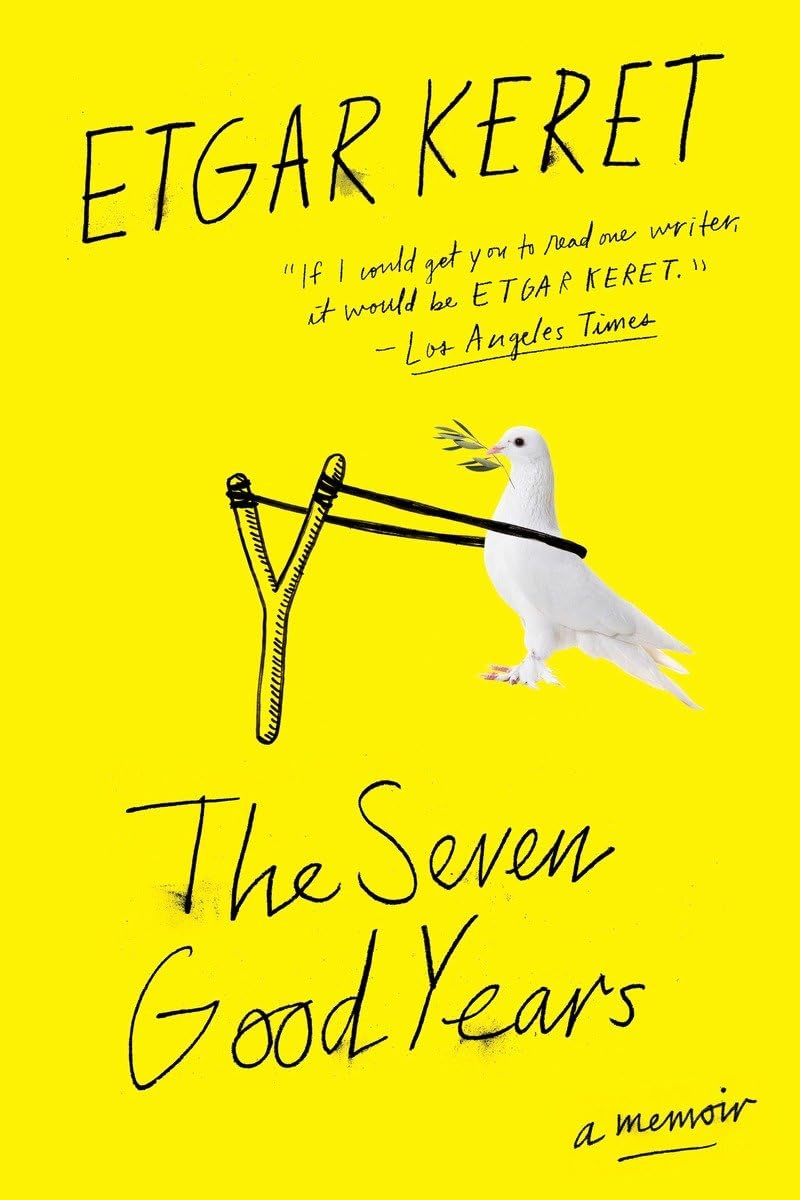



A brilliant, life-affirming, and hilarious memoir from a “genius” ( The New York Times ) and master storyteller. With illustrations by Jason Polan. The seven years between the birth of Etgar Keret’s son and the death of his father were good years, though still full of reasons to worry. Lev is born in the midst of a terrorist attack. Etgar’s father gets cancer. The threat of constant war looms over their home and permeates daily life. What emerges from this dark reality is a series of sublimely absurd ruminations on everything from Etgar’s three-year-old son’s impending military service to the terrorist mind-set behind Angry Birds. There’s Lev’s insistence that he is a cat, releasing him from any human responsibilities or rules. Etgar’s siblings, all very different people who have chosen radically divergent paths in life, come together after his father’s shivah to experience the grief and love that tie a family together forever. This wise, witty memoir—Etgar’s first nonfiction book published in America, and told in his inimitable style—is full of wonder and life and love, poignant insights, and irrepressible humor. “ Etgar Keret is a genius... ” — New York Times " A brilliant writer...completely unlike any writer I know. The voice of the next generation. " —Salman Rushdie “One of my favorite Israeli writers.” —John Green “Etgar’s stories are a reminder of that rude intangible that often goes unspoken in creative writing workshops: a great work of art is often just residual evidence of a great human soul. There is sweetheartedness and wisdom and eloquence and transcendence in his stories because these virtues exist in abundance in Etgar himself… I am very happy that Etgar and his work are in the world, making things better.” —George Saunders “Terrific… As funny, as dark, and somehow as sweet as his fiction.” —David Remnick “At once funny and profound, The Seven Good Years is a gem. Etgar Keret approaches memoir the way he does fiction—from surprising angles, with a sly wit, and bracing frankness. Read him, and the world will never look the same again.” —Claire Messud “I don’t know how Etgar Keret does it, but he can turn anything into a brilliant story. The Seven Good Years is full of them, and they happen to be true, and full of love, kindness, wisdom, humor and stuff I long for as a reader but cannot quite name. Keret’s writing is soul-healing.” —Aleksandar Hemon “Being a father, having a father—Etgar Keret is the man in the middle and he captures the job just brilliantly.” —Roddy Doyle “Hilarious, brilliant, poignant, magically economical in its language, marvelously generous in its approach to the world, this book is like its author: genius.” —Ayelet Waldman “When I first read Etgar's stories, I wondered what was wrong with him—had his mother smoked crack while pregnant? Was he dropped on his head as an infant?—until I met him, and grew to know him, and realized his problem was much worse than I had ever imagined: he is a terribly caring human being in a terribly uncaring universe. Basically, he's fucked.” —Shalom Auslander "Etgar Keret is #1 writer in Israel and #2 in my heart (after my dachshund Felix).” —Gary Shteyngart “Etgar Keret’s stories are funny, with tons of feeling, driving towards destinations you never see coming. They’re written in the most unpretentious, chatty voice possible, but they’re also weirdly poetic. They stick in your gut. You think about them for days.” – Ira Glass, host and producer of This American Life “If I could get you to read one writer, it would be Etgar Keret. His impossible blend of humor and tragedy, cynicism and empathy as well as big-hearted narratives that occupy the tiniest of page counts make him one of my favorites. Maybe one of yours.” — The Los Angeles Times “Exhilarating… For Keret, the creative impulse resides not in a conscious devotion to the classic armature of fiction (character, plot, theme, etc.) but in an allegiance to the anarchic instigations of the subconscious. His best stories display a kind of irrepressible dream logic.” —Steve Almond, New York Times “Etgar Keret possesses an imagination not easily slotted into conventional literary categories. His very short stories might be described as Kafkaesque parables, magic-realist knock-knock jokes or sad kernels of cracked cosmic wisdom.” – A.O. Scott, New York Times “[Keret’s writing] testifies to the power of the surreal, the concise and the fantastic… [O]blique, breezy, seriocomic fantasies that defy encapsulation, categorization and even summary.” — Washington Post “It's astonishing what he can do in just two pages: go from funny to bizarre to touching to satiric to meta to surprising and surreal… [A] master storyteller, creating deep, tragic, funny, painful tales with scarcely more words than you've read in this review.” —Carolyn Kellogg, Los Angeles Times "Keret’s writing is unwaveringly funny and light, making it the perfect easy read for