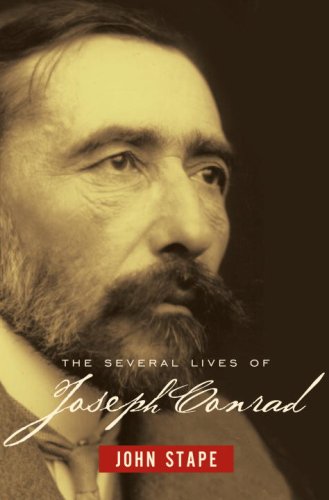



The Several Lives of Joseph Conrad is the first new biography in more than a decade of one of modern literature’s most important writers--whose work remains widely read and acutely relevant eighty years after his death. In this authoritative, insightful book, we see Joseph Conrad as a man who consistently reinvented himself. Born in 1857 in Berdichev, Ukraine, he left home early and worked as a sailor out of Marseilles; traveled to the Far East and Africa with the British merchant navy; and, finally, in 1891, settled in England, beginning a precarious existence as an novelist and family man. Here is a Conrad for our moment: a man with a deep sense of otherness; a writer with multiple cultural identities who wrote in his third language and whose fiction became the cornerstone of literary Modernism. With his exceptional knowledge and understanding of Conrad, and drawing on unpublished letters and documents, John Stape succeeds in casting an illuminating new light on the life of a willfully enigmatic man who remains one of the greatest writers of his, and our, time. *Starred Review* One of the world’s most captivating writers, Conrad led a demanding life long obscured by myth. Conrad expert Stape seeks to nail down the facts in a strict accounting of the wrenching ups and downs of Conrad’s struggle to survive and get words on the page. Writing with an eye to irony and paradox and evincing a love of description—qualities prominent in Conrad’s work––Stape lays the foundation with a sensitive rendering of Conrad’s traumatic childhood as the only child of exiled Polish dissidents. A sickly boy versed in the art of displacement, he was orphaned at 11, went to sea at 16, and was marked by all that he witnessed in far-flung places, from the Caribbean to Bangkok, Borneo, and the Congo. As Stape vividly portrays this seen-it-all “ardent Francophile” and feckless charmer resistant to authority, Stape admits that Conrad’s metamorphosis into a writer “remains an intractable mystery.” He then keeps diligent track of Conrad’s punishing cycles of creativity and despair within a marriage further burdened by financial worries and relentless bouts of ill health. Stape’s painstaking portrait clarifies many aspects of Conrad’s life, and reveals just how grueling it was for him to create his glorious and harrowing fiction. --Donna Seaman "John Stape has brought Joseph Conrad so much to life--a working writer, a man subject to pain and vicissitude, not a 'study,' not a statue--that inevitably one suffers with him. Jessie Conrad, too, is alive in these pages, and their son Borys so much so that Stape can't help wanting to give him a good thrashing. Especially striking in the scope of this superb biography is its organic human trajectory, the evolution of Conrad from where he began to what he became. The undistinguished young Conrad could really be anyone at all; the old Conrad is Conrad, and not because the image is so familiar--those omniscient creases fanning out of all-seeing eyes that have known dread. One finishes reading in something like a state of personal mourning: a life that is as sad as it is triumphant." --Cynthia Ozick, author of Heir to the Glimmering John Stape is Research Fellow at St. Mary’s University College, London. He has taught in universities in Canada, France, and the Far East. He is the editor of The Cambridge Companion to Joseph Conrad , and co-editor of two volumes of The Collected Letters of Joseph Conrad . He divides his time between Vancouver and London. Reviewed by Michael Dirda Suppose you were asked to name the most studied classic of English fiction, that single work most often read in high school and college classrooms. What would you choose? My own guess would be Joseph Conrad's nightmare-vision of moral decay, Heart of Darkness. A hallucinatory account of a journey up the Congo River to a distant trading camp, a supposed "outpost of progress," this 1902 novella foretells the whole bloody history of the past century. It misses nothing: imperialism, racism and genocide, the squalid megalomania and corruption of those in power, our era's spiritual torpor, the exploitation of third-world peoples, the raping of nature and women, massacre justified as political expediency, rampant mendacity, the ethos of the concentration camp. "Exterminate all the brutes!" Even now, Mistah Kurtz's dying words and his final scream -- "The horror! the horror!" -- continue to rip away the smiling mask of civilized values to show us what lies beneath, what lies ahead -- Paschendale, Auschwitz, AIDS, 9/11, mass starvation in Africa, the daily body count in the Middle East. In all his fiction Joseph Conrad's great theme is human nature in extremis, and perhaps only Dostoevsky plumbs more deeply into the ravaged souls of men. While Conrad's prose can be slack or overripe, and sometimes his syntax doesn't quite track, that voice on the page earns its grandeur and eloquence. It speaks with the melancholy authority of