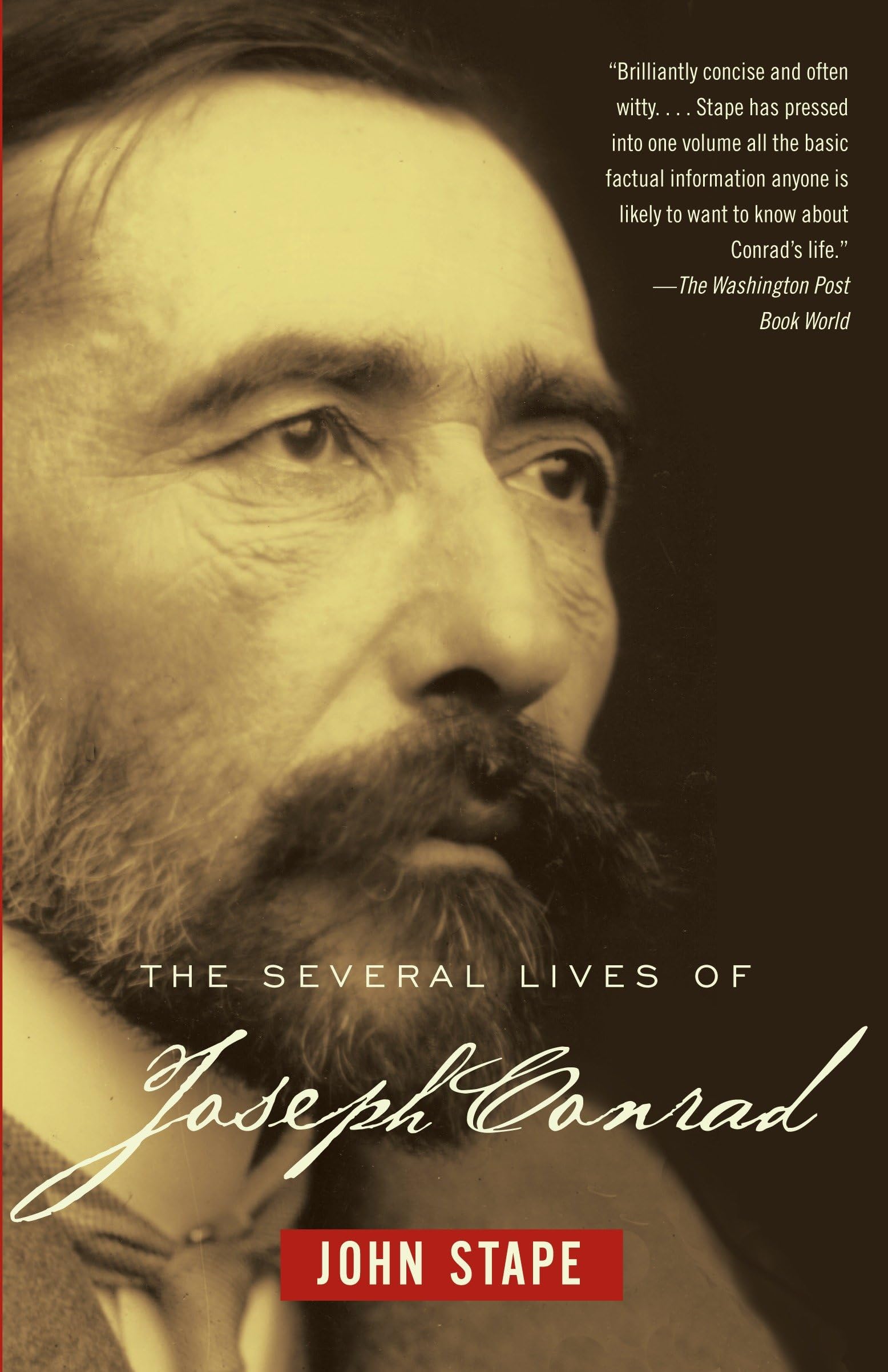



In this authoritative, insightful biography, we see the modernist master Joseph Conrad as a man who consistently reinvented himself. Born in 1857 in the Ukraine, he left home early and worked as a sailor, traveling to the Far East and Africa, and eventually settled in England, beginning a precarious existence as a novelist. John Stape describes a man with a deep sense of otherness, a writer who wrote in his third language and whose fiction became the cornerstone of modernism. With his exceptional understanding of Conrad, Stape succeeds in casting a new light on the life of a man who remains one of the greatest writers of his, and our, time. “Brilliantly concise and often witty. . . . Stape has pressed into one volume all the basic factual information anyone is likely to want to know about Conrad's life.” — The Washington Post Book World “A balanced, detailed, thoroughly researched book that is filled with fresh insights into this rather enigmatic man. . . . Terrific.” — Tucson Citizen “Stape flushes out many facts we've not seen before. He sets various records straight, debunking myths about Conrad.” — The Weekly Standard "Stape's desire to strip out the myths and not to add more is to be admired. . . . There [are] wonderful glimpses of [Conrad] through the eyes of his friends." — The Economist "Stape delivers a usefully compact . . . biography that draws on material not available to his predecessors." — The Seattle Times John Stape is Research Fellow at St. Mary's University College, London. He has taught at universities in Canada, France, and the Far East. He is the editor of The Cambridge Companion to Joseph Conrad and co-editor of two volumes of The Collected Letters of Joseph Conrad . He divides his time between Vancouver and London. 'Pole-Catholic and Gentleman' (1857-1878)'Balzac got married in Berdichev. I must write that in my notebook. Balzac got married in Berdichev.' In Chekhov's Three Sisters , Chebutykin, memorably described by Randall Jarrell as that 'one- character Theatre of the Absurd', happens upon this fact while reading a newspaper. Some hundred miles south-west of Kiev in the western Ukraine, Berdichev was a strikingly unexpected and unfashionable venue for the wedding ceremony, in 1850, of the father of the French realist novel. It was arguably an even more unlikely place for the birth on Thursday, 3 December 1857, of a great English novelist: Józef Teodor Konrad Korzeniowski, coat of arms Nalecz, later to become 'Joseph Conrad'. As he himself acknowledged when preparing his reminiscences for publication, the town was an impossible starting point: 'Could I begin with the sacramental words, "I was born on such a date in such a place?" The remoteness of the locality would have robbed the statement of all interest.'In the mid-nineteenth century, Berdichev's population was around 50,000. Passing through it in 1847, on his way to the estate at Wierzchownia of his beloved Countess Hanska (whom he married three years later), Balzac observed, with a novelist's eye, that its houses, tiny and 'as clean as pigsties', were 'all dancing the polka'. His impressions may have been coloured by an unfortunate incident while he was there: a small crowd of a couple of dozen Jews had gathered to inspect his gold watch-chain, and he beat them off with his walking-stick.Polish from the sixteenth century, Berdichev fell to Russia, along with other substantial pickings from the Polish Commonwealth, in the Third Partition of Poland in 1795. It enjoyed an ethnic and linguistic diversity of a kind usual in Eastern Europe's trading centres. A mainly Jewish community (around 80 per cent), the town boasted a strong Hassidic tradition, its cantors famed throughout the Ukraine by the mid-nineteenth century. The rest of the population was made up of the szlachta , the Polish gentry class[1], which was Roman Catholic and Polish-speaking, and 'Ruthenians', as Ukrainians were then known, who were largely Orthodox, Russian-speaking, and mainly peasants. These communities, each largely self-enclosed, rubbed elbows for trade and services, but they spoke their own languages, maintained independent cultural identities, and followed different, and sometimes antagonistic, religious traditions.By the time of Conrad's birth, some sixty years after Russia had hived off this territory, ethnic Poles formed a minority in the region. Like many a minority, they clung jealously to their past, to their language and traditions, and some, like Conrad's father, dreamt that, despite its actual ethnic composition, the territory would again some day make up part of a reconstituted and independent Poland. Conrad's parents on both sides were ethnic Poles (not Ruthenians), whose ancestors had lived in the region for two centuries. To clarify matters of considerable complexity: although Conrad is almost always referred to as 'Polish', at the time this was an ethno-linguistic and cultural, not a political, identity. Although he d