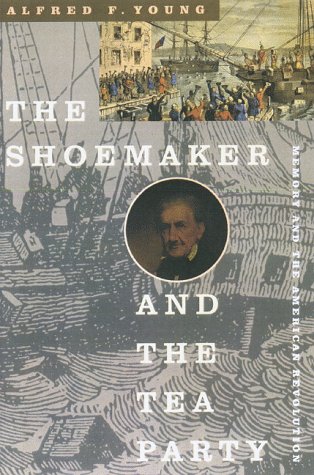
The Shoemaker and the Tea Party: Memory and the American Revolution
$28.65
by Alfred F. Young



George Robert Twelves Hewes, a Boston shoemaker who participated in such key events of the American Revolution as the Boston Massacre and teh Tea Party, might have been lost to history if not for his longevity and the historical mood of the 1830's. When the Tea Party became a leading symbol of the Revolutionary ear fifty years after the actual event, this "common man" in his nineties was "discovered" and celebrated in Boston as a national hero. Young pieces together this extraordinary tale, adding new insights about the role that individual and collective memory play in shaping our understanding of history. On December 16, 1773, some 150 men boarded three ships docked at Griffin's Wharf. Dressed as Mohawks, their faces darkened with soot, the men cracked open chests of tea and threw them into Boston Harbor. What began as a protest against the duty on tea became an icon of the American Revolution. But what did the Boston Tea Party mean to its participants? Indeed, what did the Revolution mean to the ordinary person? In The Shoemaker and the Tea Party , Alfred F. Young tells the story of George Robert Twelves Hewes, who was involved in several events in Boston during the Revolution. In 1835, when Hewes was in his 90s, he was celebrated as one of the last survivors of the Tea Party. The Shoemaker and the Tea Party comprises two linked essays. The first is about Hewes (whom Young describes as "a nobody who briefly became a somebody in the Revolution and, for a moment near the end of his life, a hero"), his memories, and what these memories reveal about the meaning of the Revolution for him. "For a moment he was on a level with his betters. So he thought at the time, and so it grew in his memory as it disappeared in his life." The second essay follows the lead of Michael Kammen and Eric Hobsbawm by looking at the dichotomies of public vs. private and popular vs. official memory, and the external forces that shape these memories into "tradition." Young does an excellent job of illustrating his theory with experiences from Hewes's life, newspaper accounts, and contemporary prints. This book will interest both scholars and general readers, though Young does presume some prior knowledge of the Revolution on the part of the reader. A thought-provoking look at the nature of memory, history, and tradition. --Sunny Delaney This brief volume manages to be two books in one: the biography of a minor figure in the American Revolution and an essay on America's collective memory of the Revolutionary era. The shoemaker in question is George Robert Twelves Hewes, who participated in the Boston Massacre, the Boston Tea Party, and other events of the rebellion. In 1835, the virtually forgotten Hewes was invited to Boston as one of the last surviving members of the Tea Party. Based on scattered archival materials, obscure printed works, and interviews with Hewes's descendants, this book offers a fascinating peek into the life of a poor man who got caught up in revolutionary fervor. Young, a senior research fellow at Chicago's Newbury Library and the author or editor of numerous books on the Revolutionary era, also presents an intriguing account of how events become "special" to a nation. The famous Tea Party, for example, was not so famous and was not even called a "tea party" until over a half-century after it occurred. Recommended for most public and academic libraries.AThomas J. Schaeper, St. Bonaventure Univ., NY Copyright 1999 Reed Business Information, Inc. George Robert Twelves Hewes was a Boston shoemaker who participated in (or perhaps observed) the revolutionary turmoil and some key events in Boston, including the Massacre and the Tea Party. After the revolution, he understandably faded into obscurity. However, the nonagenarian was "rediscovered" in the 1830s as American nationalism flowered; as a symbol of America's defining struggle, he became a source of national pride and the subject of intense interest. Young, a research fellow at the Newberry Library in Chicago, has synthesized Hewes' dictated memoirs and recollections of Hewes' descendants into a fascinating account of Hewes' life and his interaction with the great events of his youth. While Young's agenda to stress "bottom-up" history occasionally causes him to inflate the influence of some social groups, this is still a generally balanced and a very revealing portrait of a man, and the environment that influenced him and helped give birth to a nation. Jay Freeman "A wonderful model for anyone trying to reconstruct the life of an ordinary person involved in extraordinary historical events. Young's meditation on the construction of memory is extremely thoughtful and provocative. The Shoemaker and the Teaparty is a unique contribution." -- Howard Zinn, author of A People's History of the United States "Al Young has weighed into the fray of history again. As always his voice is provocative and strong." -- William Fowler, Director, Massachusetts Historical S