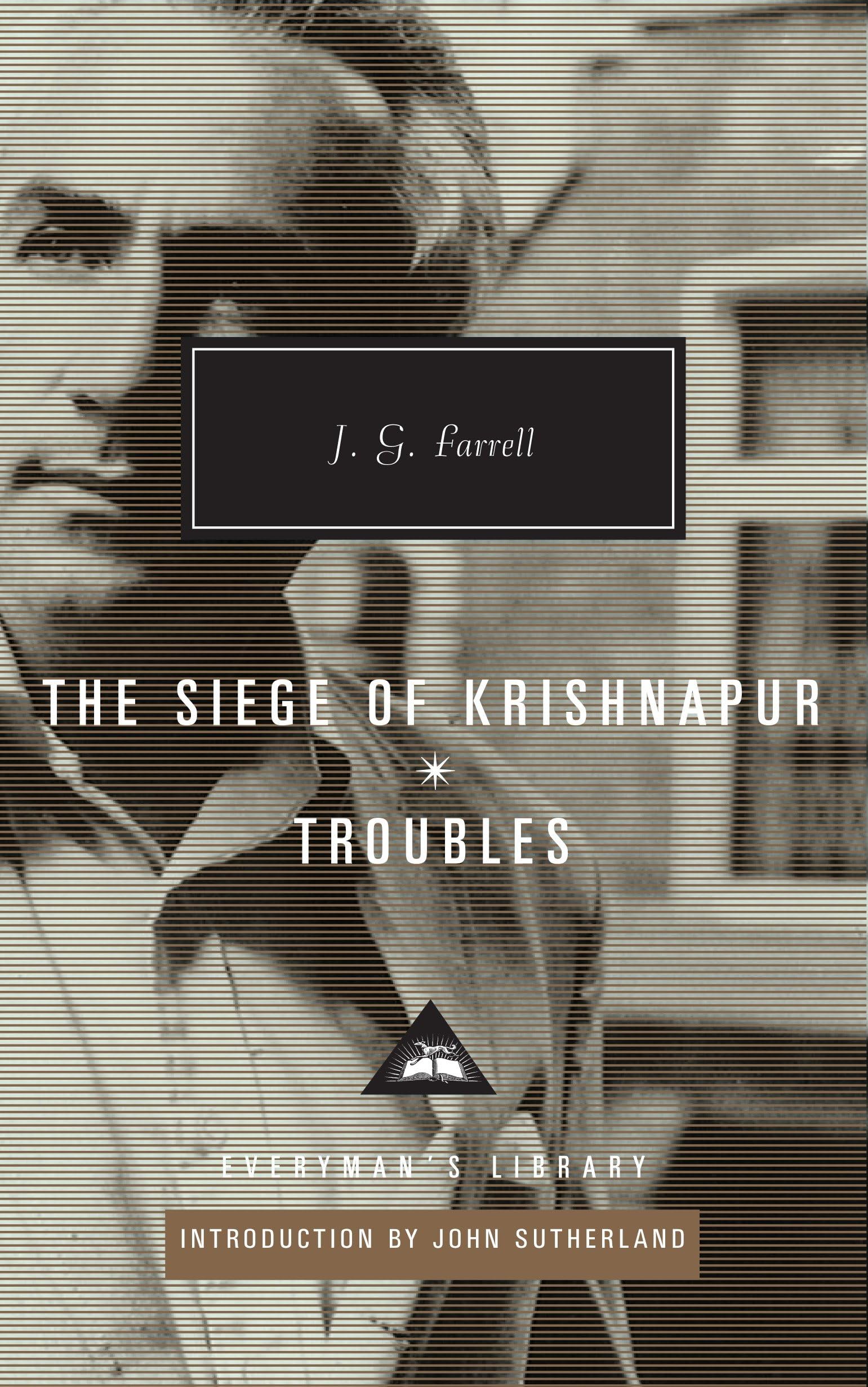
The Siege of Krishnapur, Troubles: Introduction by John Sutherland (Everyman's Library Contemporary Classics Series)
$24.54
by J.G. Farrell



Two stunning, Booker Prize-winning historical novels that vividly chronicle the crumbling edges of the British Empire in India and Ireland--in one Contemporary Classics hardcover. Inspired by historical events, The Siege of Krishnapur is the mesmerizing tale of a British outpost, under siege during the Indian Mutiny of 1857, whose residents find their smug assumptions of moral and military superiority and their rigid class barriers under fire—literally and figuratively. The hero of Troubles, having survived the battles of World War I, makes his way to Ireland in 1919, in search of his once-wealthy fiancée. What he finds is her family's enormous seaside hotel in a spectacular state of decline, overgrown and overrun by herds of cats and pigs and the few remaining guests. From this strange perch, moving from room to room as the hotel falls down around him, he witnesses the distant tottering of the Empire in the East and the rise of the violent "Troubles" in Ireland. J. G. FARRELL (1935-1979) was an Anglo-Irish novelist who grew up in England and Ireland. At the age of forty-four he was hit by a wave while fishing on the Irish coast and was washed out to sea. JOHN SUTHERLAND is the author of seventeen books on literature and language, a regular columnist for The Guardian, and an emeritus professor at University College, London. Introduction by John Sutherland From the Introduction Late in his career, in conversation with his friend Paul Barker, Farrell confided that ‘the really interesting thing that’s happened during my lifetime has been the decline of the British Empire’. The choice of epithet is tellingly unfeeling. He did not lament or rejoice in that decline. Why not? Because when things break down you see more clearly how they work. That ‘interested’ him. Unlike most other imperial powers, Britain had given up its colonial possessions without too much bloody struggle and, to be honest, something resembling relief. But for every empire in its terminal phase there is always one colonial possession which cannot, under any circumstances, be let go of. In France, as Farrell had witnessed in the 1960s, it was Algérie Française – that chunk of North Africa bizarrely designated an outlying region of ‘metropolitan France’. In England it was ‘John Bull’s Other Island’. Albion could no more part with the six counties than it could carve off Cornwall and give it to Jersey. As the 1960s ended Farrell was mature enough to handle such big themes. He was thirty-five years old, nel mezzo del cammin , in Dante’s description. He was impatient to do something worthy of his new sense of what his fiction should be. ‘When I look in the mirror,’ he wrote in a notebook, ‘I notice that I’m growing old and still haven’t done anything good. I remind myself of the main character in Chekhov’s masterly ‘‘A Dull Story’’.’ Propelled by amphetamines and a dynamic new agent, he wrote Troubles . Whatever else, it would not be a dull story. Novelists, like generals, need luck. Farrell’s chronicle of the aftermath of the 1916 Irish uprising, came out in 1970, a few months after Ulster had exploded once more into flames. Few novels have been more timely. The more so since, as Farrell always insisted, Troubles was as much about the present as the past. The novel was generally applauded for its topicality but caused much perplexity as to its tone. British soldiers and British citizens were dying. Why, it was asked, was Mr Farrell not entirely serious about this surely serious issue. The oddly comic approach – a cross between Evelyn Waugh and P. G. Wodehouse as one critic neatly put it – is very much an acquired taste. British readers had not yet acquired it and would not fully do so until the Irish flames died down a bit. Troubles is set in 1919–21. The hero of the novel, so to call him, is an English ex-Major (still addressed by that now honorary title) who, if not a military hero, did his duty in the trenches. What the Great War was all about he was never quite sure. Shell-shock has, in the medical description of the time, rendered him ‘neurasthenic’ – chronically passive. Farrell had been impressed, a couple of years before, by reading The Man Without Qualities . Musil’s use of his passive hero, Ulrich, as a reflecting surface rather than an agent had struck him as a technique to copy. As the novel opens Major Brendan Archer has come to Kilnalough, on the south-eastern coast of Ireland, to claim his bride. He has not rushed to do so. Months-long medical treatment for a post-war nervous breakdown has been required. Nor is he is entirely sure that he is actually engaged to Angela Spencer. There was a brief encounter, on leave in 1916, in Brighton. Did he propose? Did she accept? He has no distinct memory – although her letters to him during his time in the trenches make it clear that she regards him as her fiancé . Angela, once a belle , now an invalid (dying, although Archer does not know it),