The Sierra Nevada Mountains & Kings Canyon National Park: Road Log & Backcountry Geology
$34.95
by Mr. William A. Szary M.S



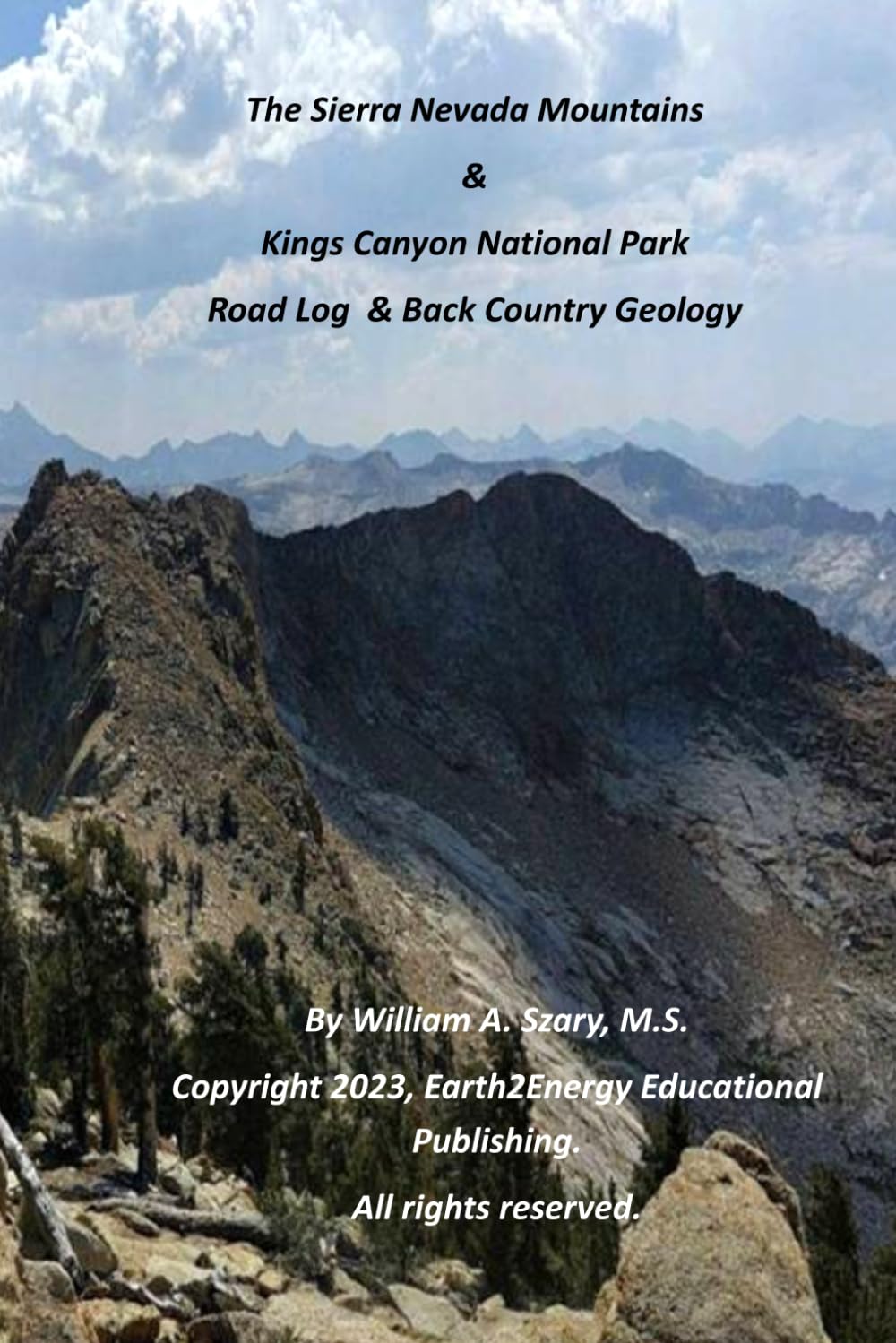
The Sierra Nevada batholith comprises the plutonic rocks of Mesozoic age that underlie most of the Sierra Nevada, a magnificent range that originated in the Cenozoic by the westward tilting of a huge block of the Earth's crust. Scattered intrusions west of the batholith in the western metamorphic belt of the Sierra Nevada and east of the Sierra Nevada in the Benton Range and the White and Inyo Mountains are satellitic to but not strictly parts of the Sierra Nevada batholith. Nevertheless, all the plutonic rocks are related in origin. The batholith was emplaced in the western margin of the North Americana plate presumably as a consequence of convergence of the North American plate with plates of the Pacific Ocean. Events that occurred along an eastward dipping subduction zone such as shifts in its position, changes in its angle of dip, the arrival of exotic terranes, and changes in the rate of subduction probably caused the episodic shifts in the locus of plutonism. No evidence has been recognized that indicates any intrusion was emplaced during a major compressional tectonic event, but some intrusions were affected by regional deformation after they were emplaced. Much of the deformation in the country rocks within and adjacent to the batholith was caused by forcible intrusion of plutonic rocks rather than by compressive regional deformation during the Nevadan orogeny. Metamorphic sedimentary and volcanic rocks are most commonly located in the western part of the batholith particulaly evident in the Boyden Cave area where metamorphic sedimentary rocks were uplifted as roof pendants during plutonic intrusion. On the eastern mountain front, metamorphic volcanics rocks with folded sedimentary rocks are also present most likely associated with fault movements along the Sierra Fault system which uplifted and tilted the batholith westward. Chapter 1 presents an introduction to the Sierra Nevada Batholith. Chapter 2 summarizes the geology of the Kings Canyon National Park. Chapter 3 discusses the regional geology of the Central Sierra Nevada Mountains. Chapter 4 presents the stratotypes of Kings Canyon, an introduction to the national park. Chapter 5 focuses on Kings Canyon National Park geology in the context of the roof pendant and terranes that make up the park. Chapter 6 covers the road logs and backcountry geology accessed by hiking trails.