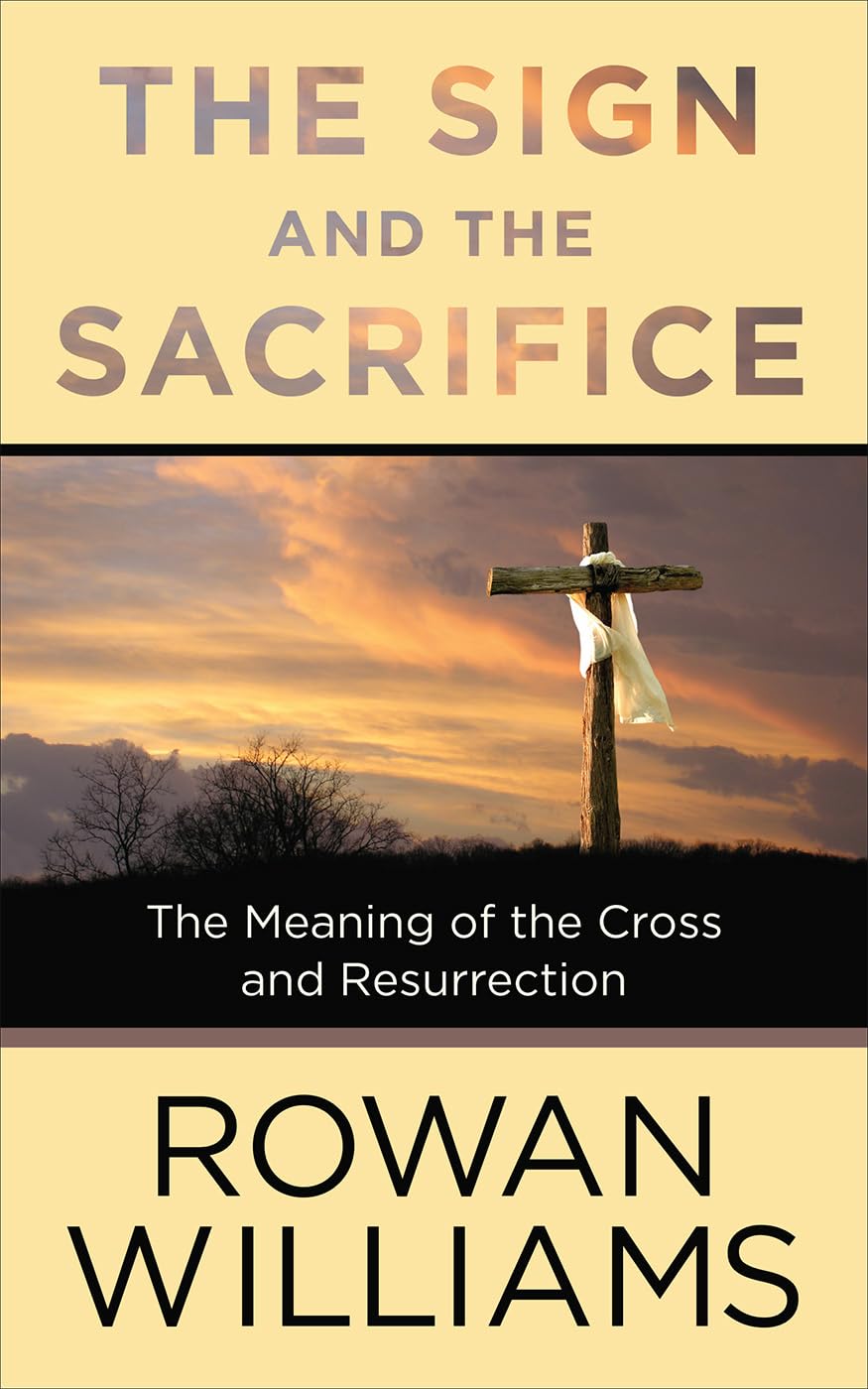
The Sign and the Sacrifice: The Meaning of the Cross and Resurrection
$10.99
by Rowan Williams



Rowan Williams, former Archbishop of Canterbury, presents the Gospel accounts of Jesus' crucifixion and resurrection as viewed through the eyes of those who witnessed them. The Sign and the Sacrifice explores the meaning of the cross and the significance of Christ's resurrection, discussing what these events meant to Jesus' followers in the early years and what they can say to us today. Rowan Williams is Master of Magdalene College, Cambridge. The former Archbishop of Canterbury, Williams is the author of numerous books, including Meeting God in Mark: Reflections for the Season of Lent and Tokens of Trust: An Introduction to Christian Belief , published by Westminster John Knox Press. The Sign and the Sacrifice The Meaning of the Cross and Resurrection By Rowan Williams Westminster John Knox Press Copyright © 2017 Rowan Williams All rights reserved. ISBN: 978-0-664-26264-8 Contents Part 1 THE MEANING OF THE CROSS, 1 The sign, 3, 2 The sacrifice, 20, 3 The victory, 39, Part 2 THE MEANING OF THE RESURRECTION, 4 Christ's resurrection – then, 61, 5 Christ's resurrection – now, 83, Epilogue: The beginning of the new creation, 100, Acknowledgements, 106, CHAPTER 1 The sign For to this you have been called, because Christ also suffered for you, leaving you an example, so that you should follow in his steps. 'He committed no sin, and no deceit was found in his mouth.' When he was abused, he did not return abuse; when he suffered, he did not threaten; but he entrusted himself to the one who judges justly. He himself bore our sins in his body on the cross, so that, free from sins, we might live for righteousness; by his wounds you have been healed. (Peter 2.21–24, NRSV) When we go into a Christian place of worship, we expect to see a cross. And when crosses are removed from public places, such as crematoria or hospital chapels, we quite reasonably get rather indignant about it. But in the world in which Christianity began, a place of worship was the last place you would expect to see a cross. We can only begin to get some sense of what it might have felt like to encounter the symbol of a cross in the first couple of Christian centuries if we imagine coming into a church and being faced with a large picture of an electric chair, or perhaps a guillotine. The cross was a sign of suffering, humiliation, disgrace. It was a sign of an all-powerful empire that held life very cheap indeed: a forceful and immediate reminder to everybody that their lives were in the hands of the state. You might well be used to seeing crosses on the outskirts of towns or by the side of the road, but most definitely not in any place of worship. When Jesus was a small boy there was a revolt in Galilee that was brutally suppressed by the Romans. We're told that there were thousands of crosses by the roads of Galilee. When in the Gospels Jesus speaks of picking up your cross and following him, he is not using a religious metaphor for things becoming a bit difficult. So a group of people who proclaimed that the sign of their allegiance was a cross had a lot of explaining to do; and so we will be looking at some of the ways in which the first Christians tried to explain themselves. Because once we get past the surface level of being used today to seeing crosses around as a religious symbol, once we let ourselves recognize what it is that we are looking at, we are bound to be faced with some of the same questions. What is this about? How does it work? Why do we have an instrument of torture at the centre of our imagination? The early Christians must have felt that they had no option but to talk about the cross. They knew that because of the death of Jesus on the cross their universe had changed. They no longer lived in the same world. They expressed this with enormous force, talking about a new creation, about liberation from slavery. They talked about the transformation of their whole lives and they pinned it down to the events that we remember each Good Friday. They couldn't get away from the cross – or so at least the New Testament seems to imply. There are in fact some New Testament scholars who try to argue that reflection on the cross of Jesus came in a little bit later. First came Jesus the charismatic teacher, the wandering prophet; first came an interest in his words rather than his deeds or his sufferings. And yet, when you read the earliest texts of Christian Scripture, not only the Gospels, it's difficult to excavate any stratum of thinking that is, as you might say, 'pre-cross'. Pretty well everything we read in the New Testament is shadowed by the cross. It is, first and foremost, the sign of how much has changed and how it has changed. Even non-Christians in the world around recognized the central importance of the cross to Jesus' early followers. The earliest picture we have of the crucifixion is scratched on a wall in Rome; it may be as old as the second century. It is a rather shoc