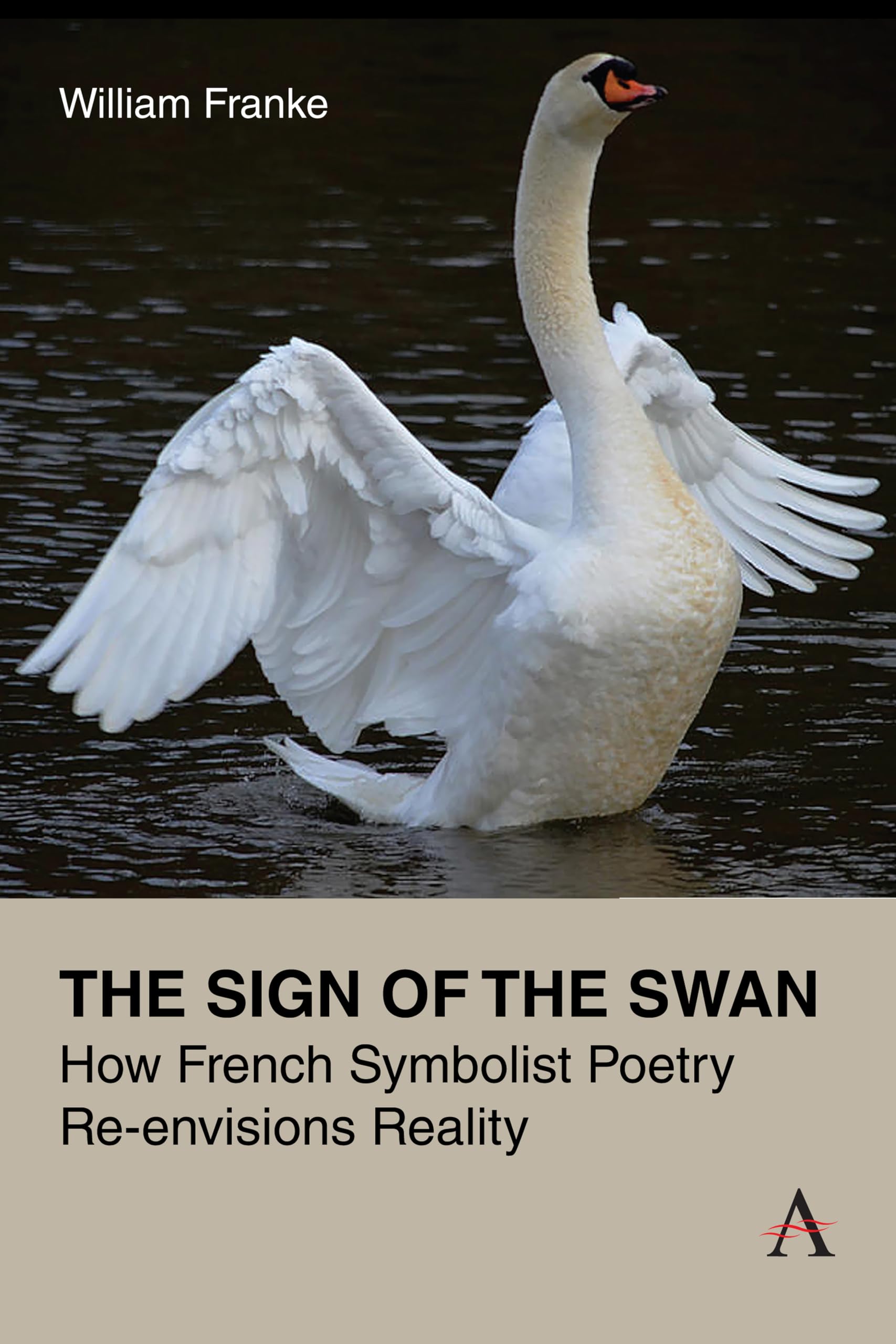
The Sign of the Swan: How French Symbolist Poetry Re-envisions Reality
$24.95
by William Franke



Offers a fresh interpretation of French Symbolist poetics, showing how Mallarmé, Baudelaire, and Rimbaud used visionary, transformative language to challenge modern secular perceptions of reality and reveal the enduring power of poetry. Despite intensive scholarly activity around its various protagonists, there is surprisingly little comprehensive attempt at critical interpretation in English of the French symbolist movement and its far-reaching purport. Most contemporary works on the topic take the form of anthologies of poetry and theory. The turn to religion, moreover, in recent decades (“post-secular” times) has opened new perspectives developed especially by Bertrand Marchal and his satellites in France, but to date without much echo in the English-speaking world. The Sign of the Swan stands out as an ambitious attempt to interpret the profound spiritual revolution wrought by this poetry in a religiously visionary key rather than as simply consonant with the general secularizing trend of art in modern times. Historically, symbolism presents itself when a need to open up other channels of meaning besides those recognized by scientific positivism comes to be strongly felt at various stages of the industrial revolution. Thus, symbolist meaning defines itself against denotative, scientific, pragmatic meaning in language. And yet an indescribable, literal rootedness of language in physiological fact is acknowledged by Mallarmé as a disappearing source of poetic creation. This irrecoverable origin can be compensated for and reconstructed by the productions of fantasy. Paradoxically, Mallarmé’s poetry exalts the pure idea and at the same time the concrete materiality of language. This book explains how this coincidence of opposites is possible. The emptiness of language resulting from its merely representing an absent object, what we may term its objective emptiness, makes it open to every sort of subjective in-pouring of contents to fill it out. What is missing on the objective side constitutes an opportunity for investment on the subjective side. It is not surprising that the symbolists discovered one of their richest symbols in the “cygne”―which not only means “swan,” but also homophonically says “sign” (“signe”). This word in French symbolist poetry, starting with Baudelaire and Mallarmé, intimates the transfiguration of the pure, blank linguistic sign, “white” like the swan, into an inexhaustible plethora of associations to be made by individuals and their subjective fantasies. The “symbol” thus becomes itself a source of perceptions, a verbal unity containing a universe. “This volume offers a lucid and intellectually bold reappraisal of Mallarmé’s poetics. It charts a distinctive path through Symbolist aesthetics and critical theory, articulating a compelling interpretive vision that reflects the depth and coherence of William Franke’s broader philosophical project.” ― Andrea Schellino, University of Louvain, Belgium; editor of the Pléiade edition of Baudelaire. “The Sign of the Swan unveils the secret life of symbols in French poetry. Through Mallarmé and his contemporaries, William Franke explores how words conjure new worlds and re-envision reality itself. He reveals how French Symbolist poetry, led by Stéphane Mallarmé, reshapes reality through language and imagination. William Franke offers a masterful analysis of the poetic interplay between image, meaning, and perception in fin-de-siècle France. A rare and precious book for now and tomorrow.” ― Philippe Beck, French poet (Grand Prix de Poésie de l’Académie française), Professor of Philosophy, University of Nantes, France; and Professor of Poetry, European Graduate School, Saas-Fee, Switzerland. William Franke is a philosopher of the humanities and a professor of comparative literature at Vanderbilt University. He is the author of over 20 books of speculative philosophy and literary criticism.