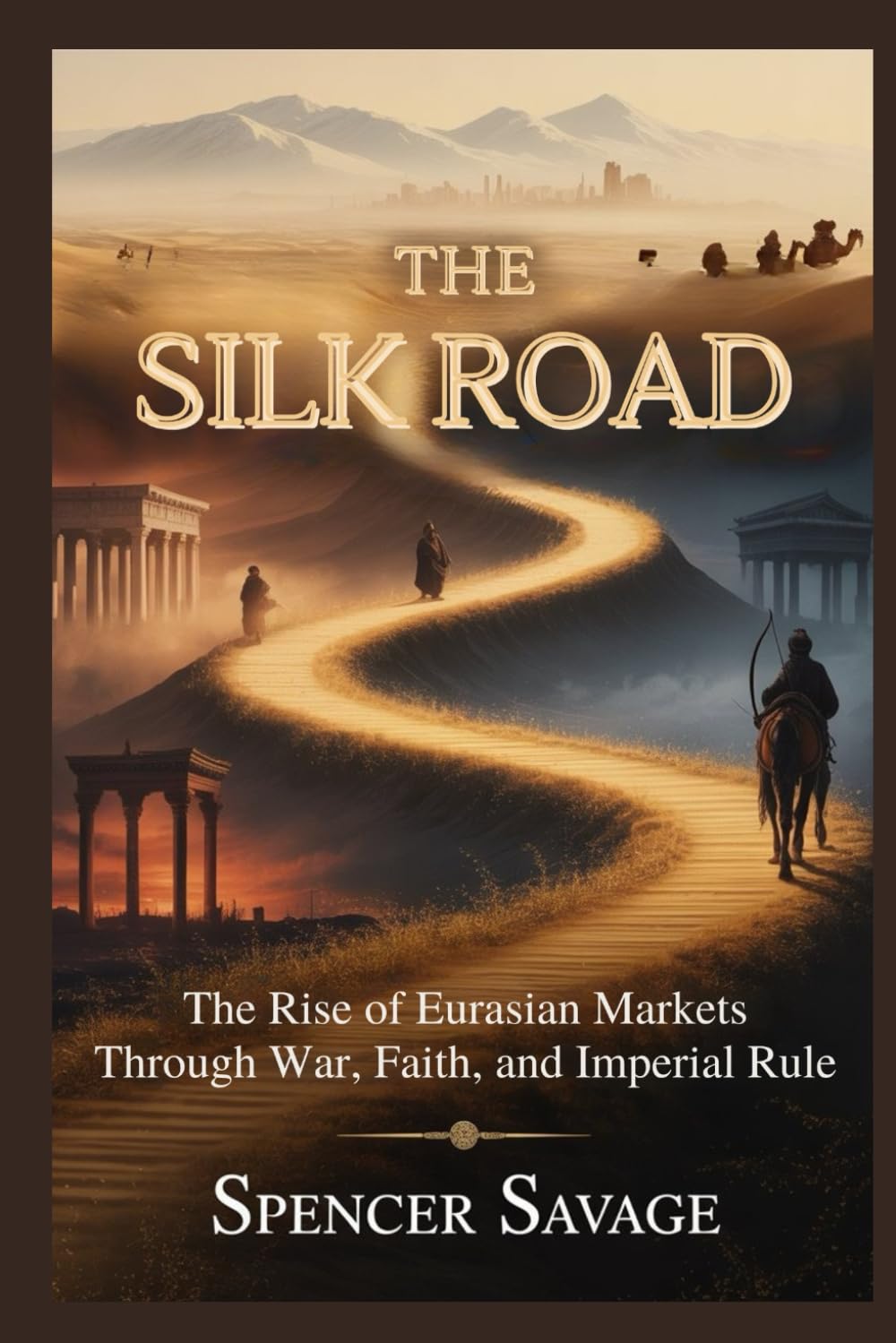
The Silk Road: The Rise of Eurasian Markets Through War, Faith, and Imperial Rule
$9.99
by Spencer Savage



The Silk Road was never just a road. It was a battlefield, a marketplace, and a bridge between worlds. What you’re about to discover will change how you see global history. This is not the familiar tale of silk drifting gently across golden dunes. It is the hidden story of military gambles, financial revolutions, religious devotion, and imperial ambition that bound Eurasia together for centuries. Few people know that the Silk Road began as a desperate strategy against nomadic raiders. From Han China’s frontier crisis to Rome’s hunger for luxury, from Buddhist monks crossing deserts to Islamic bankers reinventing finance, from Tang cosmopolitan power to Mongol unification across continents—this book reveals how markets rose through conflict, faith, and calculated control. You will uncover how: • Silk became a symbol that drained Roman silver eastward • Monasteries doubled as economic engines along caravan routes • Islamic trade law and hawala transformed global finance • Mongol postal highways connected continents at breathtaking speed The hidden truth behind the Silk Road is this: it did not simply connect East and West. It reshaped them both. Why does this matter today? Because the forces that built Eurasian markets—security, innovation, negotiation, ambition—still shape our global economy. Understanding this history reveals how interconnected our world has always been. This book is for readers who crave depth without dryness. For history lovers who want more than dates. For entrepreneurs curious about the roots of global trade. For anyone who has ever wondered how ideas, goods, and power travel across civilizations. When global tensions rise and supply chains dominate headlines, the story of the Silk Road feels more relevant than ever. It reminds us that exchange survives conquest, that faith crosses borders, and that markets grow where power and opportunity intersect. The journey begins with war. It ends with a world transformed. Ready to uncover the forces that shaped Eurasia? Click “Buy Now” and step onto the road that changed history. ⭐ ⭐ ⭐ ⭐ ⭐ Spencer Savage has written a rare kind of history book—one that is as intellectually rigorous as it is narratively gripping. The Silk Road refuses the tired romanticism of caravans and instead reconstructs the political calculations, financial systems, and religious transformations that made Eurasian exchange possible. The analysis of Han frontier policy and Islamic financial innovation is especially strong. This is serious global history written with clarity and authority. — Dr. Marcus Ellington, Professor of Eurasian History, University of Edinburgh ⭐ ⭐ ⭐ ⭐ ⭐ What impressed me most is the author's control of structure. Each empire is treated not as an isolated chapter but as part of a continuous system of movement. The sections on Tang cosmopolitanism and Mongol administrative integration are particularly compelling. Savage understands that trade thrives where law, security, and ambition intersect. This book belongs on university reading lists. — Prof. Lila Haddad, Chair of Middle Eastern Economic History ⭐ ⭐ ⭐ ⭐ ⭐ As someone who studies early globalization, I found this book deeply satisfying. It avoids clichés and instead shows how markets are built—deliberately, often violently, and always strategically. The explanation of hawala and early financial networks is one of the clearest I have read for a general audience. A remarkable synthesis. — Dr. Jonathan Reeves, Economic Historian and Author ⭐ ⭐ ⭐ ⭐ ⭐ I have taught Silk Road history for over twenty years, and I can say without hesitation that this work captures both scale and detail with rare balance. The portrayal of Buddhist monastic economies and the translation movements under Islamic rule is nuanced and precise. It reads with momentum but never sacrifices substance. — Dr. Mei-Lin Zhang, Historian of East-West Cultural Exchange ⭐ ⭐ ⭐ ⭐ ⭐ Savage restores agency to the actors who built intercontinental systems. Emperors, merchants, monks, and financiers are treated as decision-makers navigating risk. The chapter on the Mongol Yam network alone demonstrates a sophisticated understanding of administrative innovation. This is a serious contribution to popular history. — Prof. David R. Klein, Specialist in Medieval Trade Systems ⭐ ⭐ ⭐ ⭐ ⭐ I was struck by how seamlessly the narrative moves from Han military strategy to Roman consumption, then to Islamic legal refinement and Mongol unification. The transitions feel earned, not forced. It reminds the reader that connectivity is never accidental. A powerful and necessary retelling. — Dr. Farah Al-Mansouri, Scholar of Comparative Civilizations ⭐ ⭐ ⭐ ⭐ ⭐ In my years researching Central Asian political structures, I have rarely encountered a book that treats the region as a central actor rather than a corridor. This manuscript gives Samarkand, Bukhara, and the Tarim Basin the analytical weight they deserve. It is both corrective and compelling. —