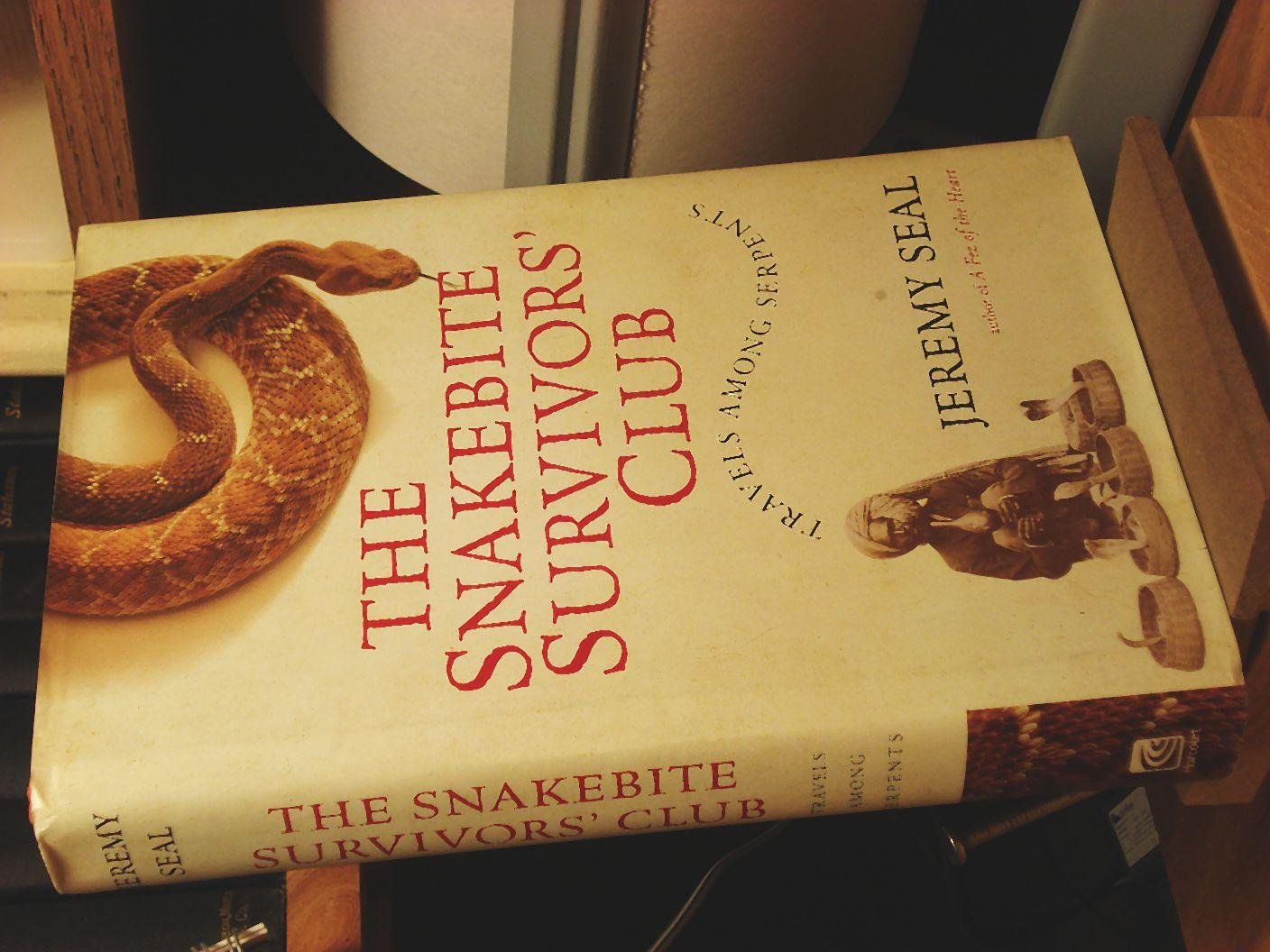



A world traveler, attempting to overcome his deadly fear of snakes, journeys to Australia, India, Africa, and America in search of the world's deadliest serpents and the people who live among them, finding a wealth of spellbinding information and experience along the way. Snakes occupy a peculiar position in the human psyche; in different cultures they have been associated with everything from birth to death, with liberal helpings of sex thrown in for good measure. Most of us are both fascinated and repelled by snakes, and Jeremy Seal is no exception. The Snakebite Survivors' Club begins with an account of how he can't bring himself to go into the reptile house at London Zoo. Being a travel writer, Seal is clearly both certifiable and able to spot good copy when he sees it, so he naturally concludes that the only solution is to set off round the world in search of as many lethal snakes and those who have survived their bites as possible. Seal's journeys through America, Africa, Australia, and India are every bit as engaging as you might expect from the man who wrote A Fez of the Heart --a book whose only failing was its badly punning title. Where Seal scores heavily is that he never becomes detached from his subject matter, unlike so many travel writers, who tend to waltz imperiously though foreign parts, affecting an intimacy they never achieve. Even when Seal is talking history, myth, or religion, he's never less than personal. Seal's interest is more than curiosity, it's phobic--and that's what makes it so compelling. Whether he's meeting the American woman who survived her husband's attempt to murder her with a rattlesnake, or the Kilifi man who survived a black mamba, or the conveniently named Dundee--the Australian who shrugged off a taipan--you can sense his subtext: "What would I have done?" and "Could I have survived?" The same feelings permeate the historical. When he retraces the steps of the first Australian to catch a taipan, you know that he's somehow expecting a snake to appear in the same place. And when it doesn't, like Seal, you are both relieved and disappointed. The Snakebite Survivors' Club is a rare mix of intelligence and whimsy, but don't for a minute think it will cure you of your fear of snakes. So if you're feeling faint-hearted, grab a copy and head for Ireland, where--legend has it--there isn't a snake in sight. --John Crace, Amazon.co.uk In his debut, A Fez of the Heart (LJ 4/1/96), Seals journeyed to Turkey in search of the symbolic hat, providing readers with an entertaining and insightful portrait of a country. In this account, Seal shares an even more unusual trek that enabled him to confront his fears of snakes, activate his imagination, and satisfy his curiosity. Visiting America, Africa, Australia, and India, Seal sought out a variety of unusual and poisonous snakes and discovered snake-related folklore, superstitions, worshipers, religious cults, and naturalists. Filled with a wealth of well-researched and entertaining information on everything from the python and mamba to the puff adder and cobra, this is as much a natural history book as a travelog. At times it will have you laughing, at others shaking your head in disgust. The only drawback is the lack of chronological order, which distracts from the flow of the book as a whole. Nonetheless, the content is excellent and proves an eye-opening read. Recommended for all public libraries. -Jo-Anne Mary Benson, Osgoode, Ont. Copyright 2000 Reed Business Information, Inc. This offbeat travelogue contains much charm and many surprises. Its ports of call are Appalachia, Kenya, India, and Australia, where snakes hold a high place, if not always high esteem, in the minds of the inhabitants. Except for Hindus in India, people fear snakes. Seal sought out the fear in traveling about each region, drolly describing the dilapidated landscapes. In America, snake handling fascinated him; it's practiced by folk taking literally Mark 16: 17-18: "And these signs will accompany those who believe: by using my name they will cast out demons; they will speak in new tongues; they will pick up snakes in their hands . . ." In Kenya and Queensland, people regard serpents as pests rather than the embodiment of Satan, but the lore of serpents' attraction, revulsion, and toxic venoms is equally rich. Seal's respectful humor in presenting the fixation on snakes carries the reader to an exotica of place and mind that modernity has passed by. Gilbert Taylor "Equal parts exotic adventure, naturalist lore, soul-baring confessional and offbeat history..." -- Publishers Weekly Feb 21, 2000 Seal's descriptions of the creatures are elegant, exotic and sensual, and he is never better than when he falls into a kind of hypnotic clarity, animating the color, shape, movement and character of his animals. He is hunter and hunted, charmer and charmed... As he flits from one part of the world to another, each new chapter sheds the last like a skin,