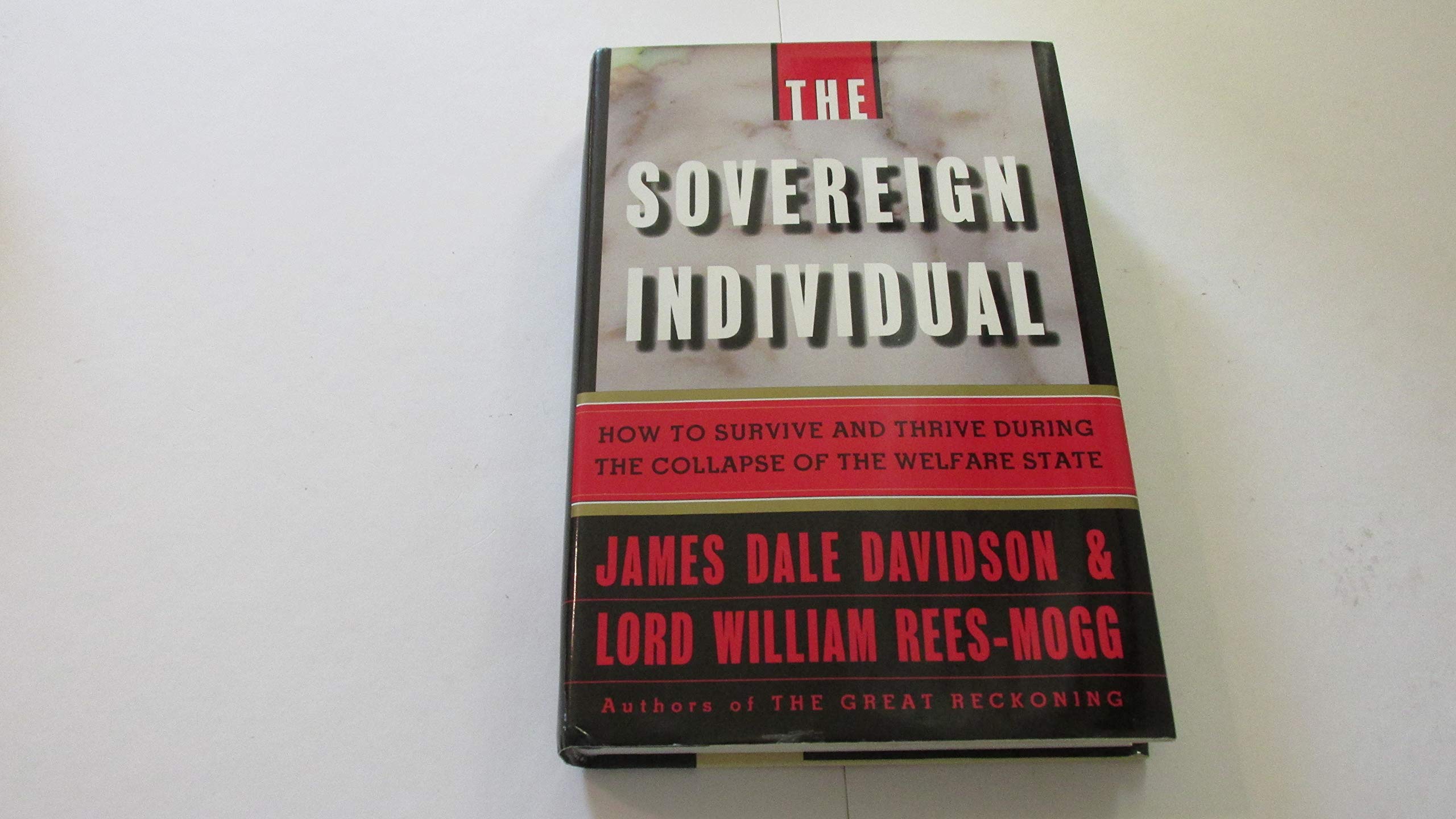
The Sovereign Individual: How to Survive and Thrive During the Collapse of the Welfare State
$75.00
by James Dale Davidson



Two investment advisors present their predictions for the coming years and outline the practical consequences of adapting to the new global economy and the information age Following up their equally visionary Blood in the Streets (LJ 5/1/87) and The Great Reckoning (S. & S., 1993), the authors offer a sweeping analysis of the implications, especially financial, of the information age. According to Jupiter Communications, a research firm specializing in emerging technologies, in the year 2000 online transactions will total about $7.3 billion, and new payment methods such as electronic money will be used for almost half of that amount. The authors explain that such developments are driving a "megapolitical" level of societal transformation similar in scope and significance to the end of the Roman Empire or the 15th-century gunpowder revolution. The key result of this information revolution will be the advent of the "sovereign individual" and the death of mass democracy and the welfare state. The authors are serious, conservative thinkers whose advice will attract attention on Wall Street. A major work; strongly recommended for academic libraries.?Dale F. Farris, Groves, Tex. Copyright 1997 Reed Business Information, Inc. Davidson and Rees-Mogg still hold out for the apocalypse. They've been sounding the alarm for more than a decade, first with Blood in the Streets: Investment Profits in a World Gone Mad (1987) and then in The Great Reckoning: How the World Will Change in the Depression of the 1990's (1991). What sets their books apart from those of other doomsayers is that a number of their specific forecasts have been accurate; it is their overwrought analysis than has gone astray. This time around they see citizenship becoming obsolete and national governments irrelevant. Violence will become more widespread and organized. In cyberspace, individual differences will no longer matter but know-how will mean everything. There will be a total transition to "the cybereconomy." The authors' warning: take cover while you can and take your money with you! David Rouse In this combination of sweeping metahistory and myopic self- interest some statements are penetrating, others appalling, and all are astonishing. Davidson and Rees-Mogg (The Great Reckoning, 1991, etc.) predict that the ``nanny state'' of the Industrial Age is about to be replaced by ``Sovereign Individuals'' in the Information Age. The growing ease of transferring assets electronically across state borders will preclude taxation (a constant source of bitter complaint in this volume), and consequently, states will cease to exist. In a decentralized environment talented individuals will act unimpeded by external authority; indeed, they will hardly need to interact with other human beings. The argument is original, and the details reflect serious thought about the social implications of emerging technology. Before following Davidson and Rees-Mogg into cyberspace, however, the reader should consider how ideological convictions shape this vision of the future. Casting the state as nothing more than an entity for waging war and with a rapacious appetite for revenues overlooks governmental functions that may be important to people not consumed with avoiding taxes. Rejecting meaningful human bonds beyond the kinship links of sociobiology and shared financial interest neglects aspects of community life that may be treasured by those not so eager to trade social responsibilities for an investor's utopia. Anticipating that widely divergent incomes in the Information Age will render democracy ``a recipe for legalized parasitism'' disregards the possibility that allegiance may rest on concerns such as legitimacy and justice. Nevertheless, Davidson and Rees-Mogg must be given their due. While wild claims (e.g., a reference to ``the poorly disguised murder of Vincent Foster'' in a vitriolic attack on the Clintons) raise questions about their objectivity, you have to respect authors who boldly state their convictions and predictions. (Author tour; radio satellite tour) -- Copyright ©1996, Kirkus Associates, LP. All rights reserved. Excerpt Chapter 1 THE TRANSITION OF THE YEAR 2000 The Fourth Stage of Human Society "It feels like something big is about to happen: graphs show us the yearly growth of populations, atmospheric concentrations of carbon dioxide, Net addresses, and Mbytes per dollar. They all soar up to an asymptote just beyond the turn of the century: The Singularity. The end of everything we know. The beginning of something we may never understand." Danny Hillis Premonitions The coming of the year 2000 has haunted the Western imagination for the past thousand years. Ever since the world failed to end at the turn of the first millennium after Christ, theologians, evangelists, poets, seers, and now, even computer programmers have looked to the end of this decade with an expectation that it would bring something momentous. No less an authority