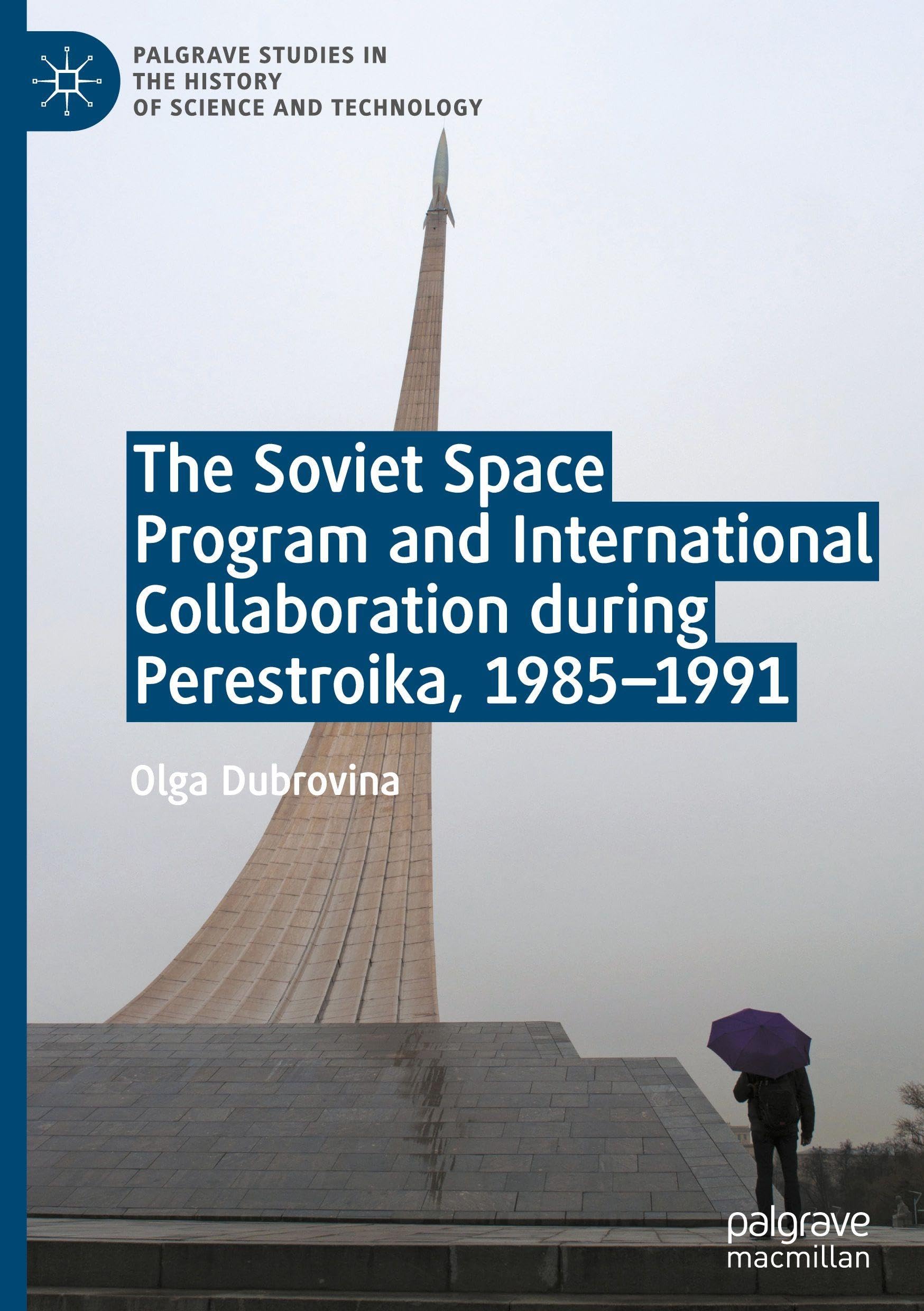
The Soviet Space Program and International Collaboration during Perestroika, 1985-1991 (Palgrave Studies in the History of Science and Technology)
$159.99
by Olga Dubrovina



This book explores the evolution of the Soviet space sector during the period of perestroika, presenting it as a revealing mirror of the broader political, economic, and social transformations that reshaped the late Soviet Union. It examines the dynamics behind the attempted transition from an authoritarian regime with a centralised economy to a democratic system and market-based economy, analysing the consequences of these profound shifts for the fabric of Soviet society. As the expansion of international scientific cooperation and the commercialisation of space infrastructure became central to changes in the field of cosmonautics, the book delves into the challenges of forging Soviet–European partnerships amid Cold War bloc divisions. It also traces the USSR’s initial steps into the emerging global market for space goods and services. At a time when space plays an increasingly vital role in our societies, economies, and foreign policy, this book is essential reading for scholars of international relations, history, and space studies. It makes a timely contribution to ongoing debates on science diplomacy and its influence on international relations and global geopolitics. “Olga Dubrovina captures a turbulent era and the complex ESA-USSR space partnership. As a reader, I strongly recommend this book.” (Lev M. Zelenyi, Scientific Director, Space Research Institute of the Russian Academy of Sciences) “‘Blessed is he who visited this world in its fateful moments,’ wrote Pushkin. Olga Dubrovina's book evokes that same blend of nostalgia, urgency, and regret. She captures a turbulent era and the complex ESA-USSR space partnership. As a reader, I strongly recommend this book and would welcome a continuation exploring Russia's dramatic post-Perestroika space journey.” (Lev M. Zelenyi, Scientific Director, Space Research Institute of the Russian Academy of Sciences) “Having lived through these turbulent years of international space cooperation, I saw firsthand how perestroika reshaped Soviet space science. This book is an important historical work, capturing the challenges faced at that time, and how determination from scientists kept international collaboration alive.” (Roger Bonnet, ESA Director of Science from 1983 to 2001) “Olga Dubrovina has produced an extraordinarily important book about an understudied aspect of the Soviet space program, the years during perestroika. As Dubrovina shows, science was an important lever of the larger political changes in the Soviet system during this crucial time. Her work is indispensable for anyone seeking to understand the source of the challenges faced by the current Russian space program.” (Asif Siddiqi, Professor, History Department, Fordham University) “Olga Dubrovina sheds light on a fascinating chapter in the history of cooperation in space between previously adverse partners during the perestroika period, 1985-1990. With great detail and profound insight, she explores the political and practical conditions which enabled a wave of short- and mid-term opportunities – paving the way for the long-term collaboration that would ultimately culminate in the creation of the largest object ever built in space: the International Space Station.” (René Pischel, Head of the European Space Agency Permanent Mission in Russia, 2009-2024) “Olga Dubrovina has produced an extraordinarily important book about an understudied aspect of the Soviet space program, the years during perestroika. As Dubrovina shows, science was an important lever of the larger political changes in the Soviet system during this crucial time. Her work is indispensable for anyone seeking to understand the source of the challenges faced by the current Russian space program.” — Asif Siddiqi , Professor, History Department, Fordham University “Olga Dubrovina captures a turbulent era and the complex ESA-USSR space partnership. As a reader, I strongly recommend this book.” — Lev M. Zelenyi, Scientific Director, Space Research Institute of the Russian Academy of Sciences This book explores the evolution of the Soviet space sector during the period of perestroika, presenting it as a revealing mirror of the broader political, economic, and social transformations that reshaped the late Soviet Union. It examines the dynamics behind the attempted transition from an authoritarian regime with a centralised economy to a democratic system and market-based economy, analysing the consequences of these profound shifts for the fabric of Soviet society. As the expansion of international scientific cooperation and the commercialisation of space infrastructure became central to changes in the field of cosmonautics, the book delves into the challenges of forging Soviet–European partnerships amid Cold War bloc divisions. It also traces the USSR’s initial steps into the emerging global market for space goods and services. At a time when space plays an increasingly vital role in our societies, economies, and foreign policy, this boo