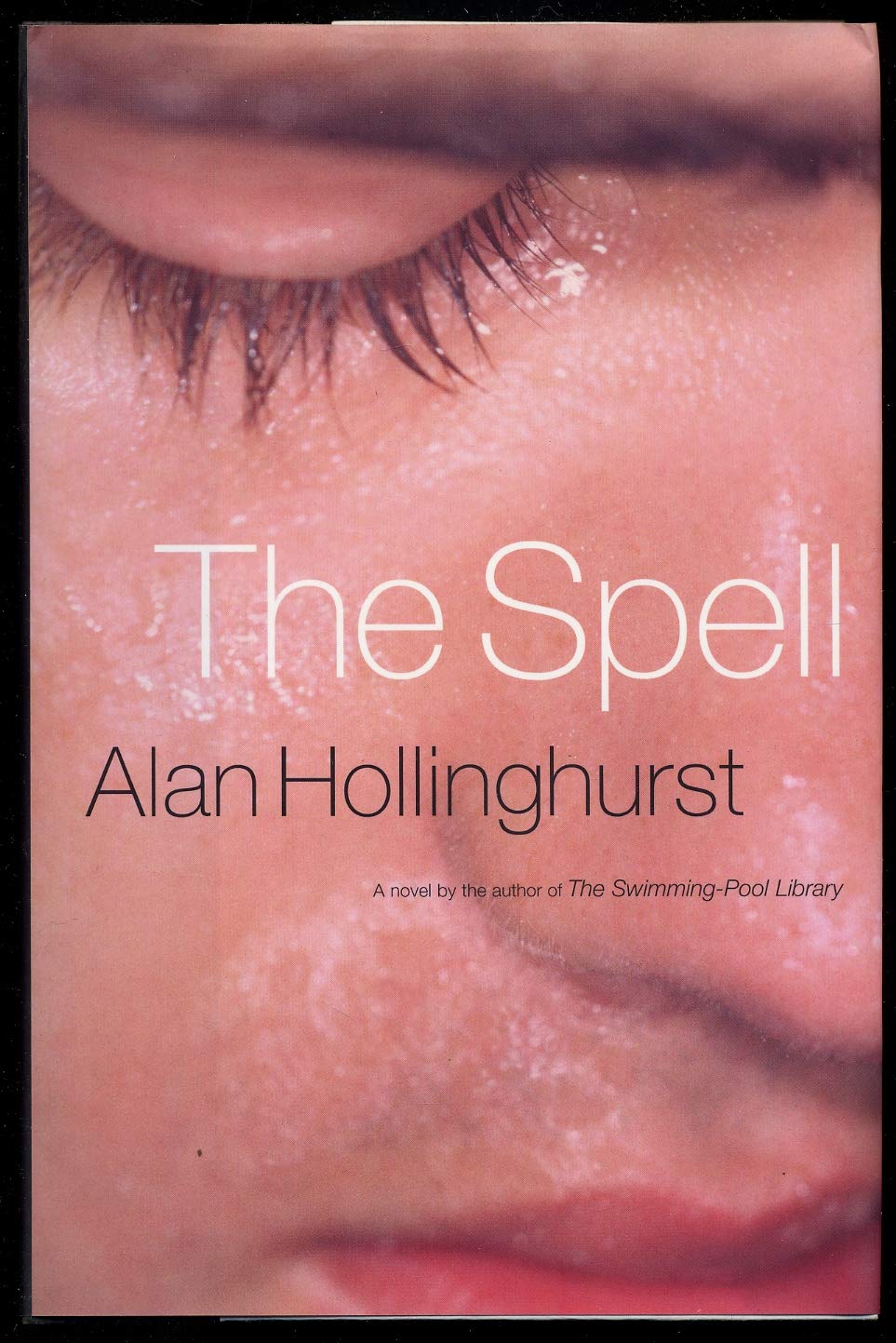



A witty study of contemporary gay life and the complex affairs of the human heart follows the interlocking passions of four different men as each falls under the spell of love or drugs, country living or urban allure. By the author of The Swimming-Pool Library. 12,000 first printing. Tour. Alan Hollinghurst writes like a dream about the nightmare of unequal affection. In his third novel, The Spell , four men dance around one another, their emotions and actions ranging from casual cruelty to anxiety to adoration. Hollinghurst's painful but smiling roundelay alternates between Dorset--where 40ish architect Robin shares a house with the impossibly self-involved Justin--and London. When Justin's ex, Alex, arrives for a weekend in the country, the atmosphere is instantly rich with jealousy and power plays. And after the trio is joined by a younger gay man, Danny--who turns out to be Robin's son--the attractions and duplicities multiply exponentially. Alex, for instance, soon admits to Danny, "I've got a ruinous taste for takers," and they (and we) are off and running. As ever, Hollinghurst's prose is musical and sensual but also deeply witty. Even the birds in this novel modulate their song from somnolent calls to outright chuckles--echoing the pleasures and absurdities of the humans they circle. And the author's feel for the easy intimacies and brutalities that his characters exchange is unmatched. As Justin (clad only in a tanga) escorts Alex around the cottage, he points out some vases: "These pots, darling, were made by potters of the greatest probity." Hollinghurst's descriptions are marvelous, whether of landscape or human frailty. After leaving a rather unrelaxed restaurant with Alex, "Danny recovered his air of bossiness and mystery, like a prefect in the school of pleasure." And when the two obtain some Ecstasy and hit one of Danny's haunts--a brilliantly realized club--the author reveals the rapture and idiocy in each moment: The boys glistened and pawed at the ground. They looked like members of some dodgy brainwashing cult.... Alex saw that what he most wanted was happening and groped marvellingly between the different kinds of happiness, the chemicals and the sex. It seemed that happening and happiness were the same, he must remember that, to tell everyone. But as amusing as Alan Hollinghurst is, his forte is loss. Again and again he reminds us that solitary sadness is a wink away from comedy and sexual possession. --Kerry Fried Set mostly in the English countryside, Hollinghursts third novel dices the complicated, jumbled lives of his four main gay characters: father and son and their new partners (who are ex-lovers). A wry novel of manners in the fashion of Jane Austens work, this novel through its omniscient point of view, exposes these stressed Londoners as they protect the ones they love (presumably each other, but certainly themselves) with small lies and little omissions. Their mixed-up relationships and compromised interests find perfect expression in the tangled garden they have no time to tend. Hollinghurst has a deft authorial hand (a game of Scrabble turns into a scene of internal fulmination and an outward display of social power). This novel firmly establishes the author after his first works: The Swimming Pool Library (LJ 9/1/88) and The Folding Star (LJ 10/1/94). Recommended for public and academic libraries and for specialized collections of gay literature.Roger W. Durbin, Univ. of Akron, OH Copyright 1999 Reed Business Information, Inc. Like The Swimming Pool Library (1988) and The Folding Star (1994), Hollinghurst's third attempts an ambitious exploration of gay male experiences and relationships. Each of four principal characters muddles along (in London and environs) professionally, socially, and romantically, in the grip of his own distinctive obsession (or ``spell''). Late-40ish architect Robin Woodfield, mourning the death from AIDS of his lover Simon, seeks another erotic counterpart to ``the secret technical joy he had always got from buildings.'' Robin's younger new lover Justin is a campy flibbertigibbet who's less attentive either to Robin or to his own ex, Alex, than to the sybaritic freedom gained when he comes into a huge inheritance. Alex, a gentle and passive soul who works for the Foreign Office, is betrayed repeatedly by his naive dream of perfect lovemost cruelly by Robin's son Danny, a heedlessly beautiful youth driven by his ``blind desire to know the world through sex.'' Moving confidently (if at times lugubriously) among their several viewpoints, Hollinghurst brings these four (and also acquaintances such as the handsome young workingman who plays them all expertly) into and out of varying degrees of intimacy and commitment, dramatized most successfully in several crisply observed scenes that include the comic saturnalia of Danny's 23rd party, a tea-party discussion of campanology (the subtext of which is, predictably, sex), and, especially, Robin's un