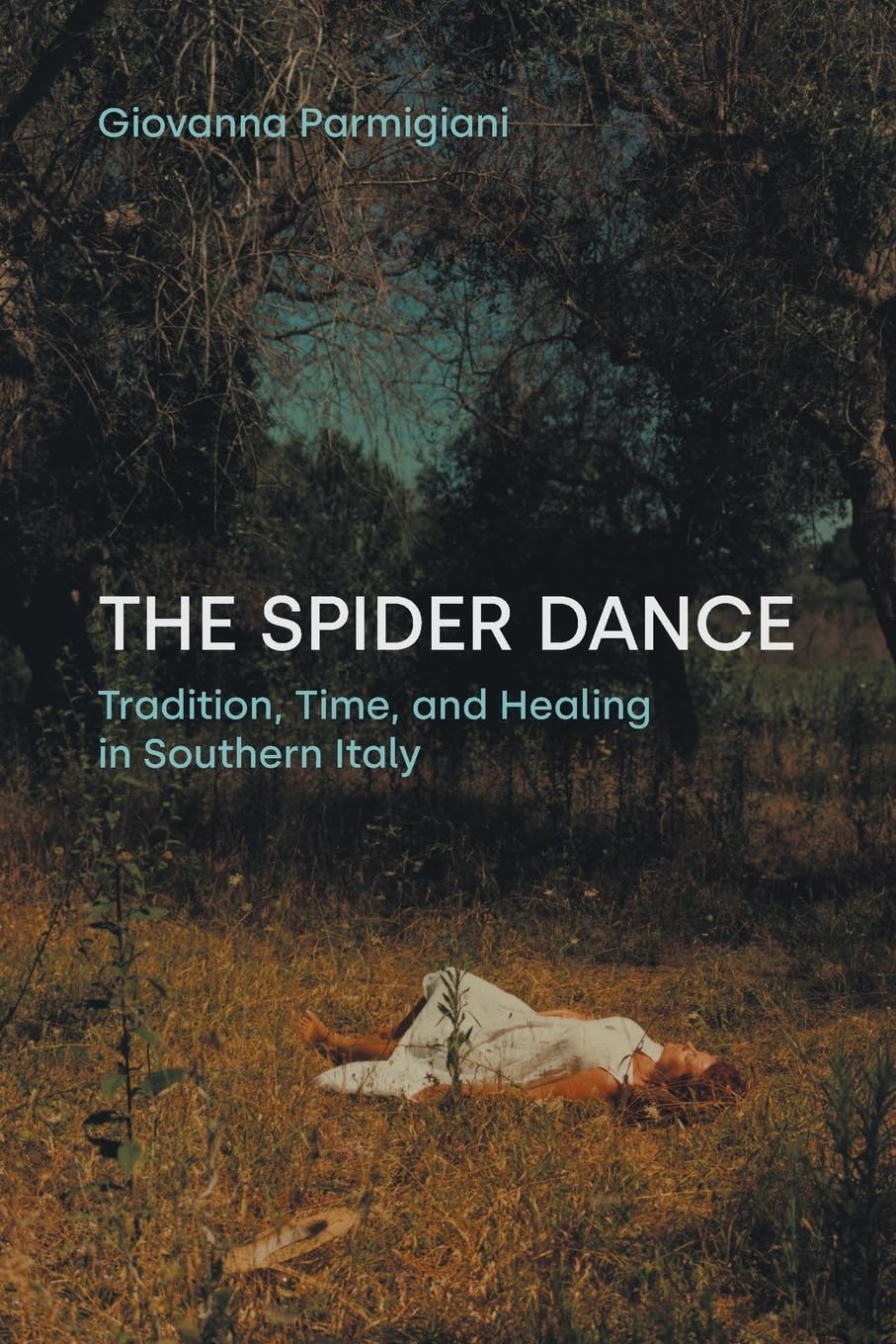
The Spider Dance: Tradition, Time and Healing in Southern Italy (Contemporary and Historical Paganism)
$34.00
by Giovanna Parmigiani



Based on ethnographic research among contemporary Pagan communities in Southern Italy (Salento, Apulia), The Spider Dance challenges (uni)linear ideas and experiences of time and temporality by showing the interconnectedness of alternative historicities, healing, and place-making among persons engaged in reviving, continuing, or re-creating traditional Pagan practices. The Spider Dance looks at local Pagans and at their ritual practice and interpretation of the traditional dance and music called pizzica. Pizzica is associated with tarantismo, a phenomenon present in that area for hundreds of years and attested until the second half of the XX century. Affecting mostly (but not only) women, tarantismo has been described in the form of malaise and physical suffering thought to be provoked by the bite of tarantula spiders and cured with pizzica music and dance. At the turn of the century tarantismo disappeared and new forms, called neotarantismi, emerged. The Spider Dance describes a novel "spiritual" form of neotarantismo and highlights its connections with contemporary forms of magic and healing. The relevance of The Spider Dance is not limited to a description of particular Pagan groups and practices. It also makes some key practical and theoretical contributions to the anthropological study of magic, of contemporary religions, of "historicities," and to scholarly debates around complementary medicine and "well-being," in Italy and abroad. Parmigiani's important and skilful ethnography on time and historicity adds a vital dimension to the study of magic, one that will certainly have wide-ranging consequences for how we understand the human mind, more-than-human worlds, consciousness, and knowledge itself. Susan Greenwood, author of The Anthropology of Magic and Magic, Witchcraft, and the Otherworld Dr. Parmigiani has written a book rich in both ethnography and theory -- a rare combination. It takes us into the heart of pizzica reclamation in the contemporary Salento, examining how creative individuals combine deeply rooted Salentine traditions with New Age and Neopagan practices, bringing traditional ontologies of time and relationality into the present. An important contribution to the ethnology of spirituality and religion in the Mediterranean. Professor Sabina Magliocco, University of British Columbia In a beautifully written autoethnography of a woman's spirituality group in southern Italy, Parmigiani challenges us to rethink how we conceive of time and the implications of that for 'being', health, and 'becoming'. The spider dance, magic, and rituals all serve as portals in her writing into another way of seeing and being in the world. This book is ground-breaking and should be read by all scholars of contemporary Paganism, women's spirituality, religion, anthropology and all who are interested in phenomenology. Helen Berger, author of Solitary Pagans: Contemporary Witches, Wiccans, and Others Who Practice Alone, Affiliated Scholar, Women's Studies Research Center, Brandeis University Giovanna Parmigiani's beautifully written and ingeniously theorized ethnography of paganism in Southern Italy carries the reader into a lifeworld where the boundaries of past, present, and future are expanded through music, magic, and dance, and bodily, spiritual, and communal well-being enhanced. Michael Jackson, author of Coincidences: Synchronicity, Verisimilitude, and Storytelling, Senior Research Fellow in World Religions, Harvard Divinity School In her superbly crafted book, The Spider Dance, Giovanna Parmigiani extends her ethnographic study of the rituals of il cerchio (the circle), a group of Pagans in Southern Italy, into a philosophical reflection on non-linear time and the "expanded present." In so doing she challenges our longstanding reliance on linear thinking and its incomplete appreciation of ritual, dance and the importance of the "expanded present" in healing practices not just in Southern Italy but throughout the world. By linking ethnographic narrative to a profound philosophical reflection on time and the nature of being, Parmigiani has produced a book that has soul, a text that will be read, debated and appreciated for many years to come. Paul Stoller, Author of Wisdom from the Edge: Writing Ethnography in Turbulent Times In this deeply researched yet wonderfully accessible ethnography Giovanna Parmigiani carries the reader along with her into the expanded present cultivated by her circle of South Italian sisters (known to some as 'witches') as they dance to pizzica music and perform practices familiar in global neo-paganism. Their expanded present folds history and destiny into a novel historicity that, to paraphrase Walter Benjamin, explodes homogeneous, empty time and fills it with meaning. Charles Stewart, University College London Giovanna Parmigiani holds a Ph.D. in Socio-Cultural Anthropology from the University of Toronto, is a Lecturer on Religion and Cultural Anthropology at Har