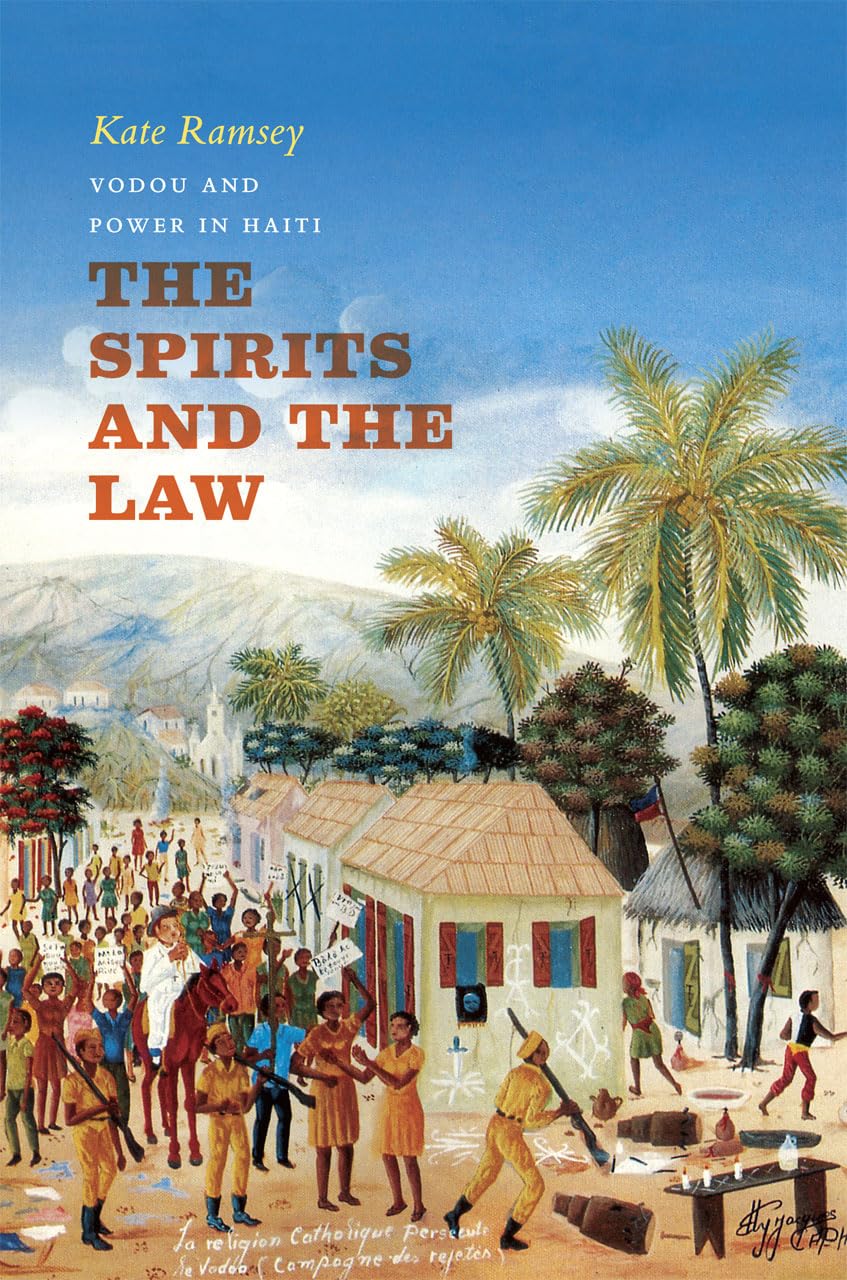



Vodou has often served as a scapegoat for Haiti’s problems, from political upheavals to natural disasters. This tradition of scapegoating stretches back to the nation’s founding and forms part of a contest over the legitimacy of the religion, both beyond and within Haiti’s borders. The Spirits and the Law examines that vexed history, asking why, from 1835 to 1987, Haiti banned many popular ritual practices. To find out, Kate Ramsey begins with the Haitian Revolution and its aftermath. Fearful of an independent black nation inspiring similar revolts, the United States, France, and the rest of Europe ostracized Haiti. Successive Haitian governments, seeking to counter the image of Haiti as primitive as well as contain popular organization and leadership, outlawed “spells” and, later, “superstitious practices.” While not often strictly enforced, these laws were at times the basis for attacks on Vodou by the Haitian state, the Catholic Church, and occupying U.S. forces. Beyond such offensives, Ramsey argues that in prohibiting practices considered essential for maintaining relations with the spirits, anti-Vodou laws reinforced the political marginalization, social stigmatization, and economic exploitation of the Haitian majority. At the same time, she examines the ways communities across Haiti evaded, subverted, redirected, and shaped enforcement of the laws. Analyzing the long genealogy of anti-Vodou rhetoric, Ramsey thoroughly dissects claims that the religion has impeded Haiti’s development. “Kate Ramsey tells a fascinating story of antisuperstition legislation in Haiti….a tour de force in the historical anthropology of Haitian vodou and the paradoxes of modernity that it so vividly manifests.” -- Andrew Apter ― American Ethnologist “Ramsey’s rich and multilayered book tells a new history of Haiti that reorients how we think politically. Both hard-hitting and revelatory, it teaches us how to understand the law writ large, its plural histories, its effects on everyday life, its ability to absorb and transform and be transformed, to command the public sphere. . . . The continued deformation of Haitian culture, the maligning of vodou—born out of the legality that might seem to deny it—is always political. In calling our attention to the relationship between dead bodies, haunting spirits, and legal authority, Ramsey guarantees a political history that is rigorous and visible—a necessary wakeup call, it is to be hoped, to a mythologized Haiti of zombies, sorcery, and witchdoctors that screens the ongoing economic greed, political guile, and sheer weight of military force.” -- Colin Dayan ― Law, Culture and the Humanities “A sophisticated investigation of how Vodou has been treated by the ruling powers of the island since the era of French colonization.” -- Matthew J. Smith ― Radical History Review “ The Spirits and the Law is a nuanced and thorough reading of a religious system that has been historically misunderstood, demonized, and criminalized. Ramsey effectively shows how Vodou’s treatment both officially and unofficially is part and parcel of a larger battle for power and self-determination from various agents that is waged locally and internationally. In her quest to reveal truths Ramsey leaves no stone unturned. What she cannot include in the main text she includes in the copious notes that could form another text in themselves. Anyone who seeks to truly “build Haiti [back] better” should make this text part of required reading, because no work will succeed in Haiti if those who go in to help refuse to understand that Haiti’s fraught and complex political history is inextricably woven with its spiritual history, a spiritual history that is not a “hindrance to progress,” as some would have us believe, but one to be respected and honored as a system that has supported and sustained Haiti against impossible odds.” -- Toni Pressley-Sanon ― sx salon “Anthropological studies of Haitian popular religion are legion, but few of them deal with its history other than to claim for it an important role in the revolution of 1791 to 1804, which ended slavery and made Haiti the Americas’ second independent state. This impressive book provides an ethnologically informed history of Vodou with a particular focus on the politics of law. In four chapters of increasing length, Ramsey deals with the colonial and revolutionary periods, the nineteenth century, the U.S. occupation from 1915 to 1934, and the debates of the following decade surrounding an emergent cultural nationalism. Ramsey’s central problem is to explain why the state only intermittently enforced the laws that criminalized popular ritual practices from colonial times until the 1987 constitution….This richly detailed and sophisticated study, supported by 150 pages of notes, extends the work of [Laënnec] Hurbon and makes an original argument about the interaction of law, culture, and development.” -- David Geggus ― Journal of Interdis