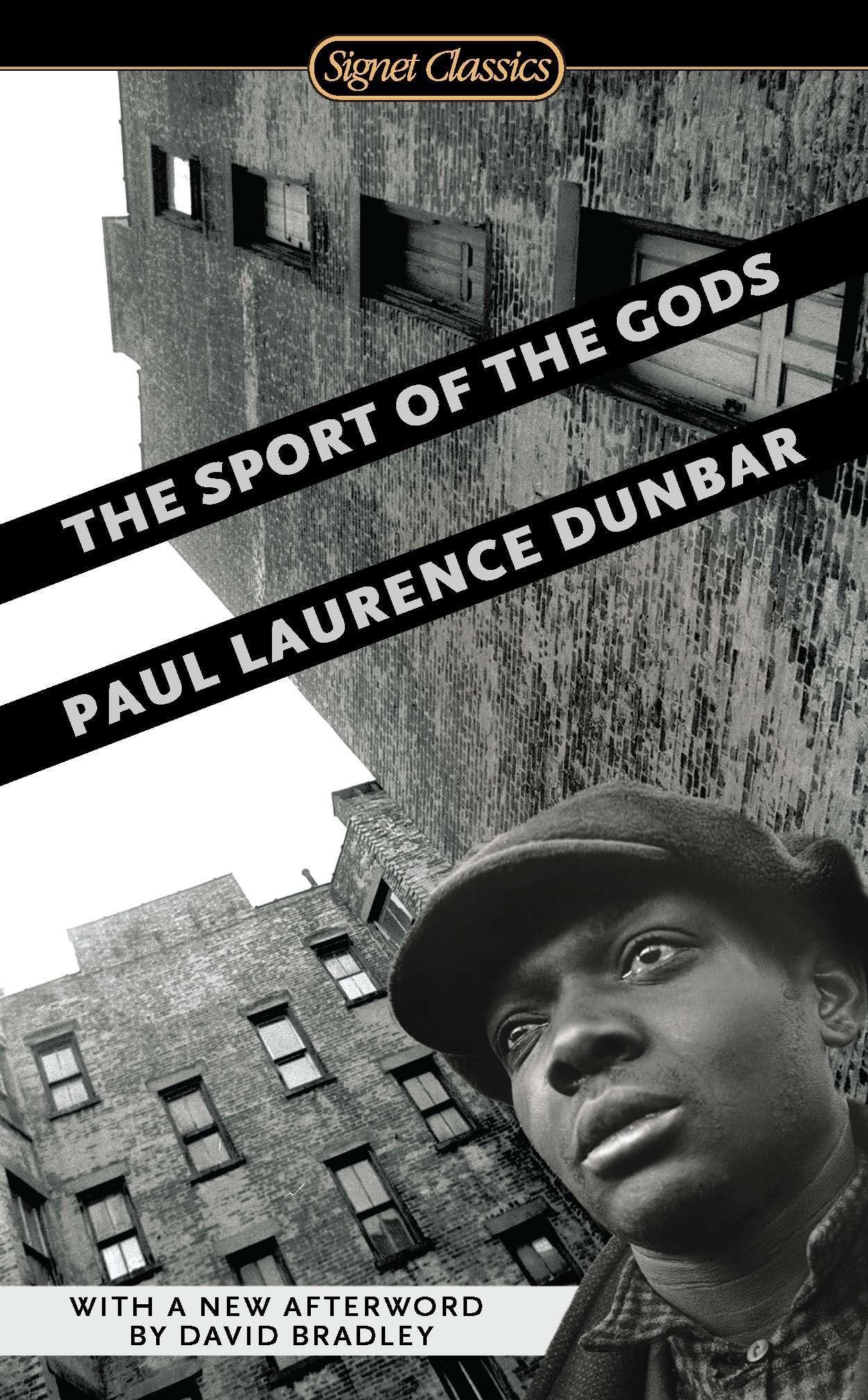



In this brilliant novel, Paul Laurence Dunbar presents a grim, ironic look at the urban black experience. The story of a displaced Southern family's struggle to survive and prosper in Harlem, The Sport of the Gods was one of the first novels to depict the harsh realities of ghetto life. "With the centennial of his death approaching next year, ''The Sport of the Gods" is both timely and necessary as the first book to compile the breadth of Dunbar's most important writings, including his short novel for which this volume is named....In these works, the stoic young man in the starched collar, as Dunbar often appeared in photographs, is a force of unbending intelligence and fiercely argued opinions. As a collection, ''The Sport of the Gods" broadens not only an appreciation of Dunbar's wide-ranging talents but underlines the wealth of potential lost when Dunbar succumbed to tuberculosis when he was only 33." -- Boston Globe "This vital repackaging of Dunbar's works, ably edited by Shelley Fisher Fishkin and David Bradley, will undoubtedly help restore his work to the stature it merits...the editors have assiduously culled fine examples of [Dunbar's] prose to supplement the poetry included here... Fishkin and Bradley's robust introductions to each section...are written in smart, accessible language...Even more valuable are the essays included here. They are indeed essential if Dunbar is to be properly assessed as a writer." -- Washington Post Book World “A star in the nation’s literary firmament . . . and the greatest African American poet before the Harlem Renaissance.”– Henry Louis Gates, Jr. “This Dunbar edition is likely to become the central one for teachers and students alike.”– Werner Sollors , professor of English literature and African and African American studies, Harvard University“This superb collection of Paul Laurence Dunbar’s writings finally brings together in one volume his essential poetry, fiction, and journalism, revealing his extraordinary talents as a writer.” – John Stauffer , professor of English and History of American Civilization, Harvard University Paul Laurence Dunbar (1872—1906) overcame racism and poverty to become one of the best-known authors in America, and the first African American to earn a living from his poetry, fiction, drama, journalism, and lectures. This original collection includes the short novel The Sport of the Gods, Dunbar’s essential essays and short stories, and his finest poems, such as “Sympathy,” all which explore crucial social, political, and humanistic issues at the dawn of the twentieth century. Shelley Fisher Fishkin is a professor of English and the director of American studies at Stanford University. An award-winning author, she is past president of the American Studies Association. David Bradley is an associate professor of creative writing at the University of Oregon, and the author of South Street and The Chaneysville Incident, for which he received the 1982 PEN/ Faulkner Award. PART ONE Poetry Introduction In 1781 Thomas Jefferson completed the first draft of what would come to be known as Notes on the State of Virginia. At inception, however, it was a collection of responses to a number of queries from a French aristocrat, Francois, Marquis de Barbe-Marbois, who served as secretary of the French legation to the United States between 1779 and 1785. Marbois' queries were wide-ranging, arising out of the science of the time, which had not yet coalesced into discrete disciplines, but instead mingled geology, geography, zoology, physiology, psychology, philosophy, biology, and botany under the rubric of "natural history," a proto-discipline that depended less on systematic investigation, and much less on experimentation, than on personal observation. Jefferson's responses, therefore, though wide-ranging and thorough, were essentially opinions allegedly supported by reason. Jefferson gave a fairly complete and accurate description of the geography, geology, flora, fauna, population, and social organization of Virginia a dispassionate, academic expression by a well-versed Man of Reason, which Jefferson purportedly was. But in the midst of his response to one query, Jefferson seemed to forget he was a member of the American Philosophical Society and became something altogether more agendaed. The query read simply: "The administration of justice and description of the laws?" Jefferson's response began, "The state is divided into counties. In every county are appointed magistrates, called justices of the peace . . ." and continued with a long and tedious summary of Virginia's statutes governing everything from landholding to marriage and naturalization. The discussion became more interesting when Jefferson explained an ongoing revision of the codes intended to remove colonial vestiges, mentioning his own proffered amendment to the revision plan itself: a proposal to emancipate Negro slaves born in Virginia once they had reached ma