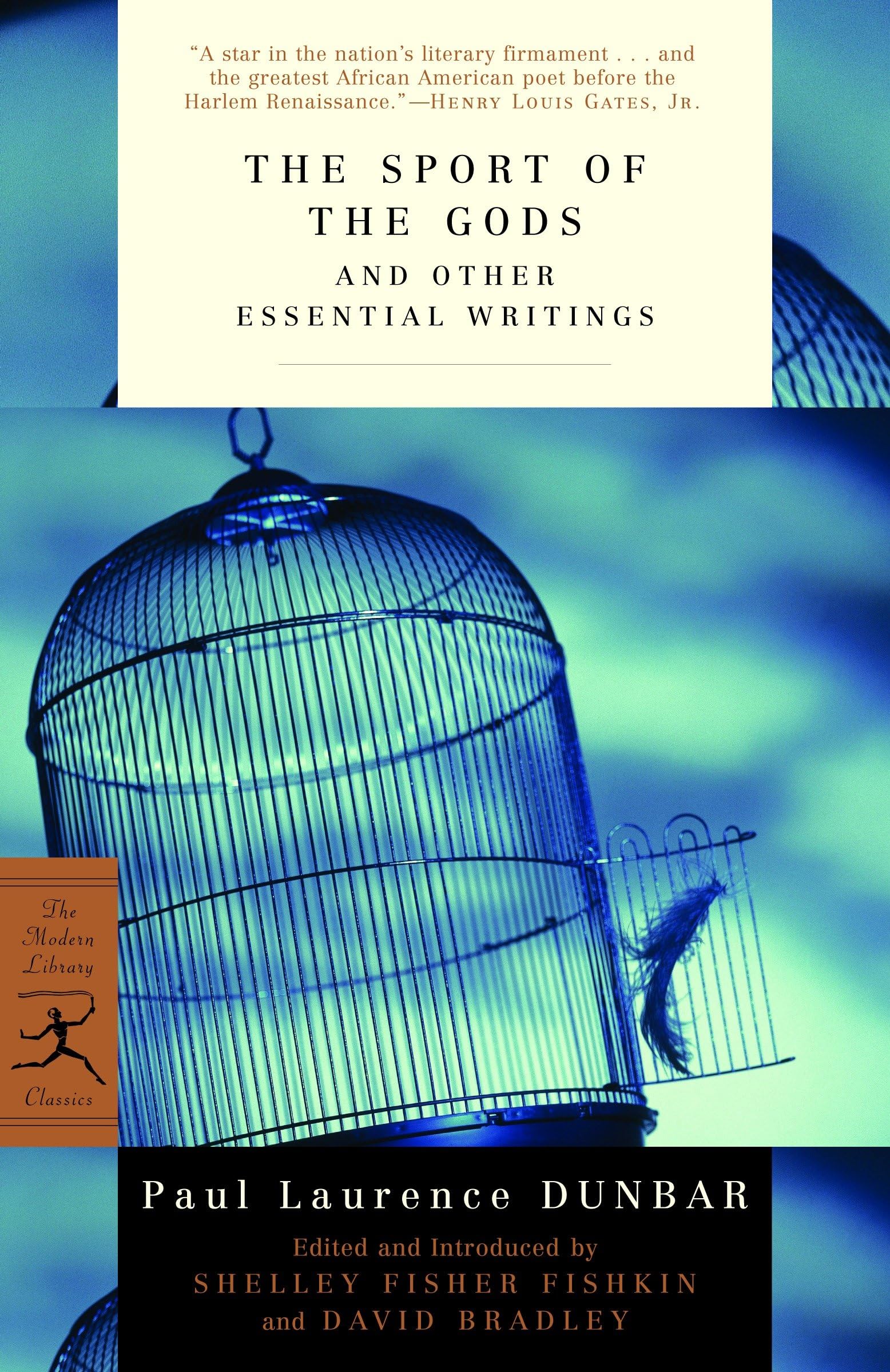
The Sport of the Gods: and Other Essential Writings (Modern Library Classics)
$14.50
by Paul Laurence Dunbar



Paul Laurence Dunbar (1872—1906) overcame racism and poverty to become one of the best-known authors in America, and the first African American to earn a living from his poetry, fiction, drama, journalism, and lectures. This original collection includes the short novel The Sport of the Gods, Dunbar’s essential essays and short stories, and his finest poems, such as “Sympathy,” all which explore crucial social, political, and humanistic issues at the dawn of the twentieth century. "With the centennial of his death approaching next year, ''The Sport of the Gods" is both timely and necessary as the first book to compile the breadth of Dunbar's most important writings, including his short novel for which this volume is named....In these works, the stoic young man in the starched collar, as Dunbar often appeared in photographs, is a force of unbending intelligence and fiercely argued opinions. As a collection, ''The Sport of the Gods" broadens not only an appreciation of Dunbar's wide-ranging talents but underlines the wealth of potential lost when Dunbar succumbed to tuberculosis when he was only 33." -- Boston Globe "This vital repackaging of Dunbar's works, ably edited by Shelley Fisher Fishkin and David Bradley, will undoubtedly help restore his work to the stature it merits...the editors have assiduously culled fine examples of [Dunbar's] prose to supplement the poetry included here... Fishkin and Bradley's robust introductions to each section...are written in smart, accessible language...Even more valuable are the essays included here. They are indeed essential if Dunbar is to be properly assessed as a writer." -- Washington Post Book World “A star in the nation’s literary firmament . . . and the greatest African American poet before the Harlem Renaissance.”– Henry Louis Gates, Jr. “This Dunbar edition is likely to become the central one for teachers and students alike.”– Werner Sollors , professor of English literature and African and African American studies, Harvard University“This superb collection of Paul Laurence Dunbar’s writings finally brings together in one volume his essential poetry, fiction, and journalism, revealing his extraordinary talents as a writer.” – John Stauffer , professor of English and History of American Civilization, Harvard University Paul Laurence Dunbar (1872--1906) overcame racism and poverty to become one of the best-known authors in America, and the first African American to earn a living from his poetry, fiction, drama, journalism, and lectures. This original collection includes the short novel The Sport of the Gods, Dunbar's essential essays and short stories, and his finest poems, such as "Sympathy," all which explore crucial social, political, and humanistic issues at the dawn of the twentieth century. Paul Laurence Dunbar (1872—1906) overcame racism and poverty to become one of the best-known authors in America, and the first African American to earn a living from his poetry, fiction, drama, journalism, and lectures. This original collection includes the short novel The Sport of the Gods, Dunbar’s essential essays and short stories, and his finest poems, such as “Sympathy,” all which explore crucial social, political, and humanistic issues at the dawn of the twentieth century. Shelley Fisher Fishkin is a professor of English and the director of American studies at Stanford University. An award-winning author, she is past president of the American Studies Association. David Bradley is an associate professor of creative writing at the University of Oregon, and the author of South Street and The Chaneysville Incident, for which he received the 1982 PEN/ Faulkner Award. "I didn't start as a dialect poet," Paul Laurence Dunbar told James Weldon Johnson in 1901. Dunbar had been a guest in Johnson's Jacksonville, Fla., home for six weeks after giving a public reading in the city. At night, Johnson would sit at Dunbar's bedside while the celebrated poet consumed his customary raw onion with salt and a bottle of beer (an antidote, he believed, to the tuberculosis with which he had been diagnosed). The two men, Johnson recalled in his autobiography, Along This Way, "talked again and again about poetry." "I simply came to the conclusion that I could write [dialect poetry] as well, if not better, than anybody else I knew of," Dunbar said to Johnson, "and that by doing so I should gain a hearing. I gained the hearing, and now they don't want me to write anything but dialect." Dunbar (1872-1906), certainly the most prominent African American poet of his day, was for at least a century after his death known primarily for that style of verse that became both his gift and his burden. The form was already out of favor by the time he and Johnson were discussing it. Johnson, himself an able poet and influential critic, concluded "that not even Dunbar had been able to break the mold in which dialect poetry had, long before him, been set by representations made of the Negro