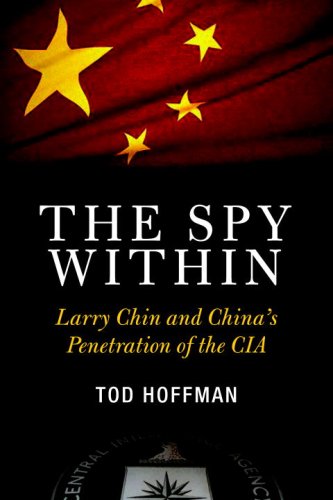



The Spy Within is the riveting true story of one of the most significant cases in the history of espionage, the longest-running penetration of an intelligence organization ever discovered. In October 1982, the FBI received notice from the CIA that was as cryptic as it was chilling: China was running a spy inside US intelligence. The CIA did not know, however, his identity, the agency he worked for, how long he had spent inside America’s secret community, or what information he was passing to China. Over the next three years, investigators labored frantically to identify the mole, to discover the secrets he had betrayed and the agents he had endangered, and to collect the evidence that would see him prosecuted for his crimes. The FBI’s expansive investigation ultimately revealed that for more than thirty years – years encompassing such pivotal events as the Korean War, the Cultural Revolution, the Vietnam War, and President Richard Nixon’s groundbreaking visit to Beijing – Larry Chin, the CIA’s own top Chinese linguist, had been China’s top spy. Chin’s reports were circulated to China’s senior leadership, read by the likes of Mao Zedong, Zhou Enlai, and Deng Xiaoping. The methods employed by the intelligence services of China’s Communist regime – methods still very much in use today even as the two nations have evolved from Cold War enemies to economic rivals – have never before been so clearly and compellingly revealed to a general audience. Tod Hoffman conducted exclusive interviews with key players in the affair, gained access to previously unreleased documents, and applied his own practical expertise as a spy-catcher to spin a captivating cat-and-mouse tale that is sure to become regarded as a classic of intelligence literature. One of several American traitors in the national security establishment who were arrested in the mid-1980s, Larry Wu-Tai Chin was convicted of espionage on behalf of the People’s Republic of China. In this reconstruction of the case, Hoffman, a writer who worked in Canadian intelligence, wends the facts adduced at trial though speculations about Chin’s rationalizations for his betrayals. Employed as a translator for three decades by the State Department and then the CIA, Chin claimed a pure motive for his spying: it improved China-U.S. relations. When laying aside his attempts to get inside Chin’s head, Hoffman turns to the main events in Chin’s downfall: an alert to the CIA of a mole in its midst; the FBI’s identification of Chin as the mole; Chin’s admissions to the FBI; and Chin’s trial, conviction, and, well, there was no sentencing because Chin committed suicide in jail. Or was Chin’s death a murder, Hoffman wonders? Sprinkling suspicions of what Chin actually passed to the PRC throughout this account, Hoffman renders a well-researched example of the Chinese approach to espionage. --Gilbert Taylor "Suspenseful cloak-and-dagger reenectmentment of the FBI sting that exposed a Chinese-American double agent in 1985.... Hoffman possesses a solid command of his material and conveys the secretive nature of espionage agencies with a novelist's panache." — Kirkus Reviews "Hoffman is a skilled writer and definitely succeeds in producing a page-turner. It is written much like a screenplay, with a lot of attention paid to describing characters, their thoughts, and their surroundings. He lets you live inside the mind of a Chinese spy, an American traitor, or a stressed and sleep-deprived FBI agent. Hoffman allows you to experience the isolation, the fear, the adrenaline, the disappointment, and the huge responsibility weighing on the shoulders of all of his characters. This book was born to be made into a great spy thriller movie ." — The McGill Daily Tod Hoffman is the author of three previous books, including Le Carre's Landscape and Homicide: Life on the Screen . An eight-year veteran of the Canadian Security Intelligence Service, Hoffman served for a period on the Counter-Intelligence: China desk. He attended the Institut d’etudes politiques de Paris and earned a master’s degree in political science from McGill University. Alexandria, Virginia, November 22, 1985 The interview was at a critical juncture, the agents knew. Control of the situation still eluded them, but they could taste it. They had successfully leveraged what little hard information they had to where he was leaning from seeking legal advice to confessing. The momentum was moving in the agents’ direction, and they weren’t about to allow it to shift . . . Larry Chin faced a conundrum. If he hoped to convince the agents of his value, he’d have to accentuate his importance. The alternative was to maintain his innocence and run the risk of learning too late that the case against him was incontrovertible. There seemed no in-between option . . . “Well, it’s a very long story.” Chin sighed. He looked Roth right in the eye as he said this. Roth, who had been mostly silent to this point, preoccupied with taking not