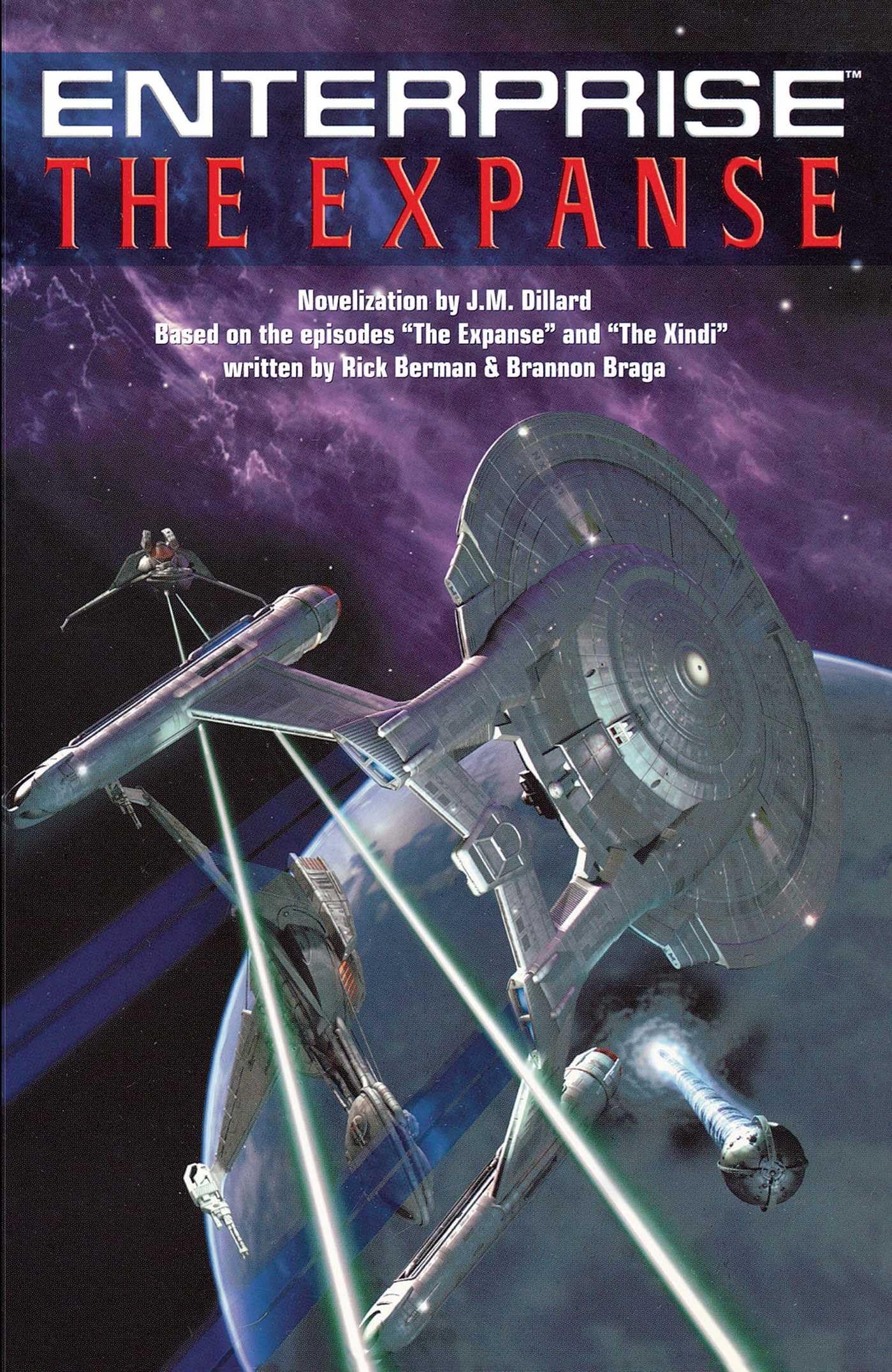



With the mindless destruction of over seven million people, Starfleet and the crew of the Enterprise must face the fact that someone is willing to destroy the Earth and all of her people. High above the planet Earth, an alien probe appears and in an unspeakably horrific instant, releases a deadly blast that strafes the planet's surface, leaving a miles-wide, smoldering crater of destruction in its wake. Millions die in Florida, Cuba, and Venezuela, their lives blotted out in a blazing millisecond. Just as swiftly, the probe implodes and crashes on the planet surface, but the remnants provide no clue as to its origin. Who are the attackers, and what provoked them? Aboard the Starship Enterprise ™, Captain Jonathan Archer learns of the destruction. His ship is called home; it is uncertain whether its mission of space exploration will continue. But before Enterprise reaches Earth, Archer is abruptly kidnapped from the bridge by the time-traveling enemies he has encountered before. He finds himself aboard a Suliban vessel, face-to-face with his old nemesis, Silik, a high-ranking individual in a battle known only as the Temporal Cold War. Silik leads him to his master, a mysterious humanoid from the far future. The humanoid claims that the attack on Earth was just a test; and the next attack will destroy Archer's home planet...unless he and the Enterprise crew stop it. To do so, they must enter a region of space called The Expanse - an area so dangerous that no ship has ever emerged from it unscathed. Vulcan crews were driven to bloodthirsty madness, Klingon crews were anatomically inverted, their internal organs exposed outside their bodies...while they still lived. Many vessels were lost, never to be heard from again. Archer faces the greatest crisis of his career: Should he believe Silik's time-traveling master, and expose his ship and crew to the perils of The Expanse, in hopes of saving Earth from destruction? And can he convince Starfleet Command and the Vulcan High Council to let Enterprise go to face her biggest challenge? J.M. Dillard grew up coddled in the wilds of central Florida. After leaving her mother’s sheltering arms, she left Florida to reside in various locales, including Washington, DC, Vermont, and Southern California. She herself now coddles a two-hundred-pound husband and two ninety-pound Labradors, all of whom are well-trained but persist in believing themselves to be lapdogs. She is the author of a plethora of Star Trek books; as Jeanne Kalogridis (her evil alter-ego), she is the author of the acclaimed Diaries of the Family Dracul trilogy, and the historical fantasy The Burning Times . Chapter 1 He was a Xindi warrior, of his culture's highest class, and out of a sense of decorum he had worn his ceremonial armor on this, his last mission, though he would not need it, and though it could not protect him from his fate. He had already attended his own death ceremony, already been honored for the heroic deed he would perform on behalf of his people, his homeworld, against the Enemy-to-come. Then, he had felt only a sense of pride. He had been accorded every pleasure, every desire: his kin were left behind with great prestige and wealth. They would build monuments to his memory. Now he sat in the Enemy's home system, at the controls of the destroyer/probe. It was a handsome craft: two concentric spheres, each as perfect as his world, each rotating within the other. It had two functions: the first, to send information to his leaders; the second, to destroy. The warrior passed through the alien solar system without difficulty, and sped toward his target: the planet where the Enemy-to-come dwelled, unaware as yet of its future crime. The world itself -- Earth, an ugly word, bitter on the tongue -- was not as hideous as the warrior had imagined, with its swirls of blue and green. There was, in fact, an odd beauty to it. For an instant, the warrior permitted himself to consider the life-forms dwelling there, on the green landforms, in the blue oceans: They were unaware of the crimes that would be perpetrated by their heirs, and therefore not guilty. The Xindi knew nothing of their culture: perhaps they were not so different from his own people. He censored the thought at once: Such reflection was dangerous, and could only hinder his mission. He slowed his vessel, and dropped down into the lower atmosphere, confident that he would not be detected, given the primitive science of the natives. He programmed the targeted area -- a peninsula and island in the western hemisphere -- into his weapon's sites. All went as he had practiced in the hundreds of simulations, yet he could not shake a feeling of displacement, of anxiety -- was it caused by his great distance from his homeworld, or was it cowardice in the face of his own demise? The ancient ceremonial armor, thicker and heavier than the sleek battle armor to which he was more accustomed, made his fingers feel thick