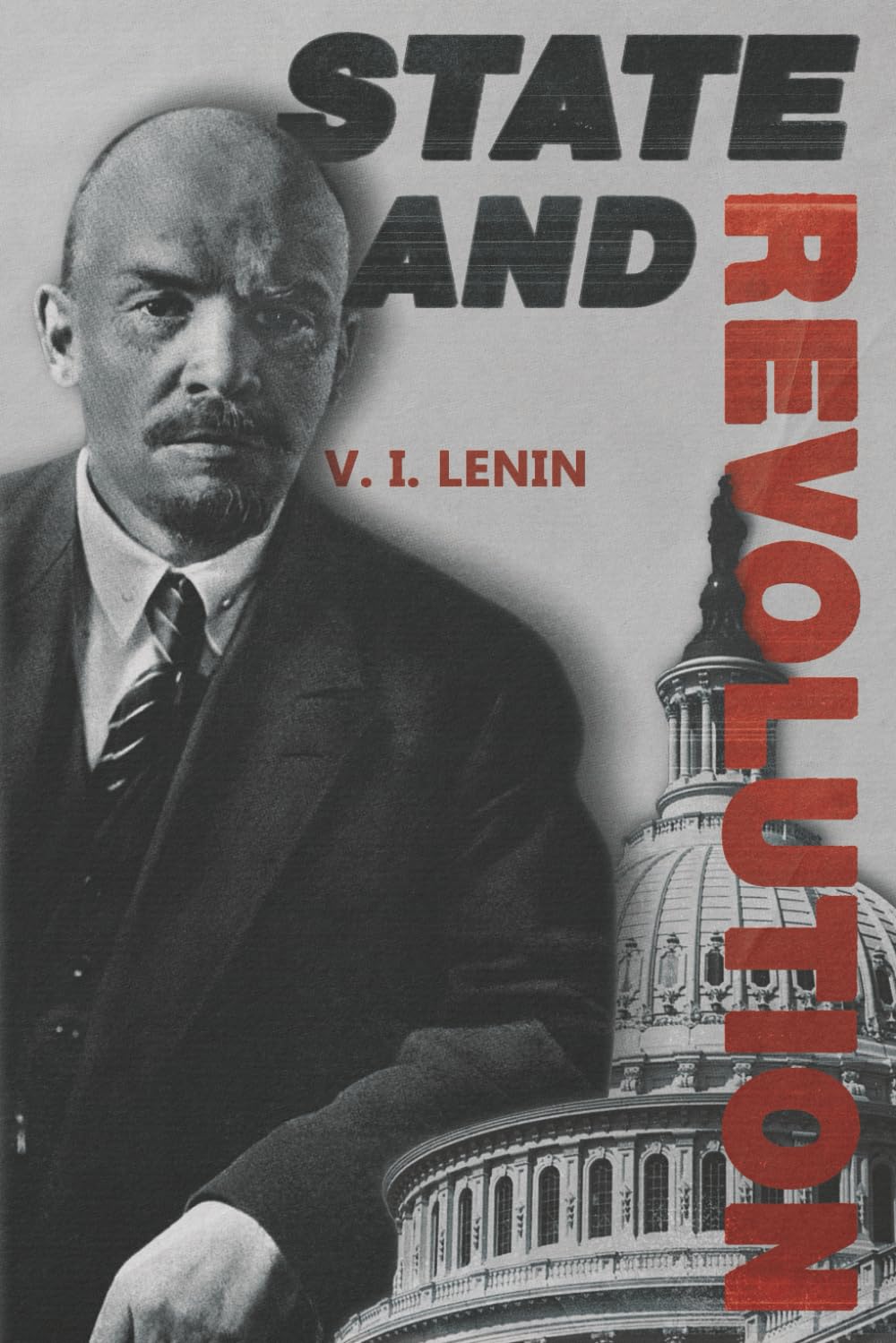



Vladimir Lenin first wrote on the need for a theoretical work addressing the question of the state in his December 1916 article, “The Youth International: A Review,” responding to Nikolai Bukharin’s “un-Marxist and un-socialist” views on the subject. He soon began preparing to write such a work, though as he collected his notes and quotations, it quickly became apparent that his critique must center on Karl Kautsky. By February 1917, he had finished compiling this notebook, “Marxism on the State.” But before he could begin writing, he was forced to postpone that work due to the outbreak of the February Bourgeois Democratic Revolution. The State and Revolution is, first and foremost, a theoretical work, a synthesis and exposition of the Marxist theory of the state. Throughout the work, Lenin emphasizes the scientific character of this theory, drawing principally on historical analyses provided by Karl Marx and Friedrich Engels of the European revolutions of 1848, the Paris Commune of 1871, and Lewis H. Morgan’s theories on early human societies. This text thus has a double utility for revolutionaries today. First, it is a tool for the ideological development of communist cadres. The Marxist theory of the state stands as one of the central pillars of Marxism-Leninism, the guiding ideology of the revolutionary proletariat. Without a firm understanding of the principles of Marxism-Leninism, there can be no hope of achieving a socialist revolution and building a communist society. Second, it is a weapon against opportunism and revisionism, which remain alive and well. Social democracy, Trotskyism, Maoism, Eurocommunism, “Socialism of the 21st century”—the list goes on. Suffice it to say that the enemies of the proletariat are numerous, and many have donned Marxist garb to steer the proletariat away from revolution. Under this guise, they advocate class-neutral conceptions of the state, promoting the illusion that we can achieve socialism from within the bourgeois state—without revolution. Yet many of these opportunists and revisionists use the same arguments today as they did a hundred years previously, arguments which Lenin tears to shreds in this work. A revolutionary must use every available tool and weapon, and this one is no exception. Today, the world once again faces catastrophe. The ongoing crisis of capitalism threatens to plunge the world into not only a renewed depression but also a renewed imperialist war, the costs of which will naturally be borne almost exclusively by the working people. If the communists are to intervene in this conflict, we must work to regroup and consolidate the revolutionary forces of this country into a new Communist Party. Too many “communists” fail to understand the lesson taught by the Bolsheviks: that only the Communist Party can lead the proletariat to revolution, and only a socialist state—backed by the Communist International—can secure the path to socialism-communism.