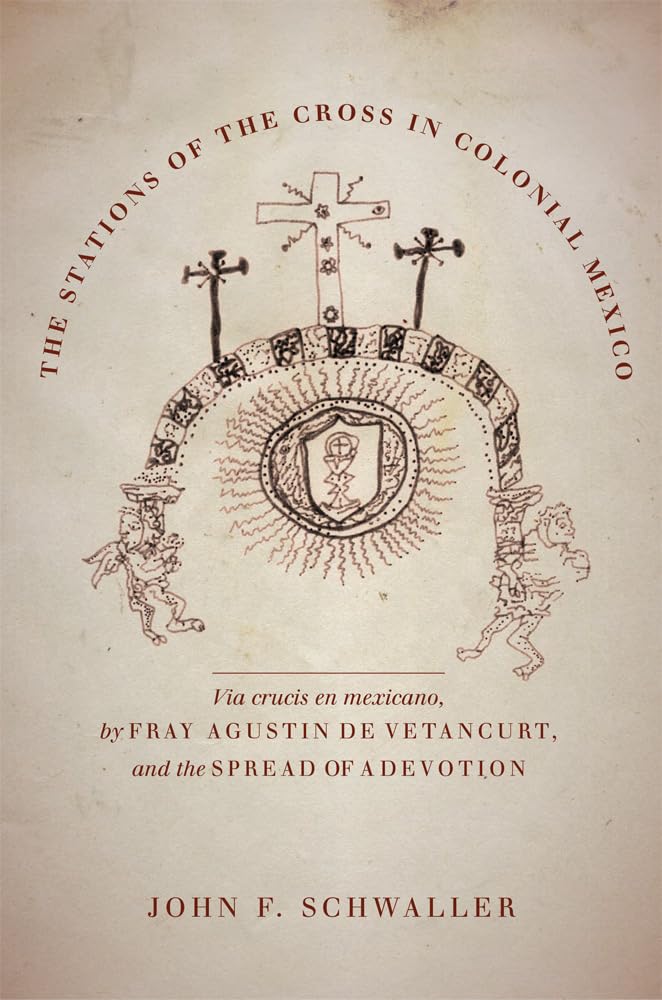
The Stations of the Cross in Colonial Mexico: The Via crucis en mexicano by Fray Agustin de Vetancurt and the Spread of a Devotion
$45.00
by John F. Schwaller



Walking the Stations of the Cross, the Christian faithful re-create the Passion, following the sorrowful path of Jesus Christ from condemnation to crucifixion. While this devotion, now so popular in the Catholic Church and many Protestant denominations, first emerged in Jerusalem and began spreading through Western Europe in the fourteenth century, it did not assume its current form, and earn the Church’s formal recognition, until almost three centuries later. It was at this time, in the last decades of the seventeenth century, that a Franciscan friar in colonial Mexico translated a devotional guide to the Stations of the Cross into the native Nahuatl. This little handbook, Fray Agustin de Vetancurt’s Via crucis en mexicano , proved immensely popular, going through two editions, but survives today only in a copy made by a native scribe from Central Mexico. Reproduced here in Nahuatl and English, Vetancurt’s handbook offers unique insight into the history, the practice, and the meaning of the Stations of the Cross in the New World and the Old. With the Via crucis en mexicano as a starting point, John F. Schwaller explores the history of the development and spread of the Stations of the Cross, placing the devotion in the context of the Catholic Reformation and the Baroque, the two trends that exalted this type of religious expression. He describes how the devotion, exported to New Spain in the sixteenth century, was embraced by Spanish and natives alike. For the native Americans, Schwaller suggests, the Via crucis resonated because of its performative aspects, reminiscent of rituals and observances from before the arrival of the Spanish. And for missionaries, the devotion offered a means of deepening the faith of the newly converted. In Schwaller’s deft analysis—which extends from the origins of the devotion, to the processions and public rituals of the Mexica (Aztecs), to the text and illustrations of the Vetancurt manuscript—the Via crucis en mexicano opens a window on the practice and significance of the Stations of the Cross—and of private devotions generally—in Mexico, Hispanic America, and around the world. “It is through publications like this one that the study of Nahuatl and Nahua culture can be moved forward. In this way it is a generous work of scholarship that will be appreciated by many.”— H-Net Reviews John F. Schwaller is Professor of History at the University at Albany (SUNY) and serves as the Latin American editor for the journal Ethnohistory . He is contributor to The Directory for Confessors, 1585 : Implementing the Catholic Reformation in New Spain .