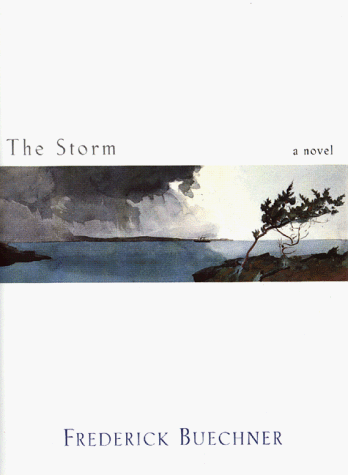



The Boston Globe calls Frederick Buechner "one of our finest writers." USA Today says he's "one of our most original storytellers." Now this acclaimed author gives us his most beguiling novel yet--a magical tale of love, betrayal, and redemption inspired by Shakespeare's The Tempest . On wealthy Plantation Island in South Florida, an old man waits, Kenzie Maxwell is a writer, a raconteur, a rascal, an altruist, a mystic--a charismatic figure who enjoys life with his rich third wife but muses daily on the sins of his past. Two decades ago, Kenzie had to leave New York because of a scandal. He'd been a volunteer at a runawat shelter, and he'd fallen in love with a seventeen-year-old girl--a girl who died while giving birth to Kenzie's daughter. His older brother, Dalton, a lawyer and board member at the shelter, decided to quell the rumors by releasing Kenzie's note of apology to the press. Kenzie's reputation--and the girl's--were destroyed. He has never forgiven his brother. Now it's the eve of Kenzie's seventieth birthday, and a storm is brewing. His beloved daughter, Bree--the child of the scandal--is coming down from New York for his birthday party. But his brother Dalton is coming down, too, to do some legal work for the island's ill-tempered matriarch. Aided and abetted by Dalton's happy-go-lucky stepson, a loutish gardener, a New Age windsurfer, a bumbling bishop, and a bona fide tempest, Kenzie must somehow contrive to reconcile with his brother--and make peace with his past. Infused with humanity, and informed by faith. The Storm is Frederick Buechner's most captivating novel since Godric --a richly satisfying contemporary story of fragmented families and love's many mysteries that will move you, make you laugh, and fill you with wonder. An island. A storm. A shipwreck. An exiled old man with a beautiful daughter--sound familiar? If The Tempest comes to mind, you're close. Frederick Buechner bases his novel The Storm on Shakespeare's melancholy last play, but adds some distinctly 20th-century twists of his own. The protagonist of this tall tale is Kenzie Maxwell, an elderly writer living off his third wife's money on an island in South Florida. Kenzie's 70th birthday is coming up, and his family starts to gather: his illegitimate daughter, Bree, comes from New York; and so does his estranged brother, Dalton--the man responsible for his leaving New York in disgrace many years before. Also along for the ride is Dalton's appealing young stepson, Nandy; Kenzie's mystical wind-surfer pal, Averill; and Calvert, the boorish gardener. Readers familiar with the play will instantly recognize who's who in this gallery of characters. Though the party gets off to a rocky start and a tempest is brewing just off shore, by the time Buechner finishes working his own rough magic, The Storm becomes a harbinger not of disaster but of reconciliation and love. --Margaret Prior A wonderfully humane and satisfying meditative romance from the Presbyterian minister and veteran author (On the Road With the Archangel, 1997, etc.). The major actions here occur on and around Plantation Island, site of an upper-class Florida resort ``ruled'' by wealthy spinster Violet Sickert. To the island has come Kenzie Maxwell, a thrice-married writer in ``exile'' following his ``scandalous'' fathering of an illegitimate child, to join his prosperous new wife Willow, her underachieving, vaguely religious 40-year-old son Averill, and Willow's live-in caretaker, the brutish Calvert Sykes (who believes he is Violet's illegitimate son). As preparations for Kenzie's 70th birthday party are shadowed by the imminent appearance of the disapproving older brother (Dalton) from whom he has long been estranged, and as a storm closes in on the island, the pattern that underlies this altogether fetching tale gradually becomes clear: Kenzie is the compromised wizard Prospero; his daughter ``Bree'' (Gabrielle) is Miranda; Averill, the sprite Ariel; Calvert, the ``monster'' Caliban; and so on. It's a fascinating set of variations on the Shakespearean source, expressed in spare, simple declarative sentences that propel the story forward with commendable swiftness. Buechner moves skillfully among the viewpoints of several major charactersthe reader is surprised by the generous shift of focus from nominal protagonist Kenzie so as to include Calvert's determination to be respected and Violet Sickert's desperate wish to be, at last, both loving and loved. All concludes with a series of funny and touching direct allusions to The Tempest (the drunken Trinculo's worship of Caliban, for instance, takes the form of a naive Bishop mistaking Calvert for a country-western singer) and a lyrical valediction declaring Kenzie's sincere affection for his family, their loved ones, and others everywhere who are ``endlessly trying, like him, to find whence they really belonged. A marvelous adaptation of Shakespeareone of the best ever. -- Copyright ©1998, Ki