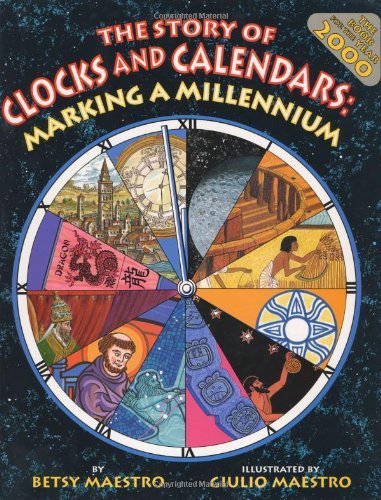



January 1, 2001, will mark the beginning of a new thousand-year period on earth. But our earth is more than four billion years old, and humans have lived on our planet for perhaps two hundred thousand years. So how can it be the year 2000? The answer is that it is the year 2000 only on the Gregorian calendar. On the Hebrew calendar, the year will be 5760. On the Muslim calendar, the year will be 1420. And on the Chinese calendar, it will be 4698. So what year is it really? It all depends on what calendar you use and when you started counting the years. Here is the fascinating story of timekeeping: how, over thousands of years, calendars and clocks came to be. 00-01 Young Reader's Choice Award Program Masterlist Notable Children's Trade Books in the Field of Social Studies 2000, National Council for SS & Child. Book Council Grade 2-5-Maestro begins with a discussion of calendars: how, when, and where they originated; the different types; and how various countries, rulers, and religions influenced timekeeping. She then discusses the passage of time marked by sundials and hourglasses, provides a general description of early clocks and watches, and brings the subject up to the present with a mention of the atomic clock. The final pages address the question of when the millennium actually begins. Maestro's writing displays its usual objectiveness and clarity. Detailed illustrations of artifacts, including the earliest-known calendars carved into bone, and colorful background scenes done in pencil, colored pencils, ink, and watercolors enhance the descriptions and add immensely to the overall success of the book. The glossary and endnotes supply additional facts about expressions, the names of the days of the week, and computers and the year 2000. The only thing lacking from this otherwise all-inclusive book is a list for further reading. Be sure to purchase more than one copy of this timely volume. Kit Vaughan, J. B. Watkins Elementary School, Midlothian, VA Copyright 1999 Reed Business Information, Inc. The year 2000 is here, or is it? As explained in this timely volume, the answer depends on which calendar you are using. Some calendars found around the globe are religious in origin, whereas others are cultural. The Gregorian calendar (the one most commonly used around the world for official business) is a Christian calendar. Examining the ancient calendars from which the Gregorian calendar grew, Maestro explores the assumptions and influences that shaped it. Did you know that March used to be the first month of the year? Or that the year 46 B.C. had 445 days? (The extra days were added because inaccurate calendars had caused the calendar year to become out of sync with the seasons.) Learn how people watched for the moon, the sun and the passing seasons to measure the years. Then move on to shorter amounts of time such as hours, minutes and seconds. Take a look at how shadows, water and sand can each be used to measure the passing of time. We also learn the story of today's clocks, which evolved in response to the need for more precise timekeeping. If you've got some time to spare, you might spend it reading this book. First, author Maestro puts things into perspective. Although it seems like a big deal to us, the beginning of the next millennium is insignificant compared with the overall age of the universe: "Our universe is probably at least twelve billion years old. A billion years is made up of one million millennia." This clear explanation typifies Maestro's ability to sort out complicated facts and make them understandable. Although the change to the next millennium is a selling point, most of the book is about the ways humans mark time, covering the Julian and Gregorian calendars, and touching on the Jewish, Muslim, and traditional Chinese calendars as well. The information will satisfy most report requests, as well as reference questions, such as how the days of the week got their names. Giulio Maestro's bright pictures are a mix of colored pencil, watercolor, and other media, and virtually all of them add more information with diagrams and labels. Most libraries will want at least one copy. Susan Dove Lempke Before beginning her career in children's books, Betsy Maestro was a teacher. Her first book with Giulio Maestro was A Wise Monkey Tale published in 1975, and since then they have collaborated on more than one hundred books. Their on-going "American Story" series began with the highly acclaimed The Discovery of the Americas and continues to help young readers understand and appreciate our nation's history. The Maestros live with two cats and a goldfish in a converted cow barn in Old Lyme, Connecticut. Used Book in Good Condition