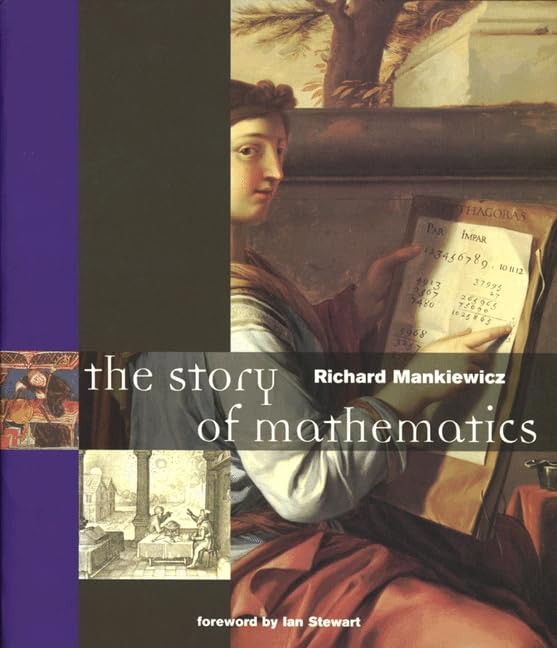



The mysterious tally sticks of prehistoric peoples and the terrestrial maps used for trade, exploration, and warfare; the perennial fascination with the motions of heavenly bodies and changed perspectives on the art and science of vision: all are testament to a mathematics at the heart of history. This visually stunning volume takes the reader on an illustrated tour of mathematics across cultures and civilizations, bringing to life a world of important ideas and-rarely supposed-great intrigue and charm. The development of mathematics can be seen in a wealth of images, from the richly illuminated manuscripts of the Middle Ages to the deeply unsettling art of Dali and Duchamp, from the austere beauty of Babylonian clay tablets to the delicate complexity of computer-generated pictures. These images, and many others, are lavishly reproduced to accompany a text that travels from the dawn of Chinese and Indian civilizations to the scientific and digital revolutions of our day. Including portraits of household names such as Kepler and Copernicus as well as lesser-known but equally compelling figures like Niels Henrik Abel and Leonhard Euler, The Story of Mathematics is a rich amalgam of history, biography, and popular science. Readers will come away understanding how and why mathematics evolved as it did--of how it entered and remained close to the center of every area of human activity. Explaining mathematical concepts without equations, Richard Mankiewicz enables us to appreciate this essential intellectual occupation without "doing the math." "The evolution of science, philosophy, and mathematics, all related, is far more important to the history of humanity than a parade of rulers and a procession of wars." Strong words, but Richard Mankiewicz comes mighty close to backing them up in his fascinating book, The Story of Mathematics . Divided into brief chapters, the book traces the development of mathematics from a baboon's fibula with 29 clearly visible notches (from Swaziland, circa 35,000 B.C.) to the Babylonian sexagesimal--or base 60--number system, which survives to this day in our method of timekeeping, to Euclid's Elements , described as "the most important textbook of all time," to fractals and other Mandelbrot sets. Along the way, Mankiewicz pays tribute to the men and women at the forefront of mathematics, though he's not afraid to dispel some myths: the Pythagorean theorem was widely known in antiquity before Pythagoras was even born, and a 14th-century Chinese manuscript clearly depicts what is now known as "Pascal's Triangle," a good three centuries before Pascal was born. Most entertaining are the chapters on practical applications of mathematics: astronomy, codemaking and -breaking, military strategy, modern art, and navigation. At times, it is difficult to follow the actual complex mathematics, but the vast majority of the book is readily accessible to the general reader. Filled with beautiful illustrations taken from ancient papyri, medieval manuscripts, scientific instruments, Renaissance painting, and computer-generated art, The Story of Mathematics is a singularly handsome volume and a pleasure to read. --Sunny Delaney Too often reduced to a catalog of formulas and numbers, or axioms and proofs, mathematics here receives the multifaceted treatment it deserves. In a text laced with beautiful illustrations and piquant anecdotes, Mankiewicz traces the rise of this profoundly human pursuit, from its earliest stirrings among tribal peoples using tally sticks to the latest speculations of theorists deploying multiphase computers. No mere diversion for specialists, mathematics here emerges as an essential tool for astronomers, a vital inspiration to artists, and a reliable guide to policymakers. The magic of numbers has enchanted Michelangelo and Blake, as well as Pythagoras and Einstein. In recent decades, mathematics may even deserve credit for averting Armageddon by confronting national leaders with sophisticated game theories demonstrating the futility of nuclear war. Inevitably, some episodes will mystify the uninitiated. (Four-dimensional fractals?) But no book could do more to draw general readers into an enterprise of unexpected splendors and surprising possibilities. Bryce Christensen Copyright © American Library Association. All rights reserved "Mankiewicz spins engaging yarns about topics that range from ancient Chinese theorems to computer age fractals in this gorgeously illustrated history. Surprisingly lucid explanations of the most complex computations make this a perfect gift for both math-philes and math-phobes." ― Discover "For personal reading and for enrichment . . . this book is great! Visually, conceptually, and textually, it draws the reader into a better understanding and appreciation of the history of mathematics. . . . Although the text is succinct, many instances in the narrative offer more insights into the development of mathematics than are found i