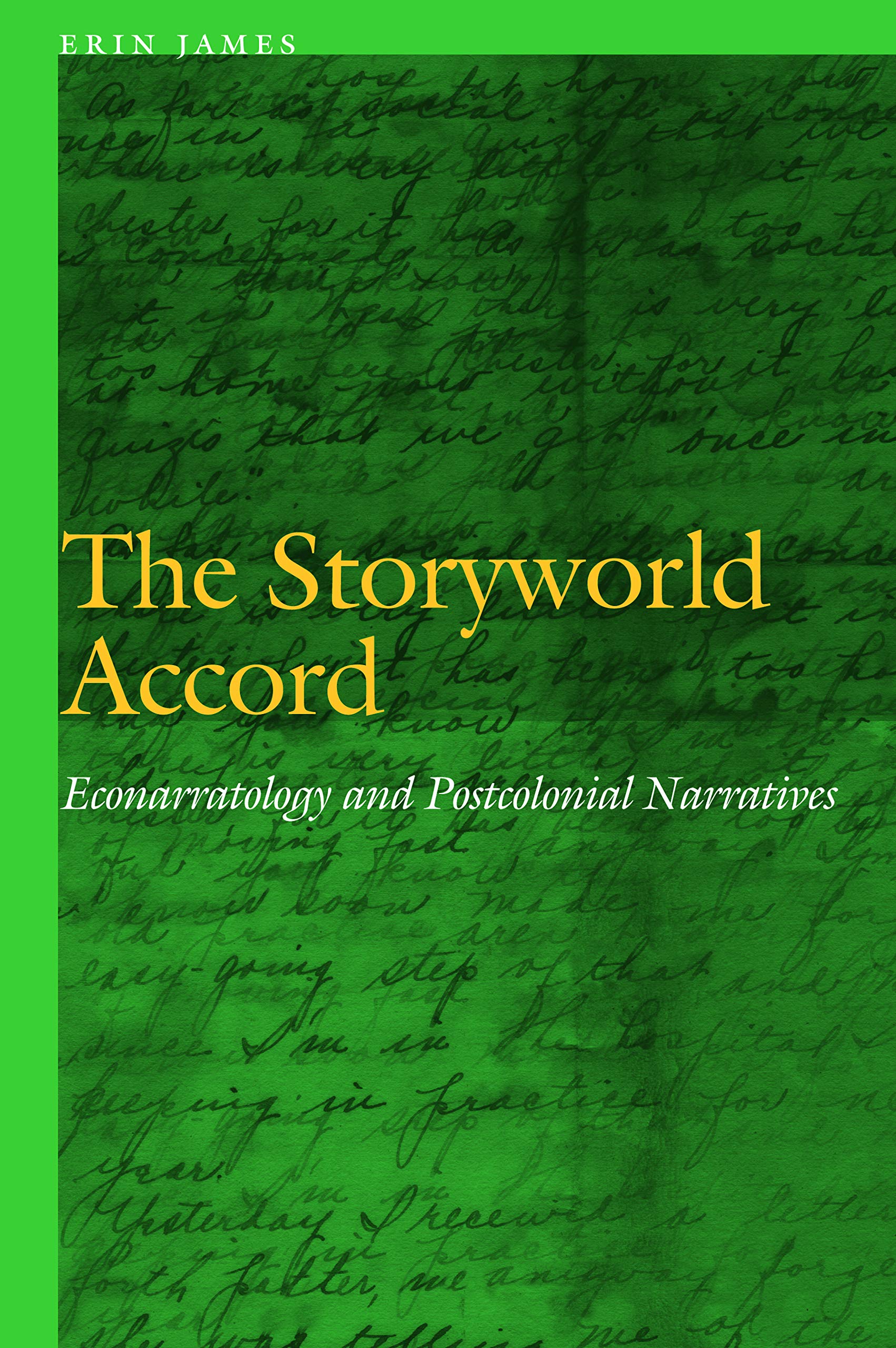
The Storyworld Accord: Econarratology and Postcolonial Narratives (Frontiers of Narrative)
$35.50
by Erin James



“Storyworlds,” mental models of context and environment within which characters function, is a concept used to describe what happens in narrative. Narratologists agree that the concept of storyworlds best captures the ecology of narrative interpretation by allowing a fuller appreciation of the organization of both space and time, by recognizing reading as a process that encourages readers to compare the world of a text to other possible worlds, and by highlighting the power of narrative to immerse readers in new and unfamiliar environments. Focusing on the work of writers from Trinidad and Nigeria, such as Sam Selvon and Ben Okri, The Storyworld Accord investigates and compares the storyworlds of nonrealist and postmodern postcolonial texts to show how such narratives grapple with the often-collapsed concerns of subjectivity, representation, and environment, bringing together these narratological and ecocritical concerns via a mode that Erin James calls econarratology. Arguing that postcolonial ecocriticism, like ecocritical studies, has tended to neglect imaginative representations of the environment in postcolonial literatures, James suggests that readings of storyworlds in postcolonial texts helps narrative theorists and ecocritics better consider the ways in which culture, ideologies, and social and environmental issues are articulated in narrative forms and structures, while also helping postcolonial scholars more fully consider the environment alongside issues of political subjectivity and sovereignty. "An ambitious and timely project."—Marco Caracciolo, Diegesis: Interdisciplinary E-Journal for Narrative Research " The Storyworld Accord is at the forefront of exciting new developments in ecocriticism and narratology."—Astrid Bracke, Green Letters: Studies in Ecocriticism Published On: 2017-02-20 “ The Storyworld Accord is ultimately a work of postcolonial literary study, and it very effectively grounds postcolonial work in an econarratology that reads stories and their worlds as opportunities to foster communication and understanding across diverse populations with differing social and environmental experiences.”—Eric Otto, author of Green Speculations: Science Fiction and Transformative Environmentalism Published On: 2014-09-18 Erin James is an assistant professor of English at the University of Idaho and has published essays in the Journal of Commonwealth and Postcolonial Literature , Journal of Narrative Theory , The Bioregional Imagination , and Teaching Ecocriticism and Green Cultural Studies . The Storyworld Accord Econarratology and Postcolonial Narratives By Erin James UNIVERSITY OF NEBRASKA PRESS Copyright © 2015 Board of Regents of the University of Nebraska All rights reserved. ISBN: 978-0-8032-4398-9 Contents Preface: "Another Place Entirely", Acknowledgments, 1. Toward Econarratology, 2. Space and Counterpersonal Narration in Sam Selvon's A Brighter Sun and The Lonely Londoners, 3. Rotten English and Orality in Ken Saro-Wiwa's Sozaboy, 4. Sight and Bodies in V. S. Naipaul's Indian Travelogues, 5. National Myths and Ontological Boundaries in Ben Okri's The Famished Road Trilogy, 6. Toward Storyworld Accords, Notes, Glossary, Works Cited, Index, CHAPTER 1 Toward Econarratology When Thursday Next transports herself to the world of Jane Eyre in Jasper Fforde's novel The Eyre Affair, the environment in which she finds herself does not surprise her. Born and raised in England—albeit a fictional, fantastic version of England that boasts pet Dodo birds and Prose Portals—Next is comfortable with the color she sees washing from the scene, the shape of the country lane stile, and the image of the rising moon. Indeed, she immerses herself in the "starkly beautiful landscape" of rural Victorian England with much ease, so much so that we might say she shares a certain environmental imagination of this space and time with the narrating Jane (66). Yet not all imaginative transportations to storyworlds are this easy, nor are all storyworlds built upon models that align so closely with readers' preconceived notions of what an environment looks and feels like. Imagine if Next had visited a Frank Herbert museum and read a passage from Dune (1966) instead of Brontë's Jane Eyre. Instead of modeling mentally the familiar shape, texture, and placement of a country lane stile and the color of a British sunset, Next would be tasked with modeling a world more than twenty-one thousand years in the future in which computers are prohibited, battles are fought over the life-extending "spice" melange, and giant sandworms roam the high desert. Or take, for that matter, readers of Fforde's text, who must model mentally a world that includes an independent Welsh republic and garden-invading mammoths to interpret Next's story. Fforde's readers then must simulate Next's understanding and experience of Jane's world as they read about Next reading abou