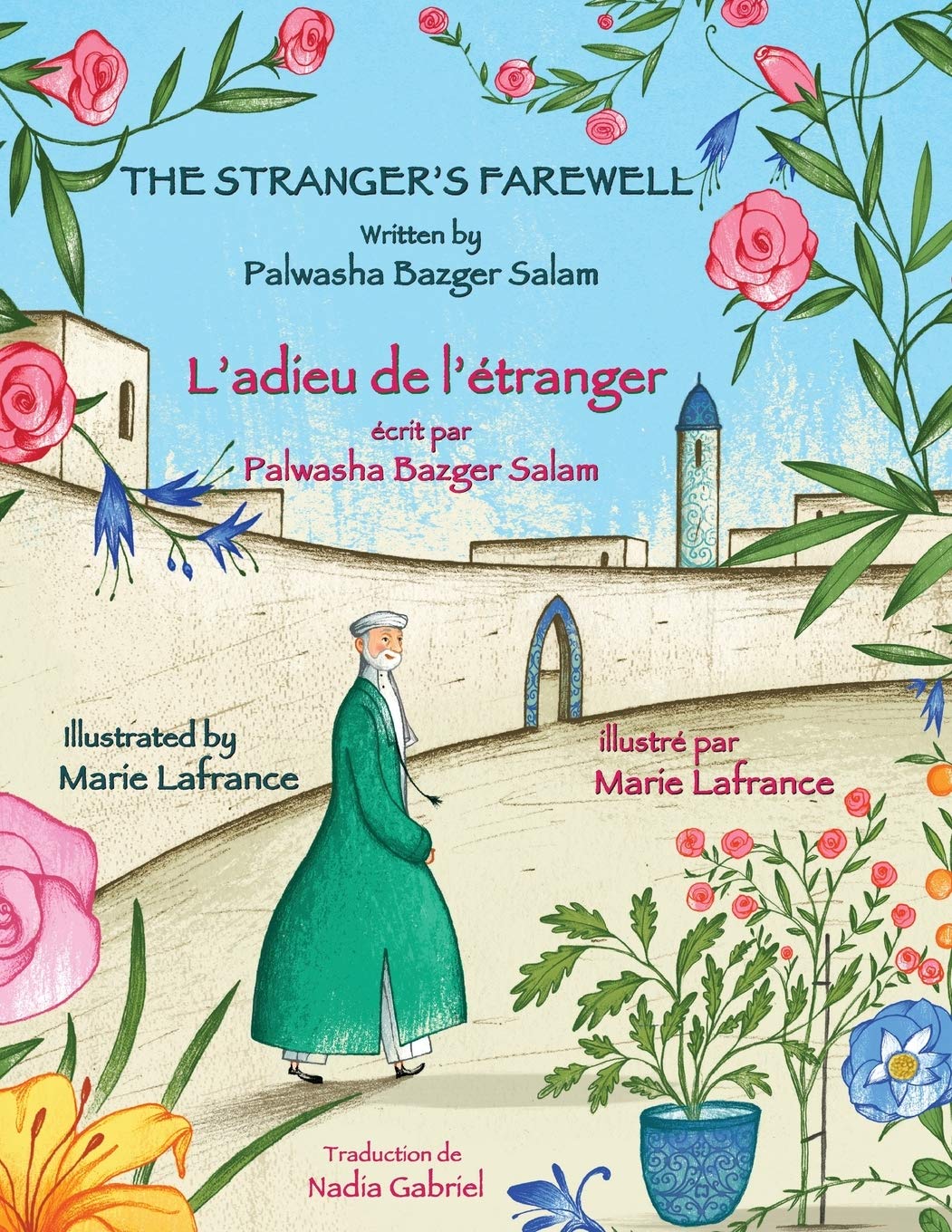
The Stranger's Farewell - L'adieu de l'étranger: Bilingual English-French Edition - Édition bilingue anglais-français (Teaching Stories)
$11.90
by Palwasha Bazger Salam



(Bilingual English-French edition) This timeless story has entertained people all over the world for hundreds of years. When a stranger who has been traveling for many days stops at the home of a young couple to ask for a glass of water and a place to rest, they make him welcome and invite him to share their meal. As we all know, small actions sometimes have large consequences, and this one did. As the stranger leaves to go on his way, he says, “May the next thing you do last until you say ‘Enough.’” These parting words reward the couple’s generosity in an amazing way. News of their changed status travels fast and prompts a greedy merchant to seek out the stranger in the hope of gaining a similar reward for himself – but, of course, the result for him is very different. This tale can teach us – in a very accessible way – something about the nature of giving and receiving. Its setting – Afghanistan, where the story is widely known – introduces children to a culture and a people that may be unfamiliar to them. The tale is retold here for young people by the Afghan storyteller and teacher Palwasha Bazger Salam, and is beautifully illustrated by Marie Lafrance. Cette histoire intemporelle a diverti les gens du monde entier pendant des siècles. Lorsqu'un inconnu qui voyage depuis de nombreuses journées fait halte chez un jeune couple pour leur demander un verre d'eau et un endroit où se reposer, ils l'accueillent volontiers et l'invitent à partager leur repas. Comme nous le savons tous, les petites actions ont parfois de grandes conséquences, et cette histoire n'échappe pas à la règle. Alors que l'étranger part continuer son chemin, il annonce : « Que la prochaine chose que vous ferez dure jusqu'à ce que vous disiez Assez. » Ces mots d’adieu récompensent la générosité du couple d'une manière incroyable. La nouvelle de leur changement de statut se répand rapidement et incite un marchand avide à rechercher l'étranger dans l'espoir d'obtenir une récompense similaire… mais, bien sûr, pour lui le résultat s'avérera bien différent. Ce conte peut nous apprendre (de façon très accessible) quelque chose sur la nature du donner et du recevoir. Son cadre — l'Afghanistan, où cette histoire est largement connue — fait découvrir aux enfants une culture et un peuple qui ne leur sont peut-être pas familiers. L'histoire est racontée ici aux jeunes par la conteuse et enseignante afghane Palwasha Bazger Salam et est magnifiquement illustrée par Marie Lafrance. "... a wisdom tale classic, retold here in the Afghan tradition. Children will appreciate its beauty, justice, and simplicity." - Midwest Book Review (U.S.) "These teaching stories can be experienced on many levels. A child may simply enjoy hearing them; an adult may analyze them in a more sophisticated way. Both may eventually benefit from the lessons within." - "All Things Considered," National Public Radio (U.S.) "They [teaching stories] suggest ways of looking at difficulties that can help children solve problems calmly while, at the same time, giving them fresh perspectives on these difficulties that help them develop their cognitive abilities" - psychologist Robert Ornstein, Ph.D., in his lecture "Teaching Stories and the Brain" given at the U.S. Library of Congress "Through repeated readings, these stories provoke fresh insight and more flexible thought in children. Beautifully illustrated." - NEA Today: The Magazine of the National Education Association (U.S.) "These stories ... are not moralistic fables or parables, which aim to indoctrinate, nor are they written only to amuse. Rather, they are carefully designed to show effective ways of defining and responding to common life experiences." - Denise Nessel, Ph.D., Senior Consultant with the National Urban Alliance for Effective Education (U.S.), writing in Library Media Connection: The Professional Magazine for School Library Media Specialists (U.S.) "... these are vibrant, engaging, universal stories...." - Multicultural Perspectives: An Official Journal of the National Association for Multicultural Education (U.S.) "... a series of children's books that have captivated the hearts and minds of people from all walks of life. The books are tales from a rich tradition of story telling from Central Asia and the Middle East. Stories told and retold to children, by campfire and candlelight, for more than a thousand years." - NEA Today: The Magazine of the National Education Association (U.S.) "... they not only entertain, but can be understood on many different levels and provide a form of 'nourishment for the brain' that can help develop thinking abilities and perceptions." - Multicultural Perspectives: An Official Journal of the National Association for Multicultural Education (U.S.) Palwasha Bazger Salam holds degrees in early childhood education from Kabul University in Afghanistan and from the University of Las Vegas in Nevada, where she currently lives and teaches. As Director of Teache