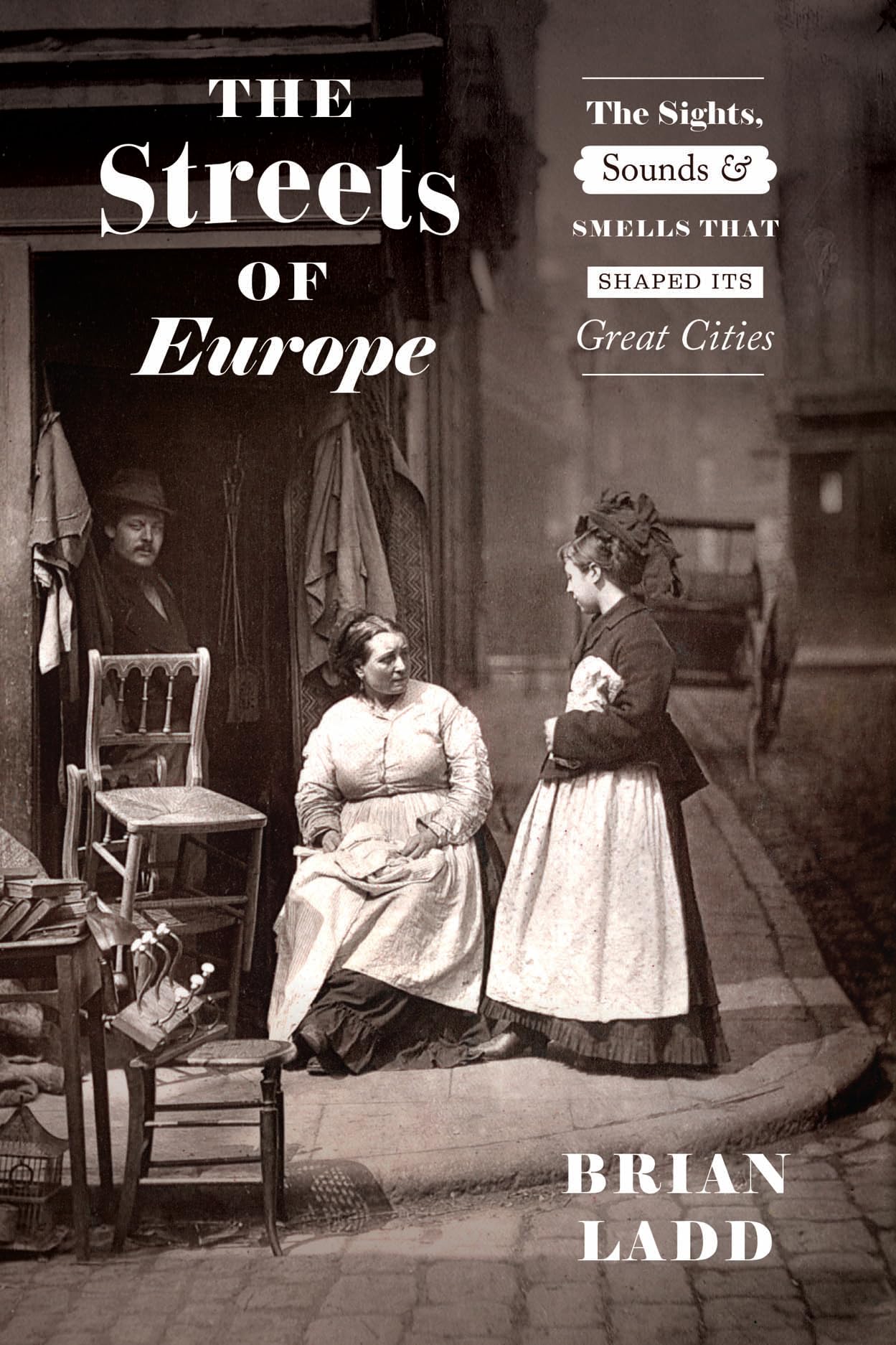
The Streets of Europe: The Sights, Sounds, and Smells That Shaped Its Great Cities
$23.97
by Brian Ladd



A multi-sensory urban history of Europe’s bustling streets. Merchants’ shouts, jostling strangers, aromas of fresh fish and flowers, plodding horses, and friendly chatter long filled the narrow, crowded streets of the European city. As they developed over many centuries, these spaces of commerce, communion, and commuting framed daily life. At its heyday in the 1800s, the European street was the place where social worlds connected and collided. Brian Ladd recounts a rich social and cultural history of the European city street, tracing its transformation from a lively scene of trade and crowds into a thoroughfare for high-speed transportation. Looking closely at four major cities—London, Paris, Berlin, and Vienna—Ladd uncovers both the joys and the struggles of a past world. The story takes us up to the twentieth century, when the life of the street was transformed as wealthier citizens withdrew from the crowds to seek refuge in suburbs and automobiles. As demographics and technologies changed, so did the structure of cities and the design of streets, significantly shifting our relationships to them. In today’s world of high-speed transportation and impersonal marketplaces, Ladd leads us to consider how we might draw on our history to once again build streets that encourage us to linger. By unearthing the vivid descriptions recorded by amused and outraged contemporaries, Ladd reveals the changing nature of city life, showing why streets matter and how they can contribute to public life. "Ladd uses contemporary observers’ records to describe not just the visual panoramas of these streets, but also their sounds and even smells, with these latter seldom attractive. Dozens of illustrations and a few photographs from the end of the era add immeasurably to the depth of Ladd’s prose. Urban planners and social historians will discover truths and myths of how European cities evolved into megalopolises." ― Booklist "Covering the period up to 1900, this study takes you through the ages to the dawn of the modern technological era, bringing into new focus the streets you walk today." -- Anna Aslanyan ― Spectator, on books of the year for 2020 "No other book has helped me as Brian Ladd’s work. Why is this book so necessary for understanding the character of the European cities? This book deals with the experiences that either gratified or horrified the European people who used the streets of the 19th century and before. The author offers no definitive answers about the value or the optimal form of streets, and certainly not about their future prospects. His purpose is, instead, to recover their historical richness by reaching back a century and more in order to convey some sense of how and why streets have mattered. Brian Ladd seeks to evoke the social frictions and stinking horrors that repelled contemporaries along with the delight they took in the sights and sounds and even the smells, of their streets. . . . This book leaves us with a very vivid perception of European streets in the 19th century." ― Journal of Urban Regeneration and Renewal "Brian Ladd’s latest book directly confronts that nostalgia, which he, as an American in Europe, has often shared. His study of European streets looks past their idealized or theorized forms to offer a portrait of what preautomotive streets were actually like, what happened there, who used them, and for what. As the book’s subtitle suggests, Ladd has hunted down sights, smells, and sounds. The result is a wonderfully vivid and readable portrait of city streets as neither all good nor all bad, as simultaneously vibrant and exciting, dirty and dangerous, familiar and confusing." ― American Historical Review "Rich and fascinating history. [Ladd's] primary sources, focused on London, Paris, Vienna, and Berlin, are largely those of city observers, rather than planners or decision-makers. Together, their voices give the text the feeling of a long and meandering urban walk: the reader is invited to take in the sights, sounds, and smells of the city, with Ladd as a capable guide. This tour covers most of the major changes of the modern city and its built landscape but from the fresh perspective of a pedestrian, making it an excellent choice for an undergraduate course on urban history." ― Central European History "[An] eminently readable account of pre-1900 London, Paris, Berlin, and Vienna." ― H-Net "In his wonderful new book, Ladd . . . . adopts a thematic approach, focusing on the period between 1700 and 1900, and making case studies of Berlin, London, Paris, and Vienna. The book opens with a look at the street as workplace. It’s easy to forget how much urban commerce was once conducted in the open air. Dentists would yank out teeth, laundresses would get into a lather, and Paris’s Pont au Change would be aptly named: long ago, it was where money-changers set up their stalls, ever wary of a strong breeze blowing their notes of exchange into the Seine. Then,