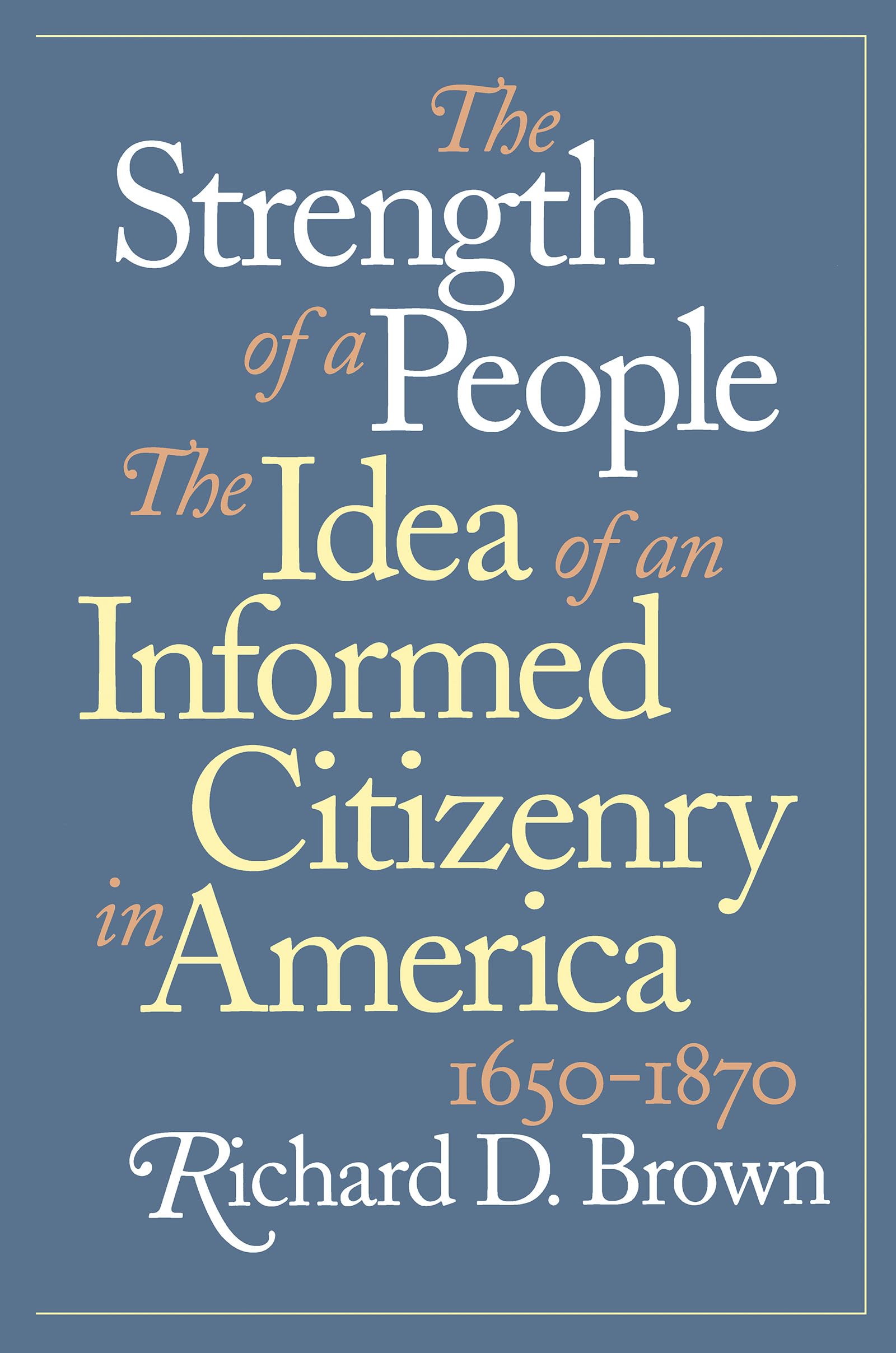
The Strength of a People: The Idea of an Informed Citizenry in America, 1650-1870
$47.50
by Richard D. Brown



Thomas Jefferson’s conviction that the health of the nation’s democracy would depend on the existence of an informed citizenry has been a cornerstone of our political culture since the inception of the American republic. Even today’s debates over education reform and the need to be competitive in a technologically advanced, global economy are rooted in the idea that the education of rising generations is crucial to the nation’s future. In this book, Richard Brown traces the development of the ideal of an informed citizenry in the seventeenth through nineteenth centuries and assesses its continuing influence and changing meaning. Although the concept had some antecedents in Europe, the full articulation of the ideal relationship between citizenship and knowledge came during the era of the American Revolution. The founding fathers believed that the First Amendment’s guarantee of freedom of the press, religion, speech, and assembly would foster an informed citizenry. According to Brown, many of the fundamental institutions of American democracy and society, including political parties, public education, the media, and even the postal system, have enjoyed wide government support precisely because they have been identified as vital for the creation and maintenance of an informed populace. “This excellent book is illuminating and provocative; it is timely as well. . . . Readers who turn to this book . . . may be assured of acquiring a solid grounding in the origins and complexities of the idea of an informed citizenry.”— American Historical Review “A rich exploration of the connections among ideas of education, citizenship, and political participation in American thought. . . . Will be of great usefulness not only to historians interested in the tensions over democratization in the early American republic but also to those interested in the roots of problems of democracy we still face.”— Journal of the Early Republic “An important and timely book.”— Journal of American History “In this rich, wonderfully informative study, Richard Brown traces the emergence and transformation of the idea of an informed citizenry in America.”— History of Education Quarterly “An important book in the ever-growing fields of book history, printing, and literacy; highly recommended for all academic and larger public libraries.”—Library Journal “A superb intellectual history of a subject that, unlike the principle of freedom of the press, has never been explored in a thoroughgoing and systematic way.”— College and Research Libraries “Brown’s analysis serves both as an insightful monograph and an important historiographical threshold in American political history.”— History: Reviews of New Books “I have read [the book] with both pleasure and admiration. It is a fine piece of work, very provocative.”―David McCullough “This is an important work of broad interest to political and intellectual historians as well as to anyone concerned about the perceived current 'crisis' of an informed citizenry.”―James H. Kettner, University of California, Berkeley “This is an important work of broad interest to political and intellectual historians as well as to anyone concerned about the perceived current 'crisis' of an informed citizenry.”—James H. Kettner, University of California, Berkeley A historical view of the role of information in a democratic society Thomas Jefferson's conviction that the health of the nation's democracy would depend on the existence of an informed citizenry has been a cornerstone of our political culture since the inception of the American republic. Even today's debates over education reform and the need to be competitive in a technologically advanced, global economy are rooted in the idea that the education of rising generations is crucial to the nation's future. In this book, Richard Brown traces the development of the ideal of an informed citizenry in the seventeenth through nineteenth centuries and assesses its continuing influence and changing meaning. Richard D. Brown is professor of history at the University of Connecticut. His books include Knowledge Is Power: The Diffusion of Information in Early America, 1700–1865 . Used Book in Good Condition