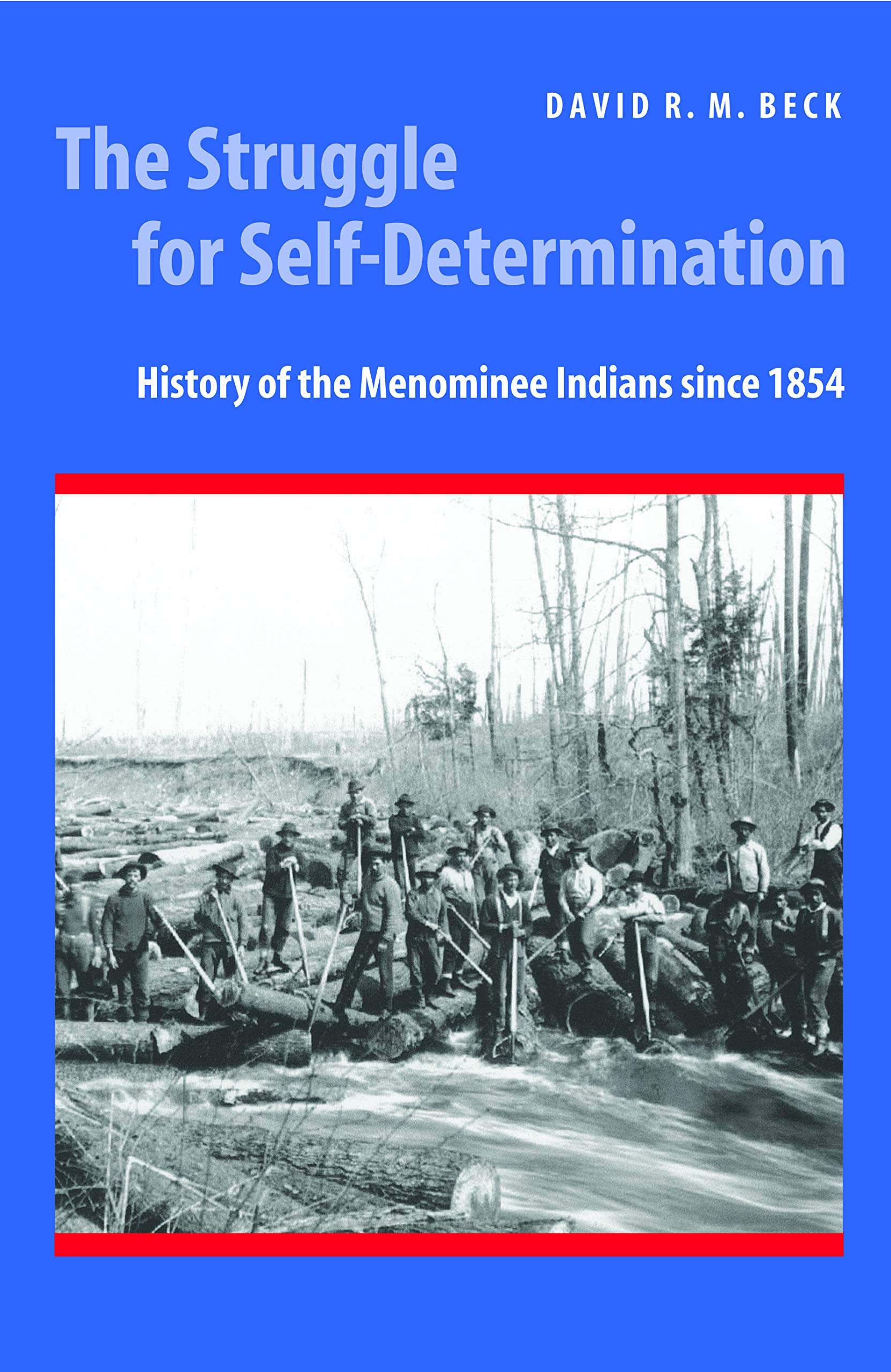
The Struggle for Self-Determination: History of the Menominee Indians since 1854
$20.54
by David R. M. Beck



Drawing on meticulous archival research and a close working relationship with the Menominee Historic Preservation Department, David R. M. Beck picks up where his earlier work, Siege and Survival: History of the Menominee Indians, 1634–1856 , ended. The Struggle for Self-Determination begins with the establishment of a small reservation in the Menominee homeland in northeastern Wisconsin at a time when the Menominee economic, political, and social structure came under aggressive assault. For the next hundred years the tribe attempted to regain control of its destiny, enduring successive policy attacks by governmental, religious, and local business sources. The Menominee’s rich forests became a battleground on which they refused to cede control to the U.S. government. The struggle climaxed in the mid-twentieth century when the federal government terminated its relationship with the tribe. Throughout this time the Menominee fought to maintain their connection to their past and to regain control of their future. The lessons they learned helped them through their greatest modern disaster—termination—and enabled them to reconstruct a government and a reservation as the twentieth century drew to a close. The Struggle for Self-Determination reinterprets that story and includes the viewpoint of the Menominee in the telling of it. Beck, David R.M. The struggle for self-determination: history of the Menominee Indians since 1854. Nebraska, 2006 (c2005). 290p bibl index afp ISBN 0803213476, $49.95 Beck (Univ. of Montana) continues where his previous volume Siege and Survival (CH, Jun'03, 40-5982) left off--the inception of the reservation experience for the Menominee people of Wisconsin. Buffeted by the earlier forces of the fur trade, intertribal rivalries, and unjust government policies, the Menominees adjusted to the changing realities. Their response did not include martial resistance, nor did they passively yield to white demands. They realistically merged old traditions with new frameworks and strategies, often creating novel institutions in the process. Rather than accept the agricultural life that whites tried to dictate to them, the Menominees continued to rely on their beloved forests and achieved a viable timber economy during the early 20th century. The tribe was harmed by government mismanagement of their resources, especially the Termination legislation of the 1950s and early 1960s that ended their treaty status, initiated taxes on their resources, and led them to economic devastation. Beck skillfully synthesizes the downward spiral of the Menominee economy, but he also admirably documents their successful legal fight to restore their tribal status and maintain their cultural values. Utilizing a vast array of sources, including numerous interviews with Menominees and their tribal records, he has produced the best single book on the subject. Summing Up: Highly recommended. For all adult levels/libraries. Published On: 2006-11-17 THE STRUGGLE FOR SELF-DETERMINATION: HISTORY OF THE MENOMINEE INDIANS SINCE 1854 , by David R.M. Beck (University of Nebraska Press; 290 pages; $49.95). Traces the group's history since the establishment of a small reservation in their homeland of northeastern Wisconsin; topics include the mid-20th century crisis of "termination," when the federal government ended its relationship with the tribe. Published On: 2005-11-21 David R. M. Beck. The Struggle for Self-Determination: History of the Menominee Indians Since 1854 . Lincoln: University of Nebraska Press, 2005. xxviii + 296 pp. Illustrations, maps, appendices, notes, bibliography, index. $49.95 (cloth), ISBN 0-8032-1347-6. Defining a Menominee Future In The Struggle for Self-Determination, Beck presents the second part of a two-book history of the Menominee Indians. His first study, Siege and Survival: History of the Menominee Indians, 1634-1856, was published in 2002 and recounts the manner in which the Menominees of Wisconsin negotiated the intrusions of French, British, and American colonizers and managed to retain both a diminished reservation and their cultural autonomy. Siege and Survival places Menominees in the forefront of the historical narrative, and Beck ably reveals that while the pressures of outsiders gradually undermined the power of the nation and its leaders in the first centuries of contact, the Menominees' core cultural values grounded their ability to resist the intrusions. As he now illustrates with great success in the continuation of that history, the Menominee cultural foundation did not crumble as tribal leaders repeatedly faced off against the U.S. government after 1854. The title of the preface, "Shaping a Tribally Defined Existence," aptly introduces both the intentions of the Menominees from 1854 to the present and Beck's presentation of that history. As he did in his first book, Beck delivers a comprehensive narrative that incorporates the voices of tho