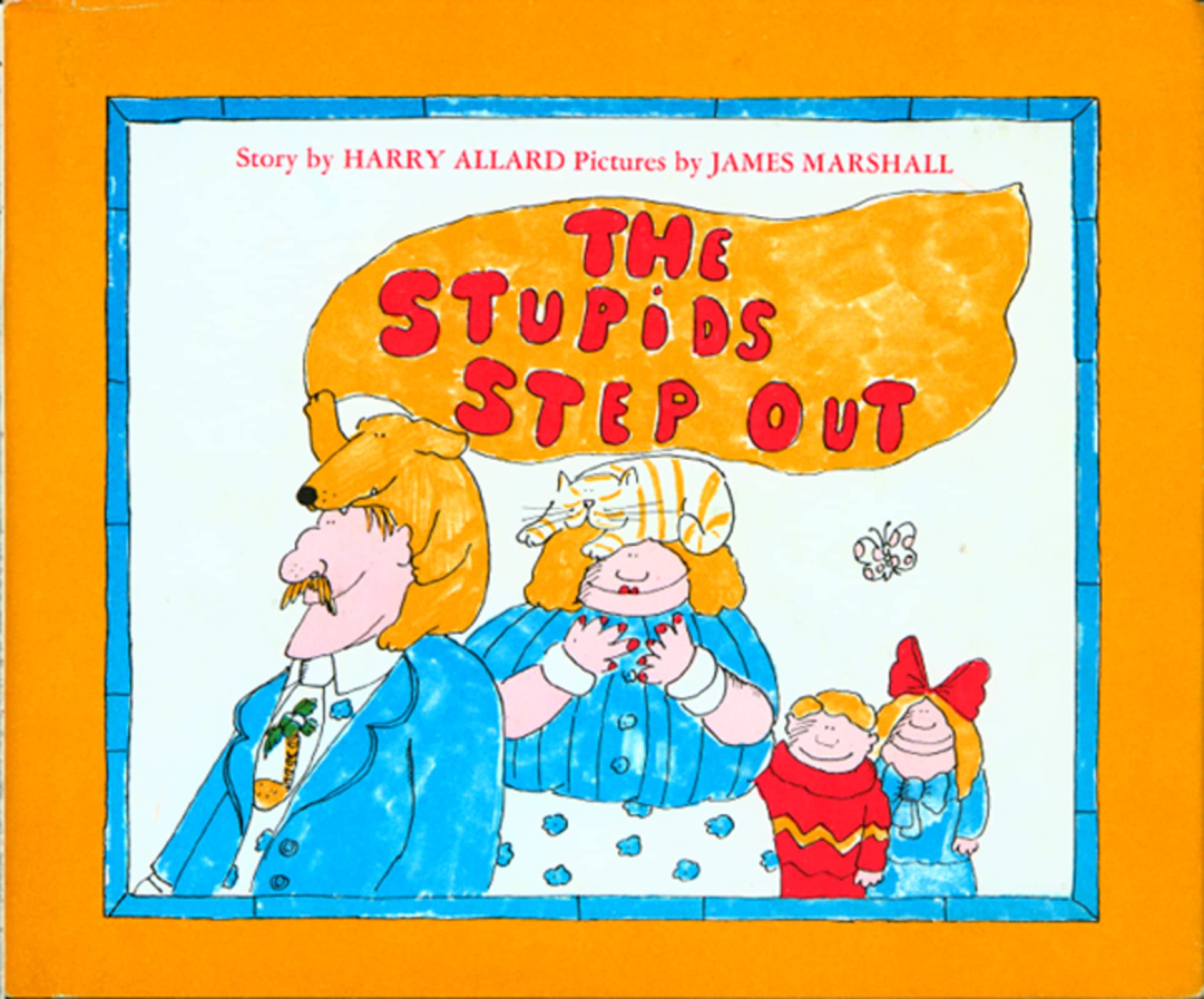
The Stupids Step Out: A Ridiculously Funny Picture Book About a Wacky Family for Children (Ages 4-7)
$7.99
by Harry G. Allard Jr



The Stupids and their dog, Kitty, have a fun-filled day doing ridiculous things. "Even youngest listeners will laugh with smug superiority as they follow these good natured dummkopfs from departure to journey's end." School Library Journal, Starred Harry Allard (1928-2017) was the author of many hilarious books for children, including several Miss Nelson and Stupid Family titles, all illustrated by James Marshall. James Marshall (1942–1992) created dozens of exuberant and captivating books for children, including The Stupids, Miss Nelson Is Missing!, and the ever-popular George and Martha books. Before creating his canon of classic, hilarious children’s books, James Marshall played the viola, studied French, and received a master’s degree from Trinity College. He also doodled. It was the doodles, and the unforgettable characters that emerged from them, that led him to his life’s work as one of the finest creators of children’s books of the twentieth century. In 2007, James Marshall was posthumously awarded the Children's Literature Legacy Award for his lasting contribution to literature for children. great theorist of the free market believed in Providence. "The happiness of mankind," Smith wrote, "seems to have been the original purpose intended by the Author of nature." The workings of the Lord could be found not in the pages of a holy book, nor in miracles, but in the daily, mundane buying-and- selling of the marketplace. Each purchase might be driven by an individual desire, but behind them all lay "the invisible hand" of the Divine. This invisible hand set prices and wages. It determined supply and demand. It represented the sum of all human wishes. Without relying on any conscious intervention by man, the free market improved agriculture and industry, created surplus wealth, and made sure that the things being produced were the things people wanted to buy. Human beings lacked the wisdom, Smith felt, to improve society deliberately or to achieve Progress through some elaborate plan. But if every man pursued his own self-interest and obeyed only his "passions," the invisible hand would guarantee that everybody else benefited, too. Published in 1776, The Wealth of Nations later had a profound effect upon the nation born that year. The idea that "life, liberty, and the pursuit of happiness" were unalienable rights, endowed by a Creator, fit perfectly with the economic theories of Adam Smith. "Life, liberty and estate" was the well-known phrase that Thomas Jefferson amended slightly for the Declaration of Independence. The United States was the first country to discard feudal and aristocratic traditions and replace them with a republican devotion to marketplace ideals. More than two centuries later, America"s leading companies—General Motors, General Electric, ExxonMobil, Microsoft, Wal-Mart, Boeing, et al.—have annual revenues larger than those of many sovereign states. No currency is more powerful than the U.S. dollar, and the closing prices on Wall Street guide the financial markets of Tokyo, London, Paris, and Frankfurt. The unsurpassed wealth of the United States has enabled it to build a military without rival. And yet there is more to the U.S. economy, much more, than meets the eye. In addition to America"s famous corporations and brands, the invisible hand has also produced a largely invisible economy, secretive and well hidden, with its own labor demand, price structure, and set of commodities. "Black," "shadow," "irregular," "informal," "illegal," "subterranean," "u