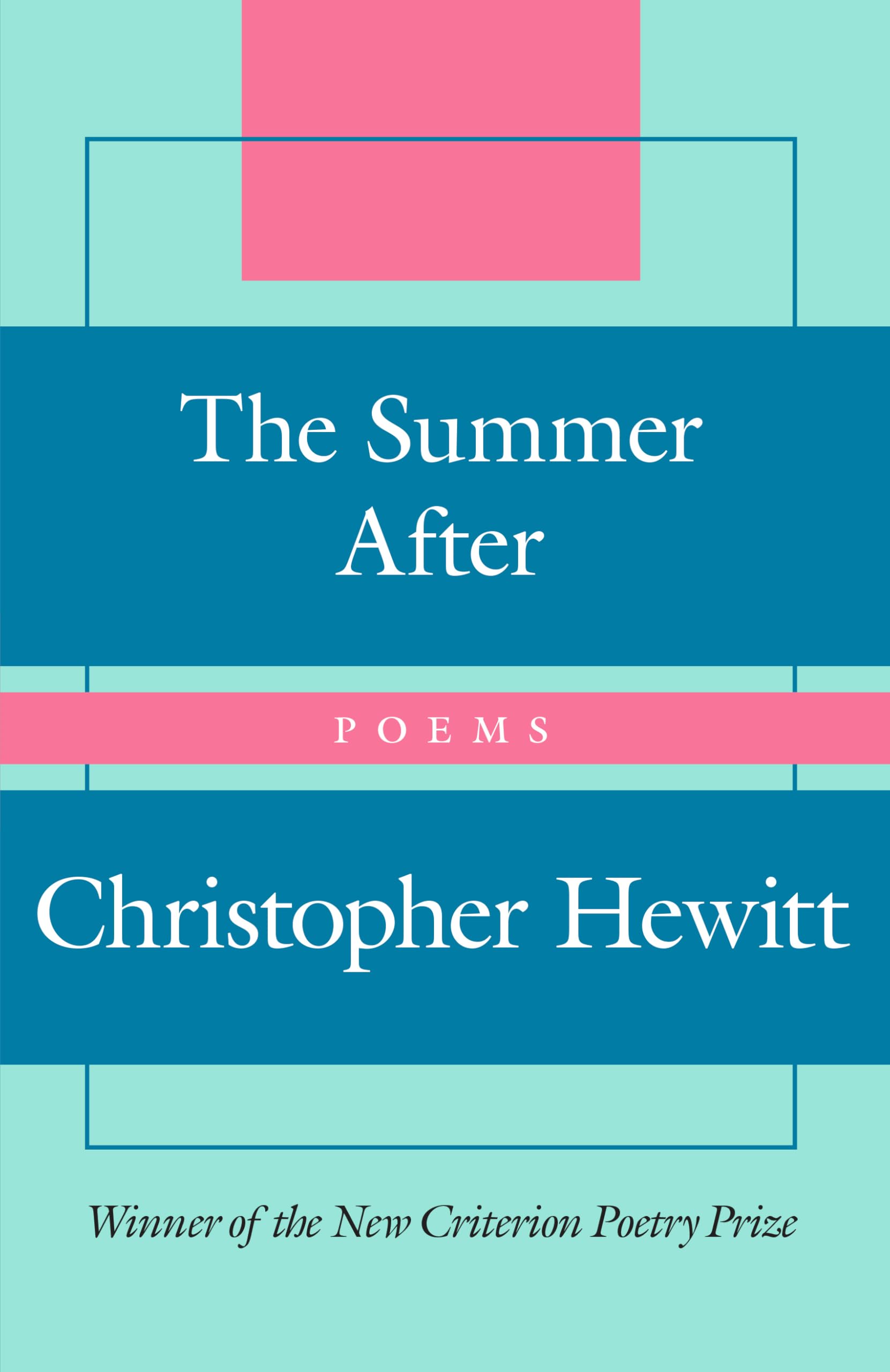



The Summer After is the winner of the twenty-fourth New Criterion Poetry Prize. Beauty, glamour, vitality, love—and their fragility or resilience in a chaotic world—animate the poems in The Summer After . Drawn from travels real and imaginary, immersed in landscapes set loose by perpetual motion, these playful yet poignant encounters with aesthetic opulence journey through the exquisite kinesis of becoming, choreographing delicate fluctuations in the permeability between self and other, past and present, growth and decay, nature and art. Tempering ebullience with technique, passion with wit, their shapely stanzas and sinuous cadences uphold as their destination—their utopia, so to speak—a language limber enough to embody, and durable enough to preserve, moments in which sensory intensity gives way to illumination. Light glancing off Murano glass, reflections in a puddle, a tower carved from quartz, and other glittering images constitute the discoveries in this exuberant debut. "The mind is ravenous," Christopher Hewitt writes, and The Summer After is a feast. His poems, fed by wonder and an intensely observant eye, take a deep dive into being, embracing the largest human passions and testifying to the beautiful fragility of the natural world. They are written in "the idiom of flux," a language dazzling as sea glass and supple as water. Hewitt's painterly sense of place, especially California, recalls David Hockney's boldly reflective colors, and the poems' sensual depth extends Thom Gunn's heartfelt erotics—for Hewitt also is a poet of love, "or its velvet shadow, lust." There are Keatsian arpeggios of phrasing, a Shakespearean elan and eloquence, The sensibility is "flame worked" because of "Stare immolate themselves to shine." The Summer After , a stunning book, pays tribute to the stuff of this world and the creative spirit that makes something marvelous of it. —Alice Fulton In his bold and original debut collection, The Summer Afte r, Christopher Hewitt's exquisite era works in Camden with his perspicacious eye. Everything Hewitt touches becomes an occasion for rare linguistic attention. Reading lines like "Let the wind, sheer fluency in search/ of anything to break its passage, urge/ on the ear its fast-and-loose philosophy," I'm eager to discover what Hewitt's own "sheer fluency" will urge on our ears in the years to come. —Jacqueline Osherow CHRISTOPHER HEWITT was raised in Dallas, Texas. He holds graduate degrees from Stanford and Cornell and is pursuing a Ph.D. at the University of Houston. his poems have appeared in Able Muse , The Adriot Journal , Ecotone , The Southampton Review , 32 Poems , and elsewhere. The Summer After is his first book.