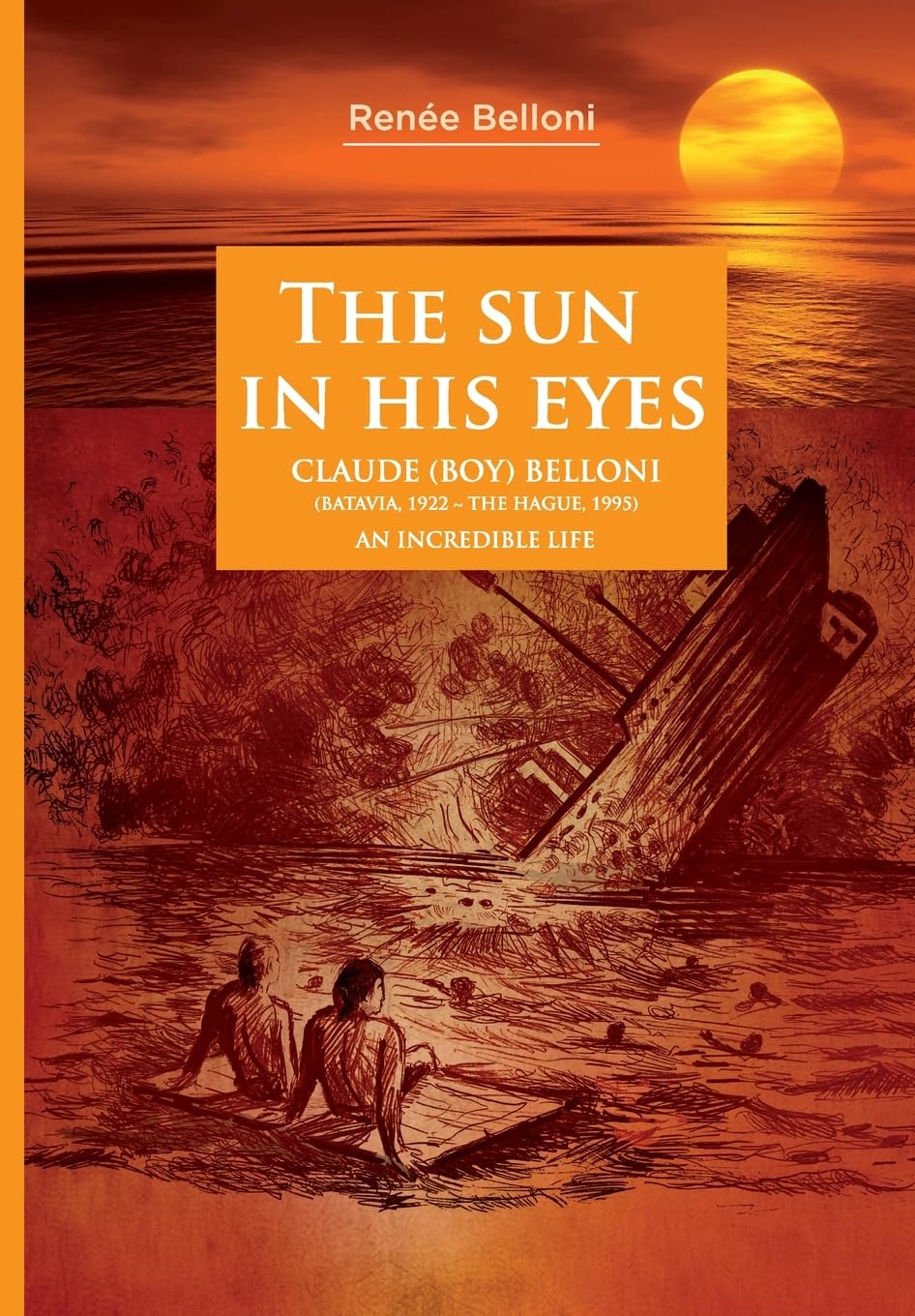
The Sun In His Eyes: An Incredible life. His life journey through The Dutch Indies, Japan, New Guinea and the Netherlands
$26.95
by Renée Belloni



This book tells partly the story of WWII in the Pacific and thrilling jungle expeditions, unveiling Claude (Boy) Belloni's real-life experiences. His diary, articles and journals take us upon his adventures, letting us uncover the unknown together. His 100 stunning photos and journalism background bring us along for the ride. Through his experiences, we gain a better understanding of what those who didn't survive went through. Thanks to his positive attitude - that sunshine in his eyes - he also had a wealth of fun and interesting experiences. Some of Claude's WWII insights: On 10 January 1942, Japan officially declared war on the Dutch East Indies. Immediately he became a prisoner of war. More than once, he had faced death before seeing the sunrise again. In May 1944, he was transported as a Prisoner Of War to Nagasaki, Japan. Several times bombers attacked the convoy. And on 24 June an American submarine torpedoed his ship with hundreds of prisoners on board, causing it to sink in minutes. Most of the prisoners drowned on the sinking ship. A passing Japanese whaling ship picked up the survivors and took them to Nagasaki. They ended up in Camp Fukuoka 14 where they had to work in the Mitsubishi factories. On 9 August 1945, he witnessed the consequences of the nuclear bomb that was launched above Nagasaki, barely 2000 meters from his Prisoners Of War camp. The forced labour, he had endured there, servitude and humiliation paled into insignificance. The entire factory district where the camp was located was completely destroyed. Dropping the atomic bomb contributed to the capitulation of the Japanese Empire on 15 August 1945. Then two days later, on the 17th of August, political leader Sukarno declared an independent republic of Indonesia. The Netherlands disagreed and hell broke loose, stretching until December 1949. For many, including my parents, who were both Prisoners Of War during this Independence War, it was more devastating, than the Japanese occupation. Marked by extreme cruelty and hardship. Yet, despite the adversity Claude faced, the light of hope never faded from his eyes. His resilience and determination saw him through tough times. Each time he stumbled, he found a way to rise again and continue for- ward. This optimistic outlook kept the sun shining in his eyes, alongside the joyous moments life brought his way — love, engaging work, and adventures into the unknown. Renée's main goal in telling this story has been to show how big, sweeping events — like wars — can completely change a person’s life. Her father’s life was shaped by the harsh realities of war, a truth he lived through. Hopefully this story reaches people who might not have any direct ties to the Dutch East Indies, New Guinea, or the Pacific wars of 1942-1949. Renée likes to bridge the gap between different times and places, to bring people into Claude’s world, hoping they will find something in his story that resonates with them, something that makes them feel connected to a larger human story. His narrative will open both doors and hearts. If you enjoy reading biographies, history, adventures, or true stories of WWII, this book is a must-read. Book review: The Sun in His Eyes What was colonial life in Indonesia for these mixed-race families caught between two worlds? Up to now, the reality is that very little has been recorded of what their lives had been like, despite the fact that mixed-race families had lived throughout colonial Indonesia for hundreds of years. It is the mission of Belloni to encourage the descendants of families such as hers to chronicle these lives before they are lost. The Sun in His Eyes is the result of her creative effort to do this. Belloni now lives in Australia having married an Australian, and so her life and the life of her family, form part of the rich multicultural background of our population. Renée Belloni's book focuses on Claude Belloni, her father, whose life was nothing less than fascinating. Conscripted as a teenager into the Royal Netherlands East Indies Army (KNIL) just prior to the Japanese invasion, he spent the first part of World War II in Japanese prisoner of war camps, before being transported by ship to Japan as slave labour. However, the ship in which he was being transported was sunk by the Allies. He was one of the few to survive this horrific event, which is portrayed on the cover of the book. He ended up as one of hundreds of forced labourers for Mitsubishi in Nagasaki, and then experienced the devastation caused by the atomic bomb dropped on that city in 1945. His life continued to face challenges. On his return to Indonesia, he found he had not been discharged from the Royal East Indies Army (KNIL) but, rather, was required as a member of the colonial forces, to fight for the Dutch against the Indonesians. Eventually, he and his family ended up in West Papua, where among other adventures, he helped New York Governor Nelson Rockefeller search for his son Michael wh