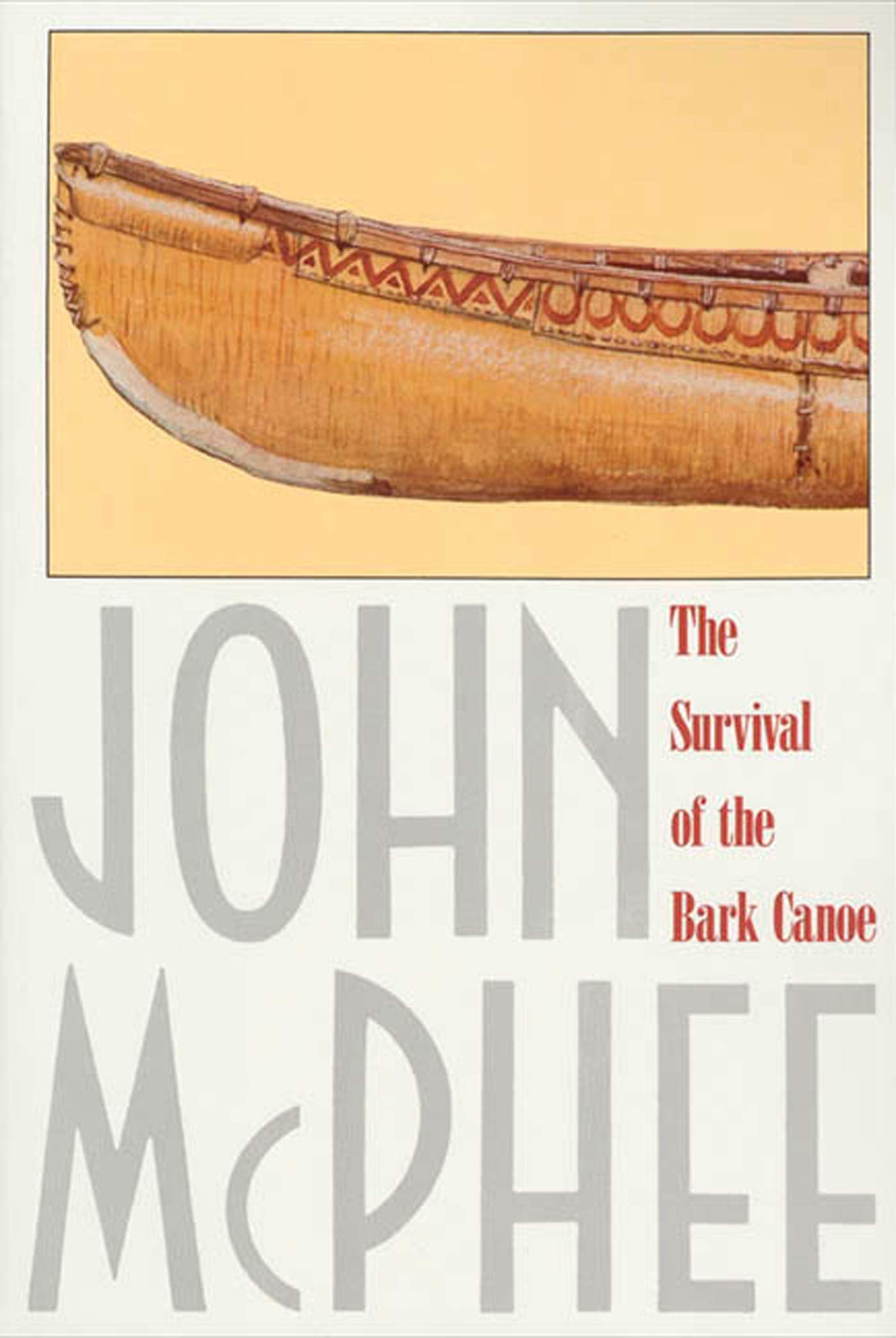



In Greenville, New Hampshire, a small town in the southern part of the state, Henri Vaillancourt makes birch-bark canoes in the same manner and with the same tools that the Indians used. The Survival of the Bark Canoe is the story of this ancient craft and of a 150-mile trip through the Maine woods in those graceful survivors of a prehistoric technology. It is a book squarely in the tradition of one written by the first tourist in these woods, Henry David Thoreau, whose The Maine Woods recounts similar journeys in similar vessel. As McPhee describes the expedition he made with Vaillancourt, he also traces the evolution of the bark canoe, from its beginnings through the development of the huge canoes used by the fur traders of the Canadian North Woods, where the bark canoe played the key role in opening up the wilderness. He discusses as well the differing types of bark canoes, whose construction varied from tribe to tribe, according to custom and available materials. In a style as pure and as effortless as the waters of Maine and the glide of a canoe, John McPhee has written one of his most fascinating books, one in which his talents as a journalist are on brilliant display. In an age of mass-produced and disposable objects, traditional crafts are becoming extinct, and appreciation for craftsmanship has become a hobby for the wealthy dilettante. But here and there, a few stalwart individuals carry on the old traditions. Henri Vaillancourt of Greenville, New Hampshire is in large part responsible for the continuing survival of the birch bark canoe. McPhee tells the story not only of Vaillancourt and his work, but of the canoe's role in American history. Many McPhee fans consider this lovely and lucid book one of his finest works. “In his own beautifully crafted work, McPhee treats both man and boat with all the respect and admiration their precarious presence commands.” ― Time “Every white water and wilderness buff should rise to it like a trout, but as all followers of Mr. McPhee's work would expect, its appeal and value cannot be so narrowly limited; it's a lively chronicle, rich in character study and observations.” ― The Wall Street Journal John McPhee was born in Princeton, New Jersey, and was educated at Princeton University and Cambridge University. His writing career began at Time magazine and led to his long association with The New Yorker , where he has been a staff writer since 1965. Also in 1965, he published his first book, A Sense of Where You Are , with Farrar, Straus and Giroux, and in the years since, he has written over 30 books, including Oranges (1967), Coming into the Country (1977), The Control of Nature (1989), The Founding Fish (2002), Uncommon Carriers (2007), and Silk Parachute (2011). Encounters with the Archdruid (1972) and The Curve of Binding Energy (1974) were nominated for National Book Awards in the category of science. McPhee received the Award in Literature from the Academy of Arts and Letters in 1977. In 1999, he was awarded the Pulitzer Prize for Annals of the Former World. He lives in Princeton, New Jersey. The Survival of the Bark Canoe By John McPhee Farrar, Straus and Giroux Copyright © 1982 John McPhee All right reserved. ISBN: 9780374516932 Survival of the Bark Canoe, The THE SURVIVAL OF THE BARK CANOE When Henri Vaillancourt goes off to the Maine woods, he does not make extensive plans. Plans annoy him. He just gets out his pack baskets, tosses in some food and gear, takes a canoe, and goes. He makes (in advance) his own beef jerky--slow-baking for many hours the leanest beef he can find. He takes some oatmeal, some honey, some peanut butter. Not being sure how long he will be gone, he makes only a guess at how much food he may need, although he is going into the Penobscot-Allagash wilderness, north of Moosehead Lake. He takes no utensils. He prefers to carve them. He makes his own tumplines, his own carry boards. He makes his own paddles. They have slender blades, no more than five inches across. He roughs them out with his axe and carves them with his crooked knife, a tool well known in the north woods, almost unknown everywhere else. And--his primary function--he makes his own canoes. He carves their thwarts from hardwood and their ribs from cedar. He sews them and lashes them with the split roots of white pine. There are no nails, screws, or rivets keeping his canoes together--just the rootlashings, in groups spaced handsomely along the gunwales, holding the framework to the bark.Vaillancourt built his first canoe in 1965, when he was fifteen. He had tried to make other canoes in earlier years, always working by trial and error, until error prevailed. He had never paddled a canoe, had not so much as had a ride in one. In a passionate way, he had become interested in Indian life, and the aspect of it that most attracted him was the means by which the Indians had moved so easily on lakes and streams through other